

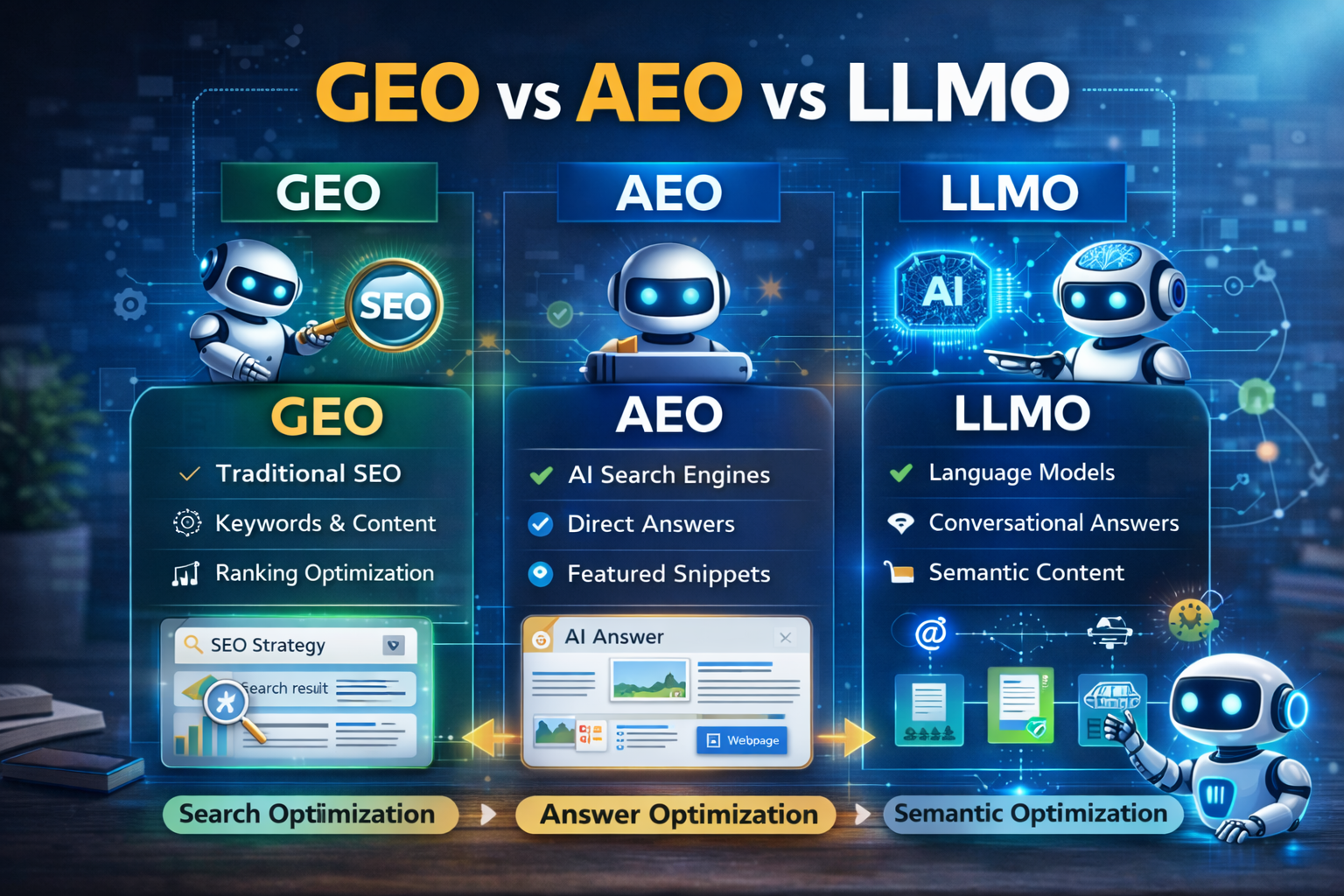
The Evolving SEO Landscape: A 2026 Perspective
The world of Search Engine Optimization (SEO) is a dynamic and ever-changing landscape. What worked yesterday may be obsolete tomorrow. Looking ahead to 2026, it's clear that the traditional methods of keyword research, link building, and on-page optimization will need to evolve significantly to remain effective. The rise of artificial intelligence (AI), machine learning (ML), and large language models (LLMs) is driving a paradigm shift, giving rise to new SEO models that prioritize automation, personalization, and generative content.
In this article, we'll explore three dominant SEO models that are expected to shape the future of search: Generative Engine Optimization (GEO), Autonomous Engine Optimization (AEO), and Large Language Model Optimization (LLMO). We'll delve into the underlying principles of each model, examine their strengths and weaknesses, and discuss their practical applications. By understanding these models, SEO professionals can prepare themselves and their organizations for the challenges and opportunities that lie ahead.
Generative Engine Optimization (GEO): The Rise of AI-Powered Content
Generative Engine Optimization (GEO) represents a fundamental shift in how content is created and optimized for search engines. At its core, GEO leverages the power of AI to generate high-quality, relevant, and engaging content at scale. This goes beyond simply spinning existing articles or paraphrasing text. GEO utilizes advanced AI models to understand user intent, identify content gaps, and create original content that meets the specific needs of searchers.
One of the key drivers behind GEO is the increasing sophistication of AI-powered content generation tools. These tools are capable of producing a wide range of content formats, including blog posts, articles, product descriptions, social media updates, and even video scripts. By automating the content creation process, GEO enables organizations to publish more content, more frequently, and at a lower cost.
Understanding the Principles of GEO
GEO operates on several core principles:
- AI-Powered Content Generation: The foundation of GEO is the use of AI models to create original content. These models are trained on vast datasets of text and code, allowing them to generate content that is both grammatically correct and semantically relevant.
- User Intent Focus: GEO prioritizes understanding user intent and creating content that directly addresses the needs of searchers. This involves analyzing search queries, identifying related topics, and crafting content that provides comprehensive and informative answers.
- Content Optimization: GEO goes beyond simply generating content. It also involves optimizing that content for search engines. This includes keyword research, on-page optimization, and link building.
- Scalability: One of the key advantages of GEO is its ability to scale content creation efforts. By automating the process, organizations can produce a large volume of content without sacrificing quality.
The Benefits of GEO
GEO offers several potential benefits for organizations looking to improve their search visibility:
- Increased Content Output: GEO enables organizations to create more content in less time, leading to increased website traffic and improved search rankings.
- Improved Content Quality: AI-powered content generation tools can produce high-quality content that is both informative and engaging.
- Reduced Content Costs: By automating the content creation process, GEO can significantly reduce the cost of producing content.
- Enhanced User Experience: GEO focuses on creating content that meets the specific needs of searchers, leading to a better user experience.
The Challenges of GEO
While GEO offers many potential benefits, it also presents some challenges:
- Content Quality Control: It's important to carefully review and edit AI-generated content to ensure that it meets quality standards.
- Originality and Plagiarism: Organizations need to ensure that AI-generated content is original and does not infringe on copyright.
- Algorithm Updates: Search engine algorithms are constantly evolving, so it's important to stay up-to-date on the latest changes and adjust GEO strategies accordingly.
- Ethical Considerations: The use of AI to generate content raises ethical questions about transparency and authenticity.
Case Study: How a News Organization Leveraged GEO to Increase Traffic
A major news organization was struggling to keep up with the demand for timely and accurate news coverage. They implemented a GEO strategy, using AI-powered content generation tools to create articles on breaking news events. The AI tools were able to quickly gather information from multiple sources, verify facts, and generate articles that were both informative and engaging. As a result, the news organization was able to significantly increase its website traffic and improve its search rankings for breaking news topics.
Autonomous Engine Optimization (AEO): The Power of Machine Learning
Autonomous Engine Optimization (AEO) takes SEO automation to the next level by leveraging machine learning (ML) to continuously optimize websites for search engines. Unlike traditional SEO, which relies on manual analysis and optimization, AEO uses ML algorithms to identify patterns, predict trends, and automatically adjust website elements to improve search visibility.
AEO systems are designed to learn from data and adapt to changing search engine algorithms. They can analyze vast amounts of data, including website traffic, user behavior, and search engine rankings, to identify areas for improvement. Based on this analysis, AEO systems can automatically adjust website elements such as title tags, meta descriptions, internal links, and content to improve search rankings.
Understanding the Principles of AEO
AEO is based on several key principles:
- Machine Learning: AEO relies on ML algorithms to analyze data, identify patterns, and predict trends.
- Automation: AEO automates many of the tasks that are traditionally performed manually by SEO professionals.
- Continuous Optimization: AEO continuously monitors website performance and adjusts website elements to improve search rankings.
- Data-Driven Decision Making: AEO makes decisions based on data rather than intuition or guesswork.
The Benefits of AEO
AEO offers several potential benefits for organizations:
- Improved Search Rankings: AEO can significantly improve search rankings by continuously optimizing website elements for search engines.
- Increased Efficiency: AEO automates many of the tasks that are traditionally performed manually, freeing up SEO professionals to focus on more strategic initiatives.
- Data-Driven Insights: AEO provides valuable insights into website performance and user behavior, allowing organizations to make more informed decisions.
- Reduced Costs: AEO can reduce the cost of SEO by automating many of the tasks that are traditionally performed manually.
The Challenges of AEO
AEO also presents some challenges:
- Complexity: AEO systems can be complex and require specialized expertise to implement and manage.
- Data Requirements: AEO requires large amounts of data to train ML algorithms and make accurate predictions.
- Algorithm Updates: Search engine algorithms are constantly evolving, so AEO systems need to be updated regularly to maintain their effectiveness.
- Ethical Considerations: The use of AEO raises ethical questions about transparency and control.
Case Study: How an E-Commerce Company Used AEO to Increase Sales
An e-commerce company was struggling to attract organic traffic to its website. They implemented an AEO system that used ML to analyze website traffic, user behavior, and search engine rankings. The AEO system identified several areas for improvement, including title tags, meta descriptions, and internal links. The system automatically adjusted these elements to improve search rankings. As a result, the e-commerce company saw a significant increase in organic traffic and sales.
Large Language Model Optimization (LLMO): Leveraging the Power of Language
Large Language Model Optimization (LLMO) focuses on leveraging the power of large language models (LLMs) to improve search visibility. LLMs are AI models that have been trained on vast amounts of text data, allowing them to understand and generate human-like text. LLMO utilizes LLMs to create high-quality, relevant, and engaging content that is optimized for search engines.
LLMO goes beyond simply generating content. It also involves using LLMs to understand user intent, identify content gaps, and optimize website elements such as title tags, meta descriptions, and internal links. By leveraging the power of LLMs, LLMO can help organizations create content that is both informative and engaging, leading to improved search rankings and increased website traffic.
Understanding the Principles of LLMO
LLMO is based on several key principles:
- Large Language Models: LLMO utilizes LLMs to understand and generate human-like text.
- Content Optimization: LLMO optimizes content for search engines by using LLMs to identify relevant keywords and create engaging content.
- User Intent Focus: LLMO focuses on understanding user intent and creating content that directly addresses the needs of searchers.
- Data-Driven Decision Making: LLMO makes decisions based on data rather than intuition or guesswork.
The Benefits of LLMO
LLMO offers several potential benefits:
- Improved Content Quality: LLMO can generate high-quality content that is both informative and engaging.
- Increased Content Output: LLMO can automate the content creation process, allowing organizations to produce more content in less time.
- Enhanced User Experience: LLMO focuses on creating content that meets the specific needs of searchers, leading to a better user experience.
- Improved Search Rankings: LLMO can improve search rankings by optimizing content for search engines and creating engaging content that attracts links.
The Challenges of LLMO
LLMO also presents some challenges:
- Cost: LLMs can be expensive to train and use.
- Complexity: LLMO systems can be complex and require specialized expertise to implement and manage.
- Bias: LLMs can be biased based on the data they were trained on, which can lead to biased content.
- Ethical Considerations: The use of LLMs raises ethical questions about transparency and authenticity.
Case Study: How a Travel Company Used LLMO to Create Engaging Content
A travel company was looking for ways to create more engaging content for its website. They implemented an LLMO strategy, using LLMs to generate articles on popular travel destinations. The LLMs were able to generate articles that were both informative and engaging, providing readers with valuable information about the destinations. As a result, the travel company saw a significant increase in website traffic and bookings.
Comparative Analysis: GEO vs. AEO vs. LLMO
To better understand the differences and similarities between GEO, AEO, and LLMO, let's examine a comparative analysis of these three SEO models in a tabular format.
| Feature | Generative Engine Optimization (GEO) | Autonomous Engine Optimization (AEO) | Large Language Model Optimization (LLMO) |
|---|---|---|---|
| Core Technology | AI-powered content generation | Machine learning and automation | Large language models |
| Primary Focus | Creating high-quality, scalable content | Continuous website optimization | Leveraging language models for content and optimization |
| Key Benefits | Increased content output, reduced content costs, improved content quality | Improved search rankings, increased efficiency, data-driven insights | High-quality content, enhanced user experience, improved search rankings |
| Main Challenges | Content quality control, originality and plagiarism, ethical considerations | Complexity, data requirements, algorithm updates, ethical considerations | Cost, complexity, bias, ethical considerations |
| Ideal Applications | News organizations, e-commerce companies, content marketing agencies | Large websites with complex SEO needs, e-commerce companies, lead generation businesses | Travel companies, educational institutions, content-heavy websites |
| Skill Requirements | AI content generation expertise, SEO knowledge, content editing skills | Machine learning expertise, SEO knowledge, data analysis skills | LLM expertise, SEO knowledge, content creation skills |
| Scalability | Highly scalable | Scalable, but requires careful monitoring | Scalable, but can be resource-intensive |
| Cost | Variable, depending on the AI tools used | Potentially high upfront costs, but can reduce long-term costs | High, due to the cost of LLMs |
This table provides a concise overview of the key differences and similarities between GEO, AEO, and LLMO. Each model has its own strengths and weaknesses, and the best choice for an organization will depend on its specific needs and resources.