

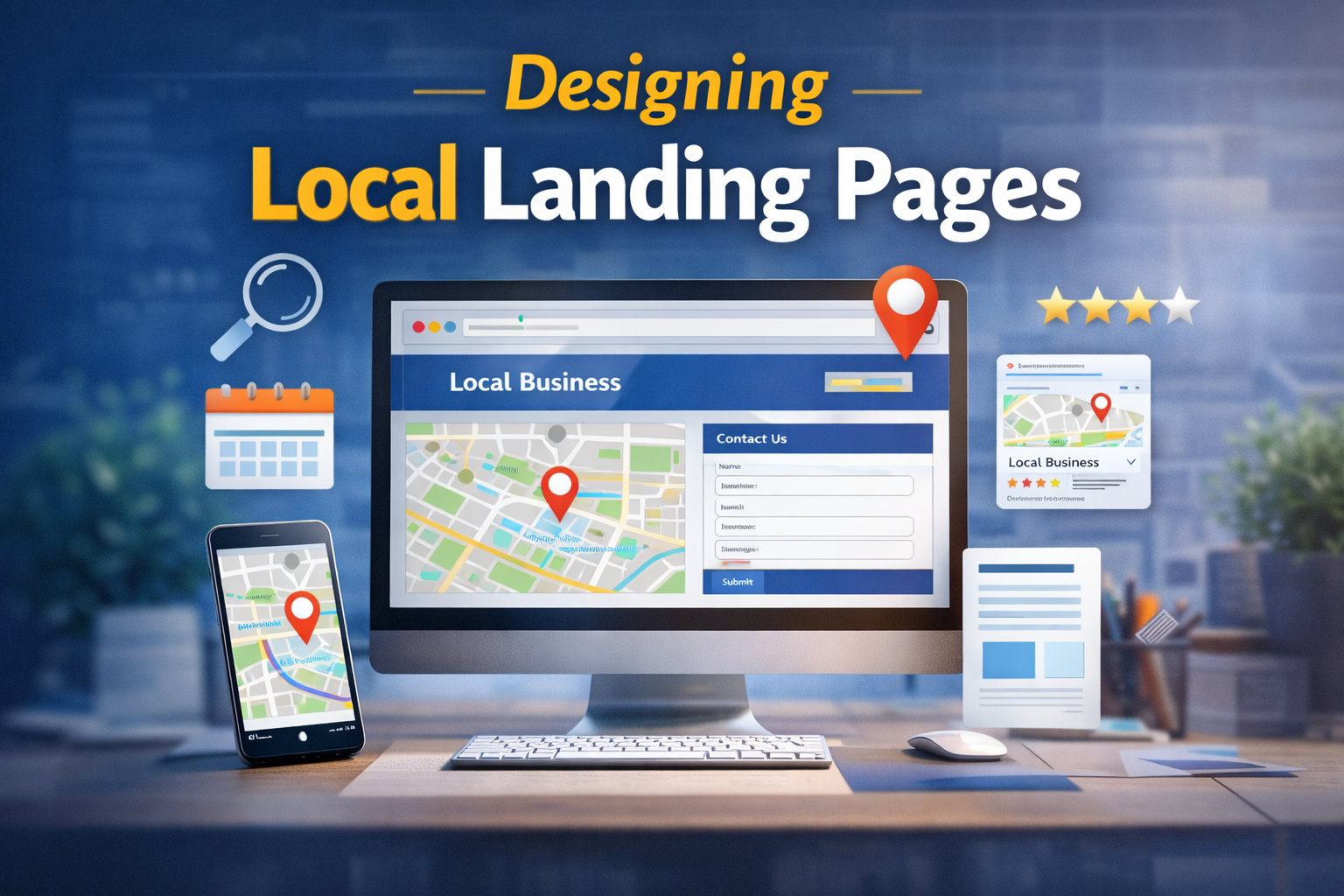
The Power of Local Landing Pages in the AI-Driven Search Era
In 2026, the digital marketing landscape is dominated by Artificial Intelligence (AI). AI-driven search algorithms, like Google's BERT and beyond, are now capable of understanding user intent with unprecedented accuracy. This means that generic marketing approaches are becoming increasingly ineffective. To thrive in this environment, businesses need to embrace hyper-personalization and localization. Local landing pages are a critical tool for achieving this, allowing you to create tailored experiences that resonate with specific geographic audiences. Think of it this way: a user searching for "best pizza near me" in London will have vastly different expectations than someone searching for the same query in New York City.
A generic pizza restaurant website simply won't cut it. A well-optimized local landing page, on the other hand, can showcase location-specific deals, highlight local ingredients, and even feature testimonials from local customers. This level of personalization not only improves user experience but also signals to search engines that your business is highly relevant to the user's query. Moreover, the rise of semantic SEO further emphasizes the importance of local landing pages. Semantic SEO focuses on understanding the meaning and context behind search queries, rather than just matching keywords. By creating content that addresses the specific needs and interests of your local audience, you can improve your website's semantic relevance and boost your rankings in local search results. This involves not just mentioning local keywords but also incorporating related entities, topics, and concepts that are relevant to the local community. Finally, entity-based ranking is becoming increasingly important. Search engines are now using entities (people, places, things, and concepts) to understand the relationships between different pieces of content. By clearly establishing your business as an entity within a specific geographic area, you can improve your visibility in local search results. Local landing pages are an excellent way to achieve this, as they allow you to showcase your business's connection to the local community and establish your authority within your niche.
Step 1: In-Depth Local Keyword Research
Effective local keyword research is the foundation of any successful local landing page strategy. It involves identifying the terms and phrases that your target audience is using to search for your products or services in a specific geographic area. This goes beyond simply translating generic keywords into local terms; it requires a deep understanding of local language, culture, and trends. Start by brainstorming a list of potential keywords based on your products or services. Then, use keyword research tools like Ahrefs, SEMrush, or Moz Keyword Explorer to identify variations, related terms, and long-tail keywords. Pay close attention to the search volume and competition for each keyword. While high-volume keywords may seem appealing, they are often more difficult to rank for. Consider targeting long-tail keywords, which are more specific and have lower competition. Next, use Google Keyword Planner to identify local keyword variations. This tool allows you to target specific geographic areas and see the search volume for different keywords in those areas. For example, if you're a plumber in Austin, Texas, you can use Google Keyword Planner to see how many people are searching for terms like "plumber Austin," "emergency plumber Austin," and "water heater repair Austin." This information will help you prioritize your keyword targeting efforts. Don't forget to analyze your competitors' websites and landing pages to see what keywords they are targeting. This can provide valuable insights into the keywords that are working well in your industry. You can use tools like SpyFu or SimilarWeb to analyze your competitors' keyword strategies. Finally, leverage AI-powered keyword research tools to uncover hidden opportunities. These tools can analyze vast amounts of data to identify emerging trends, uncover semantic relationships between keywords, and even predict future keyword demand. For instance, an AI tool might identify that searches for "eco-friendly cleaning services" are on the rise in a particular neighborhood, allowing you to create a landing page that caters to this growing demand.
Real-World Example: Local Keyword Research for a Coffee Shop in Seattle
Let's say you own a coffee shop in the Ballard neighborhood of Seattle. Your initial keyword research might focus on terms like "coffee shop Seattle," "best coffee Seattle," and "Seattle coffee." However, to truly optimize your local landing page, you need to dig deeper. Using local keyword research tools, you might discover the following: Neighborhood-specific keywords: "Coffee shop Ballard," "Ballard coffee," "best coffee in Ballard" Product-specific keywords: "Latte Ballard," "Espresso Ballard," "Cold brew Ballard" Amenity-specific keywords: "Coffee shop with wifi Ballard," "Dog-friendly coffee shop Ballard," "Coffee shop open late Ballard" Trending keywords: "Iced coffee Ballard" (particularly during summer months) By incorporating these keywords into your local landing page, you can significantly improve your visibility in local search results and attract more customers from the Ballard neighborhood.
Step 2: Crafting Compelling and Locally Relevant Content
Once you've identified your target keywords, the next step is to create compelling and locally relevant content that resonates with your audience. This means going beyond simply mentioning your keywords; you need to create content that addresses the specific needs, interests, and pain points of your local customers. Start by creating a clear and concise headline that includes your primary keyword and highlights the value proposition of your business. For example, "[Your Business Name]: The Best [Your Service] in [Your City]" is a simple but effective headline that can attract attention and improve search engine rankings. Next, write a compelling introduction that grabs the reader's attention and explains why your business is the best choice for their needs. Focus on the benefits of your products or services, rather than just the features. For example, instead of saying "We offer a wide range of [Your Product]," say "Enjoy the convenience and reliability of our [Your Product], designed to make your life easier." Use bullet points, lists, and headings to break up your content and make it easier to read. People tend to scan web pages rather than read them word-for-word, so it's important to present your information in a clear and concise manner. Incorporate local testimonials and case studies to build trust and credibility. Hearing from other local customers can be a powerful way to convince potential customers that your business is the right choice. Make sure to include the customer's name, city, and even a photo if possible. Include high-quality images and videos that showcase your business, products, and services. Visual content can be a great way to engage your audience and communicate your message more effectively. Use images that are relevant to your local area, such as photos of local landmarks or events. Don't forget to include a clear call to action (CTA) on your landing page. Tell visitors exactly what you want them to do, whether it's to call you, fill out a form, or visit your store. Make your CTA prominent and easy to find.
Regional Variations in Content Adaptation
It's important to tailor your content to the specific cultural nuances of each region. What works in one region may not work in another. For example: United States: Emphasize value, convenience, and customer service. Use strong calls to action and focus on the benefits of your products or services. Europe: Focus on quality, craftsmanship, and sustainability. Highlight the history and tradition of your business. Asia: Emphasize relationships, trust, and community. Use testimonials and case studies to build credibility. Latin America: Focus on family, community, and personal connections. Use emotional appeals and storytelling to connect with your audience. By adapting your content to the specific cultural nuances of each region, you can increase your chances of resonating with your target audience and driving conversions.
Step 3: Optimizing for Semantic SEO and AI-Driven Search
In the age of AI-driven search, semantic SEO is more important than ever. Semantic SEO focuses on understanding the meaning and context behind search queries, rather than just matching keywords. To optimize your local landing page for semantic SEO, you need to create content that is not only relevant to your target keywords but also addresses the underlying intent of the search query. Start by identifying the key entities related to your business and your target keywords. Entities are people, places, things, and concepts that are relevant to your topic. For example, if you're a pizza restaurant in New York City, your key entities might include "pizza," "New York City," "Italian food," "restaurants," and "delivery." Use schema markup to provide search engines with more information about your business and your content. Schema markup is a type of code that you can add to your website to tell search engines what your content is about. For example, you can use schema markup to tell search engines that your business is a pizza restaurant, that it's located in New York City, and that it offers delivery services. Create content that answers common questions related to your business and your target keywords. This can help you rank for featured snippets and improve your visibility in zero-click searches. Use tools like AnswerThePublic to identify common questions related to your industry. Use natural language processing (NLP) to analyze your content and identify areas for improvement. NLP is a type of AI that can understand and process human language. You can use NLP tools to analyze your content and identify keywords, entities, and semantic relationships. This can help you optimize your content for semantic SEO and improve your search engine rankings.
Leveraging AI for Content Optimization
AI can be a powerful tool for optimizing your local landing pages for semantic SEO. Here are some ways you can leverage AI: AI-powered content creation: Use AI writing tools to generate high-quality, locally relevant content that is optimized for semantic SEO. AI-powered keyword research: Use AI keyword research tools to identify emerging trends and uncover hidden keyword opportunities. AI-powered content analysis: Use AI content analysis tools to identify areas for improvement and optimize your content for semantic SEO. AI-powered personalization: Use AI personalization tools to deliver personalized content to each visitor based on their location, interests, and behavior. By leveraging AI, you can create local landing pages that are not only highly relevant to your target audience but also optimized for the latest search engine algorithms.
Step 4: Designing for Mobile and Voice Search
In 2026, mobile devices account for a significant portion of all web traffic. It's essential to ensure that your local landing page is fully optimized for mobile devices. This means using a responsive design that adapts to different screen sizes, optimizing images for mobile viewing, and ensuring that your website loads quickly on mobile devices. Voice search is also becoming increasingly popular. To optimize your local landing page for voice search, you need to focus on long-tail keywords and conversational language. Think about how people would ask a question using their voice, and then create content that answers those questions. Make sure your local landing page is easy to navigate on mobile devices. Use a clear and concise menu, and avoid using too many pop-ups or ads that can disrupt the user experience. Ensure that your phone number and address are prominently displayed and easy to click on. Optimize your local landing page for Google My Business. Google My Business is a free tool that allows you to manage your business's online presence across Google, including Search and Maps. Make sure your Google My Business listing is complete and accurate, and that you're regularly posting updates and responding to reviews.
Optimizing for Zero-Click Searches
The rise of zero-click searches presents a unique challenge for marketers. Zero-click searches are searches that are answered directly on the search engine results page (SERP), without the user having to click through to a website. To optimize for zero-click searches, you need to focus on providing clear and concise answers to common questions related to your business and your target keywords. Use schema markup to help search engines understand your content, and optimize your Google My Business listing to ensure that your business information is displayed prominently on the SERP.
Step 5: Tracking, Analyzing, and Optimizing Your Results
Once you've launched your local landing page, it's important to track, analyze, and optimize your results. This will help you identify what's working well and what needs improvement. Use Google Analytics to track key metrics such as traffic, bounce rate, conversion rate, and time on page. Set up conversion tracking to track the number of leads, sales, and other conversions that are generated from your local landing page. This will help you measure the ROI of your landing page and identify areas where you can improve your conversion rate. Use A/B testing to test different versions of your landing page and see which one performs better. You can test different headlines, images, calls to action, and layouts. A/B testing can help you optimize your landing page for maximum conversions. Regularly review your keyword rankings and make adjustments to your keyword strategy as needed. Keep an eye on your competitors and see what keywords they are targeting. Use Google Search Console to identify any technical issues that may be affecting your website's performance. Continuously monitor and analyze your results, and make adjustments to your local landing page as needed. This will help you stay ahead of the curve and ensure that your landing page is always performing at its best.
Common Mistakes to Avoid
Not conducting thorough local keyword research: This is the most common mistake. Without proper keyword research, you're essentially flying blind. Creating generic content: Your content must be locally relevant and address the specific needs of your target audience. Ignoring mobile optimization: In 2026, mobile optimization is no longer optional; it's essential. Not tracking and analyzing your results: You can't improve what you don't measure. Forgetting about schema markup: Schema markup helps search engines understand your content and improve your visibility in search results. Neglecting Google My Business: Your Google My Business listing is a crucial part of your local online presence. By avoiding these common mistakes, you can increase your chances of creating successful local landing pages that drive targeted traffic and boost conversion rates.
Future Trends in Local Landing Page Design
The future of local landing page design is likely to be shaped by a number of emerging trends, including: AI-powered personalization: AI will be used to deliver increasingly personalized experiences to each visitor, based on their location, interests, and behavior. Voice search optimization: Voice search will continue to grow in popularity, making it even more important to optimize your landing pages for conversational language and long-tail keywords. Augmented reality (AR): AR will be used to create immersive and engaging experiences that allow visitors to virtually interact with your products or services. Hyperlocal marketing: Businesses will increasingly focus on targeting specific neighborhoods or even individual streets with their marketing efforts. Privacy-focused marketing: Consumers will become increasingly concerned about their privacy, making it important to be transparent about how you collect and use their data. By staying ahead of these trends, you can ensure that your local landing pages remain effective and continue to drive results in the ever-evolving digital landscape.