

Key Facts
- More than 1,700 delegates from 52 countries attended Cambridge Tech Week, a 15% increase on 2025.
- The five-day event ran from 14 to 18 September under the theme How Deep Tech Changes the World.
- The programme focused on commercialising deep-tech research, access to investment, collaboration between researchers and industry, and infrastructure for AI and quantum computing.
- More than 80 emerging companies and scaleups exhibited at Innovation Alley at Cambridge Guildhall.
- Myonerv won the 2026 Cambridge Tech Week Pitch Competition for wearable neurostimulation technology designed to help stroke patients regain movement.
- Agritech startup LAMBDA won the People's Choice award for advanced photonic materials intended for greenhouse agriculture.
- The two pitch winners shared a £7,500 prize.
- International delegations attended from Finland, Romania, Estonia and Serbia, with more than 20 companies brought by the British-Serbian Chamber of Commerce and eight Serbian businesses exhibiting.
- Sessions examined AI energy demands, sovereign computing, dual-use technology and the changing boundary between civilian and defence innovation.
- Speakers included BenevolentAI founder Kenneth Mulvany, author Calum Chace, CMR Surgical co-founder Mark Slack, Balderton Capital general partner Suranga Chandratillake and LinkGevity founder Dr Carina Kern.
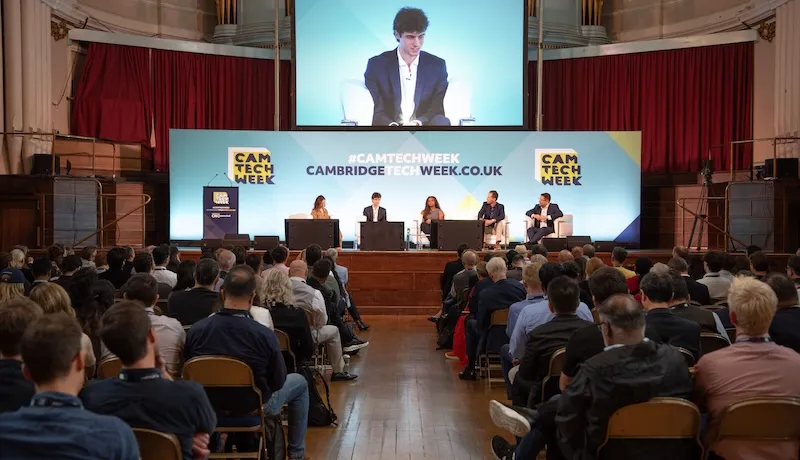
Cambridge Tech Week has reported a 15% rise in attendance, with more than 1,700 delegates from 52 countries taking part in a five-day programme that put deep technology at the centre of the conversation.
The event, held from 14 to 18 September, brought together founders, investors, researchers, policymakers and technology companies for discussions spanning artificial intelligence, quantum computing, healthtech, energy, infrastructure and security. Much of the programme was organised around the theme How Deep Tech Changes the World, reflecting a growing emphasis on turning research into commercial businesses rather than treating scientific breakthroughs as distant possibilities.
Commercialisation, access to investment and collaboration between researchers and industry featured prominently. So did the infrastructure needed to support technologies such as AI and quantum computing, from energy supply and data centres to sovereign computing capabilities and specialist talent pipelines.
Deep Tech Moves From Laboratory to Market
Deep tech is a broad term, but it generally describes companies whose innovations are rooted in scientific discovery or engineering breakthroughs. These can include advanced materials, biotechnology, photonics, quantum systems, neurotechnology and AI. Such ventures often face longer development cycles, higher capital requirements and greater technical uncertainty than software-only startups. Cambridge, with its concentration of university research, science parks, spinouts and specialist investors, has become one of Europe's most closely watched clusters for this kind of company building.
That context shaped much of the week. Panel sessions and fireside discussions explored the so-called valley of death between research funding and commercial scale-up. Founders described the challenge of proving technical feasibility, protecting intellectual property, assembling multidisciplinary teams and attracting investors patient enough to support long timelines. Investors, meanwhile, spoke about the need for clearer pathways to market, stronger manufacturing partnerships and regulatory frameworks that can keep pace with innovation.
The event also placed significant weight on the infrastructure that deep tech requires. AI models are increasingly energy-intensive, and the growth of generative and agentic systems has raised questions about electricity demand, grid capacity and the carbon intensity of computation. Quantum computing, while still at an earlier stage, brings its own demands for specialised facilities, cryogenics and highly trained engineers. Healthtech and biotechnology companies need access to clinical expertise, data governance and validation pathways.
Startups Take the Spotlight
More than 80 emerging companies and scaleups exhibited at Innovation Alley at Cambridge Guildhall, giving early-stage teams a chance to present their work to investors, corporate partners and potential customers. The event's pitch competition showcased a group of early-stage technology companies, with two winners emerging from the final.
Myonerv won the 2026 Cambridge Tech Week Pitch Competition for its wearable neurostimulation technology, which is being developed to help stroke patients regain movement. The startup was founded by chief executive Sam Kamali, whose motivation for developing the technology followed his cousin suffering a stroke aged 11 after a bleeding brain tumour caused by previously undiagnosed leukaemia. The personal origin story underscored a recurring theme of the week: deep-tech innovation is often driven by specific, human problems rather than abstract technical ambition.
Agritech startup LAMBDA was named the People's Choice winner. The company is developing advanced photonic materials designed for use in greenhouse agriculture. Its technology aims to improve the way controlled environments manage light, potentially boosting crop performance and resource efficiency. The two companies shared a £7,500 prize, a modest sum in the capital-intensive world of deep tech but a useful signal of recognition for early-stage teams.
Their success also highlighted the breadth of the Cambridge ecosystem. The finalists and exhibitors represented fields ranging from neurorehabilitation and photonics to AI, cybersecurity, biotechnology and advanced materials. For many, the value of the week lay less in the prize money than in the connections made with investors, researchers and corporate partners who can help translate prototypes into products.
International Delegations Strengthen Global Reach
The event attracted a significant international presence, with delegations attending from countries including Finland, Romania, Estonia and Serbia. The British-Serbian Chamber of Commerce brought more than 20 companies to Cambridge, with eight Serbian businesses exhibiting across areas including AI, telecommunications, cybersecurity, agritech, healthtech and biotechnology.
That international dimension matters for deep tech. Scientific talent, capital and customers are distributed globally, and no single cluster can solve every problem alone. Cross-border delegations can help startups find partners in new markets, expose investors to opportunities outside their home regions and create research collaborations that span institutions and jurisdictions. For Cambridge, the presence of overseas companies also reinforces its role as a convening point for European and global deep-tech networks.
The programme did not shy away from policy and security questions. Sessions examined the growing energy demands associated with AI, sovereign computing capabilities and the increasing crossover between civilian and defence technologies. The Big Tech Debate focused on dual-use technology and the changing boundary between civilian and defence innovation, while separate sessions examined the development and commercialisation of AI, quantum and health technologies.
Dual-use technology is a sensitive area. Many advanced technologies can serve both commercial and defence purposes, from AI and quantum sensing to advanced materials and biotechnology. Governments are increasingly interested in protecting critical capabilities, supporting domestic industry and ensuring that sensitive research does not fall into the wrong hands. At the same time, startups need access to markets and investment to scale. The debates reflected the tension between openness and security that now shapes deep-tech policy in many countries.
Prominent Voices and Cross-Sector Debate
Speakers during the week included BenevolentAI founder Kenneth Mulvany, author Calum Chace, CMR Surgical co-founder Mark Slack, Balderton Capital general partner Suranga Chandratillake and LinkGevity founder
Source: UKTN News