

Key Facts
- DoorDash is testing a text-based AI agent that can turn messages into food orders.
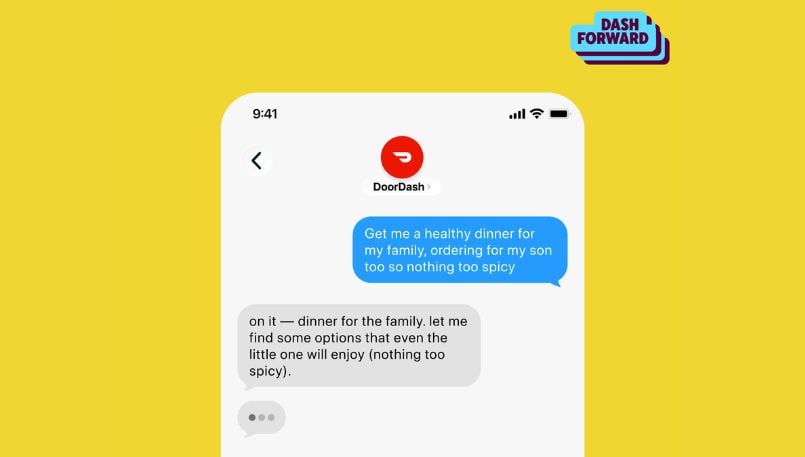
- The agent works through Apple Messages and links a user's phone number to their DoorDash account.
- It uses previous purchases, preferences, and saved payment cards to assemble and complete orders.
- The experience is an extension of Ask DoorDash, a conversational assistant introduced in June.
- The test is currently limited to the United States and appears, based on a demo, to be available only to iPhone users.
- DoorDash also announced DashOS, DashBuddy, and DoorDash Air as part of a broader AI and delivery push.
DoorDash is experimenting with a new way to order food that does not require opening its app. The company is testing a text-based AI agent that can receive a request through Apple Messages and turn it into a real DoorDash order. The idea is simple: instead of launching an app, searching for a restaurant, comparing menu items, and building a cart, a customer could send a short message such as “Order my usual” and let an automated system handle the rest.
That simple phrase, however, hides a complicated set of operations. To make the request work, DoorDash links a user’s phone number to their DoorDash account. The system can then draw on previous purchases and preferences, identify the relevant restaurant and items, assemble a cart, and use the user’s saved card at checkout. The important part is what happens between the message and the transaction: the company’s AI system uses consumer memory and connected tools to interpret the request and retrieve the information needed to act on it.
That means a vague instruction such as “my usual” can trigger several underlying operations that previously required the customer to perform manually. The agent might need to determine which restaurant the user means, which items they regularly order, whether any customization is required, and whether the saved payment method is still valid. Each of those steps must be handled accurately for the text-ordering experience to feel convenient rather than frustrating.
DoorDash is testing whether its app can disappear from the ordering process
DoorDash describes the experience as something closer to messaging a friend who already knows what you like. Send a request, and let the agent work out the details. The system can use account history and connected tools to interpret vague instructions, identify likely items, and assemble an order. DoorDash says that could be useful when opening the app and browsing is inconvenient or unnecessary, particularly for repeat purchases.
The company also says the agent can act proactively, using past behavior to suggest an order at a relevant time. For example, it might ask whether a user wants coffee based on their previous morning orders. That kind of proactive suggestion shifts the interface from a search-driven tool to an assistant that initiates conversations. It also raises the possibility that ordering becomes less about deliberate browsing and more about responding to a timely prompt.
If the experiment works, the app itself could become less central to the transaction. Customers would still need a DoorDash account, payment information, and a delivery address, but they might not need to open the app or navigate its menus. Instead, the messaging thread becomes the storefront, the search bar, and the checkout process all at once. That is a significant change for a company whose business has been built around a mobile app.
An extension of Ask DoorDash
The text-based agent is not a completely new system. It builds on Ask DoorDash, the conversational assistant the company introduced in June, which lets users describe what they want in natural language. The new text experience essentially moves that capability from a DoorDash search bar into a messaging thread. That matters because the company appears to be betting that by putting its agents where users already send messages and make requests, ordering can become something they simply ask for rather than something they have to work through actively.
Conversational commerce has become a major area of interest for technology companies. Virtual assistants, chatbots, and AI agents are being tested across retail, travel, and food delivery. The appeal is straightforward: natural language can lower the friction of digital transactions. Instead of learning an app’s interface, a customer can state an intent and let software handle the details. For repeat purchases, where the intent is predictable, that approach can be especially efficient.
But the approach also depends on trust. An AI agent that can access purchase history, preferences, and payment credentials must be accurate and secure. Mistakes in item selection, restaurant choice, or order timing could be costly for both customers and the platform. A proactive suggestion that arrives at the wrong moment could feel intrusive rather than helpful. DoorDash’s test will likely need to demonstrate that the system can handle ambiguity without creating new problems.
What else is coming to DoorDash
The text-ordering agent is just one piece of DoorDash’s latest push. The company also introduced DashOS, a platform that connects restaurant tools for ordering, reservations, loyalty, guest management, and marketing. DashOS appears designed to give restaurants a more unified view of their operations and customer relationships, while also integrating with DoorDash’s broader ecosystem.
Then there is DashBuddy, an AI assistant that helps Dashers get answers and personalized guidance through text and the Dasher app. For delivery workers, an AI assistant could help with navigation, account questions, earnings information, and other routine tasks. That fits a pattern of applying AI to different sides of the marketplace: consumers, merchants, and delivery drivers.
On the delivery side, DoorDash Air is preparing to pilot drone deliveries in Northern California, with its own aircraft and the infrastructure needed to move orders from restaurants to customers. Drone delivery has been explored by several logistics and retail companies, but it remains difficult to scale because of regulatory, safety, and operational challenges. A pilot in Northern California would allow DoorDash to test the technology in a controlled environment.
Together, the announcements push DoorDash beyond simply an app for ordering food. AI is being added to the consumer, restaurant, and delivery sides of the platform. The company is not only trying to make ordering easier; it is trying to make the entire logistics network more automated and responsive.
What does this mean for users?
For customers, the biggest change is that ordering food can become less tied to the DoorDash app itself. Instead of opening the app, searching, comparing options, and building a cart, users can just send a routine text message and let DoorDash handle the steps in between. That could be particularly appealing for people who order the same meal or drink regularly and do not want to repeat the same sequence of taps every time.
But the shift will not happen everywhere at once. The text-ordering agent is currently limited to the United States, and based on a demo, it appears to be available only to iPhone users, further narrowing access. That limitation suggests the test is still in an early phase. Apple Messages provides a familiar and widely used messaging environment, but it also ties the experience to Apple’s ecosystem. Expanding to other platforms would likely require additional development and possibly different integrations.
There are also practical questions about how the agent handles edge cases. What happens if the user’s usual restaurant is closed? What if an item is out of stock? What if the user sends a message that is ambiguous or changes their mind mid-order? The value of the system will depend on how gracefully it manages these situations. A text-based agent must know when to proceed automatically and when to ask for confirmation.
Privacy and data control will be another consideration. To interpret vague requests, the system needs access to account history and preferences. Customers may want clear controls over what the agent can remember, how proactive suggestions work, and whether their data is used to train AI models. The convenience of texting an order comes with a trade-off in how much the platform knows about a user’s habits.
Other technology companies have been experimenting with similar ideas. Messaging platforms, retail apps, and search engines are all exploring how AI agents can complete tasks on behalf of users. The promise is that instead of navigating multiple apps and websites, a person can describe what they want and let an assistant handle the steps. The challenge is that these agents must interact with real-world services, verify identity, manage payments, and recover from errors. Food delivery is a useful test case because the transactions are frequent, the preferences are often repetitive, and the consequences of a mistake are usually manageable but still annoying.
The competitive landscape could also shape how quickly the feature expands. If consumers respond well to text-based ordering, other delivery platforms may accelerate their own AI assistant efforts. If the experience feels unreliable or intrusive, adoption could stall. Much will depend on the quality of the underlying models, the accuracy of user memory, and the ability of the system to know when it should ask a question rather than make an assumption.
The road ahead for AI ordering
The experiment is still early, but the direction is notable. DoorDash is testing whether its most convenient interface might eventually be no interface at all — just a request and an order. If the company can make the text agent reliable, it could reduce friction for repeat purchases and create a new layer of engagement that does not depend on users opening an app.
That shift would also have implications for restaurants. If more orders arrive through a conversational agent rather than a visual menu, restaurants may need to think differently about how their menus, promotions, and availability are represented to AI systems. The ordering experience could become less about photos and categories and more about structured data that agents can interpret accurately.
For now, the test remains limited. DoorDash has not said when or whether the feature will expand beyond the initial group of users. But the company’s broader announcements around DashOS, DashBuddy, and DoorDash Air show that it is investing in AI and automation across multiple parts of its business. The text-ordering agent is one of the clearest examples of how that strategy could change the customer experience.
If successful, it could make ordering food feel less like using an app and more like sending a message. The question is whether the technology can handle the complexity behind a simple request. “Order my usual” may sound effortless, but making it work reliably requires memory, context, payment security, and a deep integration with the user’s account. DoorDash is betting that AI can manage that complexity — and that customers will prefer the simplicity of a text.
Source: TechRepublic News