

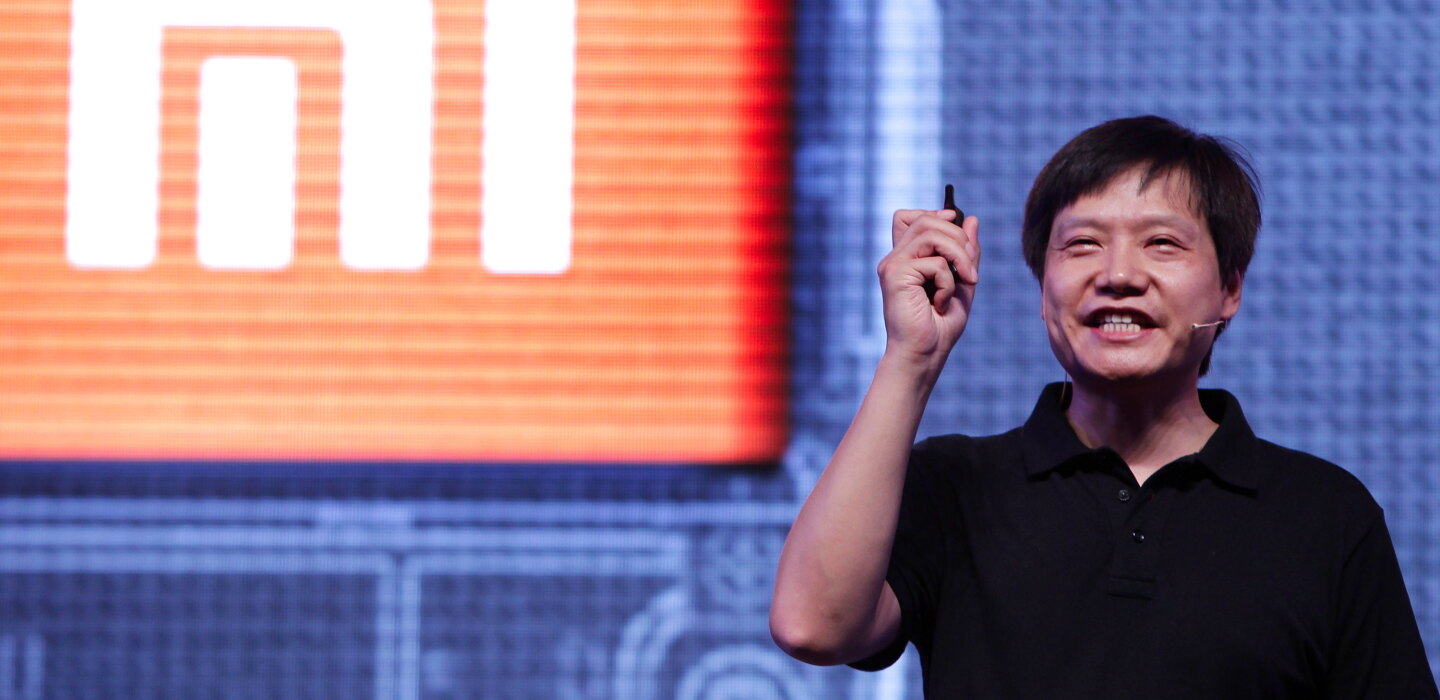
Lei Jun steps into the spotlight
In early 2014, the Chinese consumer-technology market was not merely competitive; it was combustible. Lenovo, the established leader in personal computers and a growing force in smartphones, faced a fast-moving challenger called Xiaomi. The challenge was personal as much as commercial. Xiaomi had just raised its 2014 smartphone sales target to 60 million units, 20 million more than it had initially planned. That figure alone would have been enough to draw attention. But the projection behind it was more striking: if Xiaomi’s sales accelerated as expected, it could match Lenovo’s smartphone volumes by 2015, with both companies reaching roughly 100 million units. The man steering that escalation was Lei Jun, a 44-year-old billionaire whose fortune was estimated at $3.8 billion and who ranked among the 25 richest people in China.
Lei Jun was not a showman in the traditional mold. He was described as discreet, yet his company’s tactics were loud, fast and deliberately public. Xiaomi’s rise turned him into one of the most closely watched technology executives on the planet, not because he gave grand speeches, but because the business model he was building seemed to threaten established hardware makers on several fronts at once. Xiaomi combined attractive specifications, aggressive pricing, online distribution and a community-driven marketing style. It was a formula designed for a market where consumers were moving from feature phones to smartphones in enormous numbers and where speed to scale mattered more than conventional retail polish.
Who is Lei Jun?
By the time Xiaomi became a global talking point, Lei Jun had already spent years in China’s technology sector. He was born in 1969 in Xiantao, Hubei province, and studied computer science at Wuhan University. His career took him through software and internet businesses, including leadership roles at Kingsoft, a Chinese software company, and later angel investing. That experience gave him a view of both software ecosystems and consumer internet behavior. It also gave him a network of entrepreneurs and engineers that would prove useful when he founded Xiaomi in 2010 with a group of partners.
Xiaomi’s origins mattered to its strategy. The company was not built as a traditional hardware manufacturer with heavy factories and vast retail chains. It was built around the idea that software, online communities and tightly managed supply could create a more efficient consumer electronics company. Xiaomi developed MIUI, an Android-based operating system that attracted users through frequent updates and community feedback. That software layer helped create loyalty before the company was selling large volumes of hardware. When Xiaomi did sell phones, it could rely on an engaged base of users, online channels and word-of-mouth enthusiasm rather than expensive television campaigns.
Lei Jun’s personal wealth and reputation also shaped the company’s image. He was not an unknown founder experimenting in a garage. He was a seasoned operator and investor with the credibility to attract talent, partners and media attention. His $3.8 billion fortune made him one of China’s richest individuals, but Xiaomi’s public persona depended less on luxury and more on accessibility. The company promised powerful devices at prices that undercut better-known international brands. That positioning fit a founder who projected quiet determination rather than flashy excess.
A Chinese challenger in full sprint
The smartphone race in China was fierce because the stakes were enormous. Lenovo was the sector leader, with a broad portfolio and a strong position in personal computers that gave it distribution and brand recognition. Xiaomi was the principal challenger, younger and more online-native. In 2013, Lenovo had sold twice as many smartphones as Xiaomi. That gap might have discouraged a conventional challenger. Instead, Xiaomi responded by raising its targets and accelerating its plans. The company’s revised goal of 60 million smartphones for 2014 signaled that it intended to compress years of growth into a short period.
The numbers told a story of ambition rather than caution. Selling 60 million units would require Xiaomi to manage supply chains, component procurement, assembly capacity and logistics at a much larger scale. It would also require maintaining consumer excitement across multiple product launches. Xiaomi’s projections suggested that by 2015 it could reach 100 million units, putting it on par with Lenovo. That was not a modest claim in a market where scale determined bargaining power with suppliers and visibility with carriers, retailers and app developers. The competition was not just about selling phones; it was about becoming the platform through which hundreds of millions of users accessed mobile internet services.
Until 2012, Xiaomi’s activities had focused on the Chinese market. That focus allowed it to learn quickly, refine its online sales model and build a brand among Chinese consumers. But by 2014, the company was turning outward. Internationalization transformed Xiaomi from a well-known domestic challenger into a potential global player. The move was not simply about finding new customers; it was about proving that the Xiaomi model could travel beyond its home market. Expansion brought new challenges, including different consumer preferences, local regulations, patent risks, distribution partners and after-sales expectations. Yet the direction was clear: Xiaomi wanted to be more than a Chinese phenomenon.
The Xiaomi playbook: low prices, fast sales and online noise
Xiaomi’s approach relied on a mix of product design, pricing and marketing that was unusual for the hardware industry. The company specialized in the design and commercialization of consumer computing terminals, with smartphones at the center. It avoided the classic model of spending heavily on advertising and then recovering costs through high retail margins. Instead, it sold primarily online, kept margins thin and used social media to generate demand. The result was a sense of scarcity and urgency around product launches. Consumers did not simply see an advertisement and walk into a store; they waited for a sale, joined an online queue or tried to buy during a narrow window.
That method turned launches into events. In November, 150,000 smartphones were sold in just 10 minutes on the WeChat messaging platform. The following week, 100,000 Redmi Note phablets, devices with very large screens, were sold in 34 minutes. These numbers were small compared with the total Chinese smartphone market, but they were symbolically important. They demonstrated speed, consumer appetite and the power of online platforms to concentrate demand. They also created headlines, which in turn fed the cycle of attention. Xiaomi did not need to buy massive advertising space if its sales records and online frenzy could generate coverage on their own.
Lei Jun refused to spend massively on advertising, according to the company’s public posture, but he understood the mechanics of social networks. Xiaomi’s marketing was built around community, exclusivity and direct communication with users. Fans discussed software features, criticized designs and celebrated launches. That engagement gave the company a loyal base and a feedback loop that traditional manufacturers often lacked. It also made Xiaomi appear more agile. When a product sold out in minutes, the shortage could be framed as proof of popularity rather than a failure of supply. The strategy was not without risk, because repeated sellouts could frustrate buyers, but it was effective at building visibility.
Hiring Hugo Barra and signaling global intent
Xiaomi’s international ambitions were reinforced by a high-profile talent move: the recruitment of Hugo Barra, one of the architects of Google’s Android operating system. Hiring a senior Android figure sent a clear signal that Xiaomi was serious about software, global expansion and its relationship with the Android ecosystem. It also raised the company’s profile outside China. For a young hardware maker trying to be taken seriously by international media, engineers, developers and partners, the appointment was a credibility multiplier.
The move reflected a broader truth about the smartphone industry. Hardware alone was not enough. The operating system, app ecosystem, user interface and services mattered enormously. Xiaomi’s MIUI gave it a software identity, and Barra’s arrival suggested that the company wanted to strengthen its global product organization. It also indicated that Xiaomi was willing to compete for talent with the world’s biggest technology companies. That was important in a market where engineering leadership and software polish could differentiate devices that otherwise looked similar on paper.
Lenovo, Xiaomi and the numbers behind the race
The comparison with Lenovo was unavoidable. Lenovo was the incumbent, with a global brand, a broad product line and deep experience in personal computing. Xiaomi was the insurgent, younger and more focused on online sales. Lenovo’s 2013 smartphone sales were twice Xiaomi’s, which meant Xiaomi still had much to prove. But Xiaomi’s growth rate was the variable that unsettled rivals. If the company could sustain its momentum, the gap could close faster than established players expected. The possibility that Xiaomi could sell as many smartphones as Lenovo by 2015 turned a local rivalry into a strategic threat.
The numbers also highlighted the importance of China’s domestic market. It was the base from which Xiaomi could build scale. A large home market allowed the company to negotiate with suppliers, amortize design costs and test its online sales model. Once it had achieved sufficient volume, it could consider international expansion. That sequence was central to Xiaomi’s rise: dominate a massive domestic market first, then use scale and brand attention to enter new countries. The strategy was not unique, but Xiaomi executed it with unusual speed and a distinctive marketing style.
The $50 smartphone ambition
Lei Jun’s most provocative goal was to conquer the world with a $50 smartphone. That ambition captured the logic and the risk of Xiaomi’s model. A $50 smartphone could expand the addressable market dramatically, bringing connected computing to consumers who could not afford premium devices. It could also pressure competitors that relied on higher prices and margins. But building a capable phone at that price required extreme efficiency in design, components, manufacturing and distribution. It left little room for error, and it raised questions about profitability, quality and after-sales support.
The $50 target also illustrated how Xiaomi framed its mission. The company did not present itself merely as a seller of gadgets. It presented itself as a company that could make technology more accessible. That narrative resonated in emerging markets and in China, where many consumers were price-sensitive but increasingly sophisticated about specifications. Xiaomi’s challenge was to deliver on the promise without sacrificing the user experience. A cheap phone that felt slow or unreliable could damage the brand, especially as the company expanded beyond its most loyal fan base.
Pressure points behind the growth
Rapid growth brought pressure on several fronts. Supply chain management was one. Selling tens of millions of devices requires reliable access to screens, chips, memory, cameras and batteries. Component shortages or quality problems can delay launches and damage reputation. Xiaomi’s online flash-sale model depended on tightly managed inventory, but scaling that model internationally was harder. Different markets had different distribution norms, carrier relationships and consumer expectations. A strategy that worked in China could not simply be copied everywhere.
Competition was another pressure point. Lenovo was only one rival. International brands, local manufacturers and other Chinese challengers were all fighting for the same customers. As Xiaomi expanded, it would encounter companies with strong patent portfolios, established retail networks and deep marketing budgets. Intellectual property was a particular concern for a young company entering new markets. Legal disputes could slow expansion or force costly settlements. Xiaomi’s low-margin model also meant that it had less financial cushion than premium rivals if sales slowed or costs rose.
Brand perception was a further challenge. Xiaomi’s success depended on excitement, community and the perception of exceptional value. If product launches became routine, if competitors matched its specifications, or if buyers grew tired of limited availability, the advantage could erode. The company needed to keep improving its software, design and services while maintaining its price edge. That was a difficult balance. The same social-media energy that amplified Xiaomi’s successes could also amplify complaints when something went wrong.
Lei Jun’s position in the industry therefore rested on more than a single product or a single sales target. It rested on whether Xiaomi could turn attention into durable scale and whether its low-cost, online-first model could adapt to markets beyond China. The 60 million target for 2014 and the 100 million projection for 2015 were markers of ambition, but they were also tests of execution. The company had already shown that it could generate demand quickly. The harder task was to build the systems, partnerships and trust needed to sustain that demand over time.
For now, Lei Jun’s dream remained explicit: to conquer the world with a $50 smartphone. It was a vision that combined engineering ambition, consumer accessibility and commercial aggression. Whether or not Xiaomi reached that price point at scale, the goal itself changed the conversation in the mobile industry. It suggested that the next phase of competition would not be won only by premium brands with large advertising budgets, but by companies that could combine software, online communities and efficient hardware economics. Lei Jun had become the thorn in the industry’s side precisely because that possibility could no longer be dismissed.
Source: l'Opinion News