

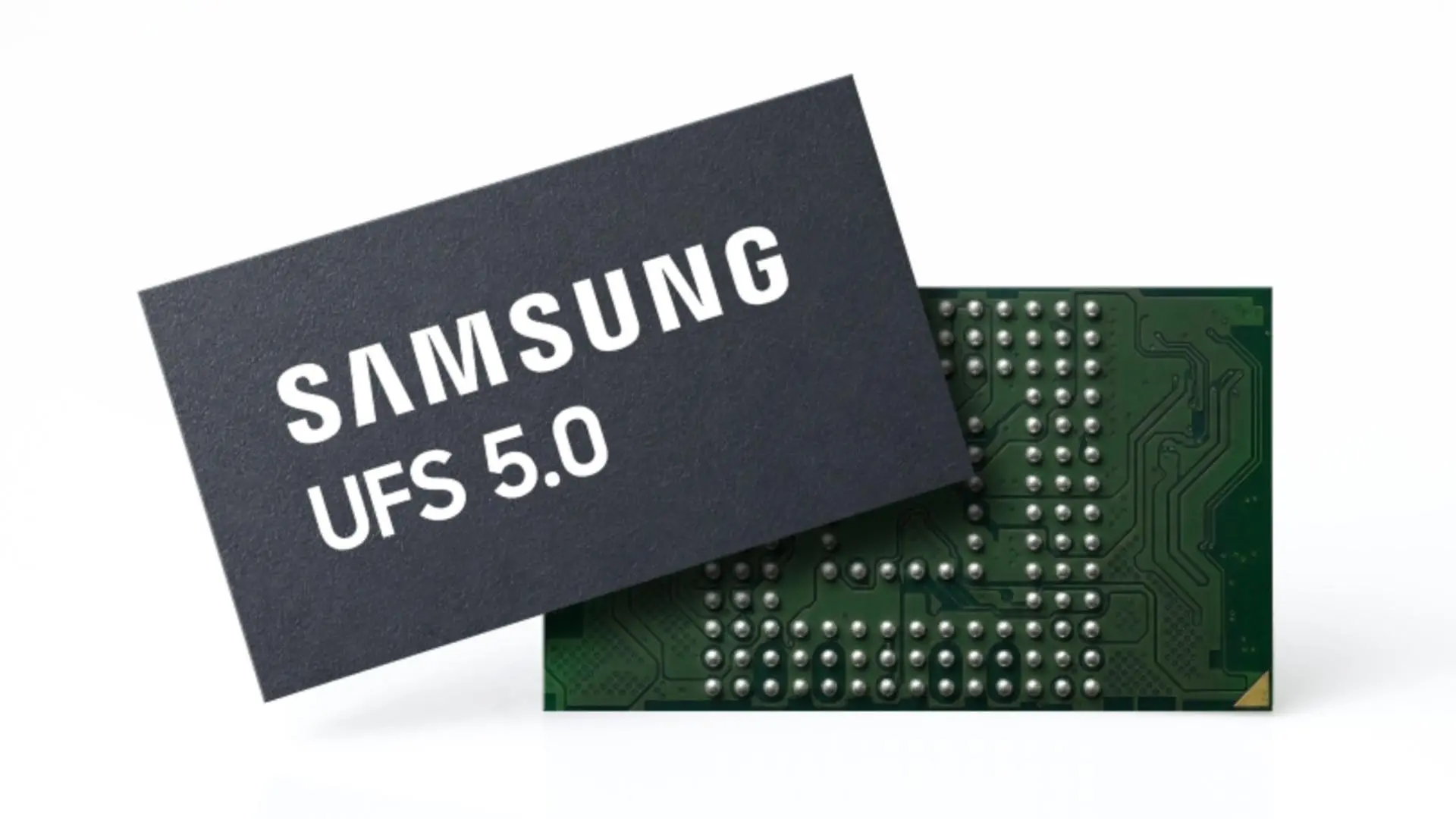
The mobile storage landscape is on the verge of a transformative leap. Samsung, the global leader in memory technology, has officially unveiled the world's first UFS (Universal Flash Storage) 5.0 chips. This announcement marks a pivotal moment for the smartphone industry, promising a substantial upgrade in data transfer speeds and overall device performance. The new standard is set to redefine what users can expect from their next-generation Galaxy phones, particularly in terms of app responsiveness, large file handling, and the increasingly critical realm of on-device artificial intelligence.
What is UFS 5.0 and How Does It Work?
Universal Flash Storage (UFS) is the standard storage interface used in most modern smartphones, tablets, and other portable devices. It is designed to provide high-speed data transfer while maintaining low power consumption, making it ideal for battery-powered electronics. UFS 5.0 represents the latest iteration of this standard, succeeding the current UFS 4.0 and 4.1 specifications. The key improvement lies in its extraordinary bandwidth capabilities. According to Samsung, the new chips can achieve sequential read speeds of up to 10.8 GB/s and sequential write speeds of up to 9.5 GB/s. These numbers are more than double the theoretical maximum of UFS 4.1, which topped out at 4,300 MB/s for reads and 4,100 MB/s for writes. The remarkable speed increase is achieved through a combination of advanced NAND flash technology, a more efficient controller architecture, and optimizations in the memory interface. The new standard also supports multiple lanes for data transfer, allowing for parallel processing that dramatically reduces latency.
Performance Gains Over Previous Generations
To fully appreciate the magnitude of this upgrade, it is essential to compare UFS 5.0 with its predecessors. The jump from UFS 3.1 to UFS 4.0 was already significant, offering roughly 80% faster read speeds. However, UFS 5.0 is in a league of its own. With a read speed of 10.8 GB/s, a Galaxy phone equipped with this storage could theoretically read an entire 4K movie in under a second. For everyday use, this translates to virtually instant app launches, near-instantaneous file transfers, and seamless multitasking. For example, copying a large video file from a computer to a phone via a USB connection would be dramatically faster, approaching the speeds of internal SSDs. Write performance is equally impressive. Write speeds of 9.5 GB/s mean that capturing 8K video or saving high-resolution photos from a burst mode will happen with no lag. This is particularly beneficial for professional photographers and videographers who use their phones as primary tools.
Efficiency and Size Improvements
Performance alone is not the only area where UFS 5.0 excels. Samsung has also emphasized significant efficiency gains. The company claims that the new chips are up to 40% more energy-efficient than UFS 4.1. This is achieved through innovative techniques like clock gating, which shuts down unused logic circuits to save power, and multi-voltage technologies that allow different parts of the chip to operate at optimal voltage levels. As a result, devices using UFS 5.0 will benefit from longer battery life, especially during intensive tasks like gaming or video editing. Furthermore, the physical size of the chip has been reduced. The new UFS 5.0 package measures just 7.5mm x 13mm x 0.9mm, making it smaller than its predecessor. This shrinkage is crucial for smartphone designers who are constantly fighting for internal space. A smaller storage module allows for larger batteries, better cooling solutions, or thinner device profiles – all desirable features for consumers.
Impact on Smartphone Experience
The real-world implications of UFS 5.0 are vast. For the average user, the most noticeable difference will be in app performance. Opening resource-intensive applications like games, video editors, or large office documents will become near-instantaneous. File management will also feel snappier. Browsing through a gallery of thousands of high-resolution images or transferring a backup of the entire phone to a PC will be completed in a fraction of the time. Additionally, UFS 5.0 will enable better multitasking. Switching between multiple demanding apps will be faster and smoother, reducing instances of reloading or stuttering. For gamers, this means shorter loading screens and richer, more detailed environments that can be streamed from storage in real time. The technology is also a boon for AI applications, which are becoming increasingly central to the smartphone experience.
AI and Real-World Applications
On-device artificial intelligence is one of the most exciting frontiers for smartphones. Features like real-time language translation, advanced image recognition, and generative AI models require fast access to large models and datasets. UFS 5.0's high bandwidth directly supports these workloads. A faster storage interface allows AI models to load more quickly, enabling more responsive and complex on-device inference. For example, a Galaxy phone with UFS 5.0 could run a large language model for voice assistants that is much more capable than what is currently possible. It could also handle high-resolution image upscaling or video enhancement in real time without sending data to the cloud. This not only improves privacy but also reduces latency. Furthermore, the efficiency gains help mitigate the power draw associated with running such demanding AI tasks, preserving battery life.
Expected Timeline and Devices
According to Samsung, mass production of UFS 5.0 chips is scheduled to begin in the fourth quarter of 2026. Initial capacities will range up to 1 TB, with smaller options likely for mid-range devices. Industry leaks strongly suggest that the Samsung Galaxy S27 series, expected to launch in early 2027, will be among the first smartphones to feature the new storage. The Galaxy S27 is also rumored to use the Exynos 2700 chipset, which is in development and is expected to natively support UFS 5.0. This combination could give the S27 a significant performance advantage over competitors. However, other major smartphone manufacturers will eventually adopt the standard as well, likely in their flagship models from 2027 onwards. The smartphone industry typically transitions to new storage standards within a year of the first chips becoming available.
Market Implications and Competitive Landscape
The introduction of UFS 5.0 places Samsung in a strong position in the memory market. As the pioneer, Samsung can reap the benefits of early production yields and secure long-term contracts with device makers. The technology also helps Samsung maintain its competitive edge over other memory providers like SK Hynix and Micron, who will need to develop their own UFS 5.0 solutions. For consumers, the standard will eventually trickle down to more affordable devices, but the initial premium will be reserved for flagship phones. The performance boost might also accelerate the development of new use cases, such as 8K video recording at higher frame rates, more sophisticated AR/VR experiences, and cloud-like storage performance on the device. Additionally, UFS 5.0 could influence the design of external storage solutions, allowing for ultra-fast USB drives that leverage the same technology.
Challenges and Adoption Hurdles
Despite the impressive specifications, there are challenges to widespread adoption. The biggest is thermal management. Higher speeds generate more heat, and smartphone designs are already constrained by cooling. Manufacturers will need to implement effective thermal solutions, such as vapor chambers or graphite sheets, to prevent throttling during sustained high-performance tasks. Another challenge is cost. The advanced manufacturing process for UFS 5.0 chips will initially make them more expensive than UFS 4.1. This will likely limit their use to premium devices until economies of scale bring prices down. Compatibility with existing hardware is also a factor. The memory controller and the main processor must support the UFS 5.0 interface. This means chipset manufacturers like Qualcomm, MediaTek, and Samsung itself need to include the necessary IP in their designs. The timeline for that integration suggests that only future high-end chipsets, such as the next iteration of the Snapdragon 8 series or Exynos 2700, will be compatible.
Another consideration is the diminishing returns for average users. While benchmarks show massive improvements, the human eye can only perceive so much speed. For routine tasks like checking emails or browsing social media, the difference between UFS 4.1 and UFS 5.0 might be imperceptible. However, for power users, content creators, and gamers, the upgrade will be transformative. As always, the industry is moving forward, and what seems like overkill today often becomes table stakes tomorrow. The larger storage capacities and faster speeds pave the way for software that is more ambitious, driving even greater innovation in mobile computing.
Samsung's announcement of UFS 5.0 is more than just another incremental improvement; it is a foundational technology that will shape the next generation of smartphones. With its combination of speed, efficiency, and compact size, it promises to unlock new possibilities for mobile experiences. The Galaxy S27 series, likely launching in 2027, will be a showcase for this technology, but the impact will extend far beyond Samsung's own products. As the industry standard evolves, all smartphone users will eventually benefit from faster, more capable devices. The future of mobile storage has arrived, and it is remarkably fast.
Source: Android Authority News