

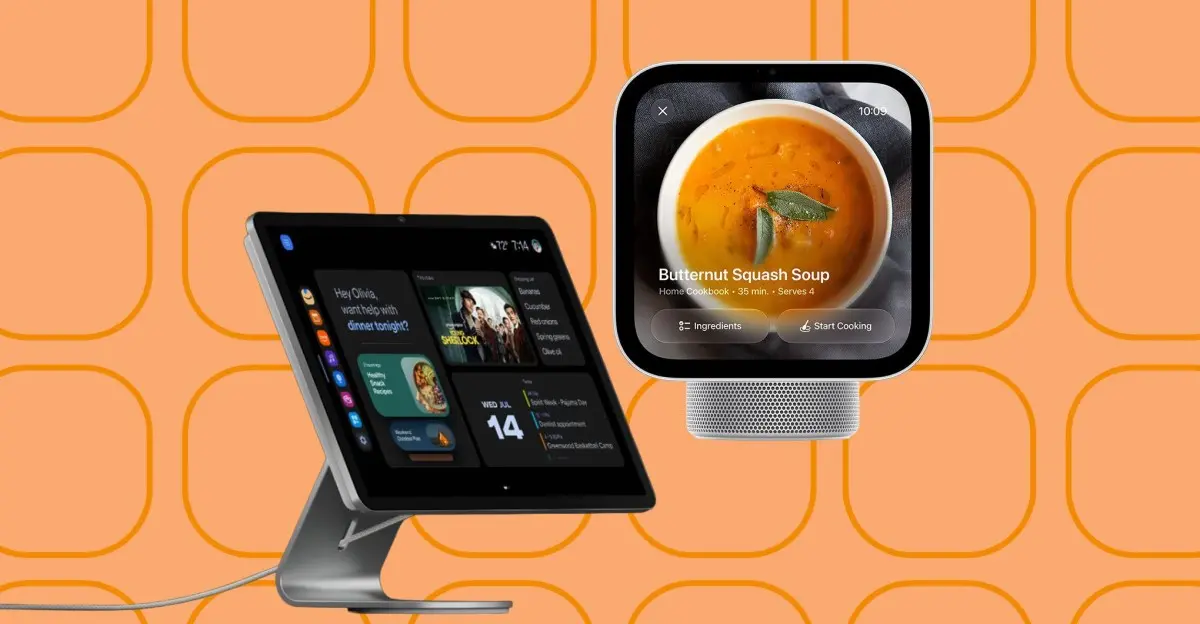
Smart displays spent years stuck in an awkward middle ground. They were supposed to be useful hubs for the home, but many models were slow, limited, and built around voice assistants that often felt more like novelties than tools. Apple and Amazon are now trying to change that with two new devices that take the category in different directions. Apple’s HomeView costs $299, while Amazon’s Echo Show 16 costs $499.99. Both arrive with hardware that is far closer to a computer than the inexpensive smart speakers with screens that defined the category only a few years ago.
Key facts at a glance
- Apple’s HomeView is priced at $299 and uses an A18 chip and a Liquid Retina display.
- Amazon’s Echo Show 16 is priced at $499.99 and uses a MediaTek processor and a Nanomatte display also used in the new Alexa Tablet.
- Both devices are designed to be always-on shared screens for calendars, doorbell cameras, meal planning, and smart home controls.
- Apple’s device is built around the iPhone and personal recognition; Amazon’s is built around household sensing and shared features.
- The earlier smart display category was criticized for underpowered hardware and limited software; earlier examples included the Echo Show 5 at $85 and the Nest Hub at $99.
- Google’s Pixel Tablet experiment with a detachable screen was reported to have been canceled after 18 months.
The shift matters because the smart display has long promised more than it delivered. Early models tried to combine a voice assistant, a photo frame, a video player, a home control panel, and a calendar into one device. Too often, they did each job only adequately. Screens were small, processors were slow, and software was built around whatever voice assistant happened to be attached. The result was a category that seemed useful in theory but was easy to ignore in practice. Many households used a smart speaker for music and timers, then returned to their phones for calendars, lists, cameras, and controls.
The new pitch is different. Apple and Amazon are not simply adding touchscreens to speakers. They are building devices with computer-class components and software designed for a screen that stays in one place and serves several people. That is a meaningful change. A family computer does not need to run spreadsheets or handle homework. It needs to be the shared surface where the household checks the day, sees who is at the door, adjusts the thermostat, and decides what to eat. It needs to be available to everyone without a login ritual or a search for a charger.
That idea has become more urgent as household life has become more digital. Calendars, grocery lists, meal plans, school schedules, chores, package deliveries, and home security all live in apps. Often they live on one person’s phone, which turns that person into the household’s unofficial administrator. The mental load grows quietly: remembering the appointment, checking the delivery, letting the dog walker in, dimming the lights, and telling everyone else what is happening. A communal screen can spread that work across the household. It can make the day visible to everyone at once, not just to the person who happens to hold the main phone.
The connected home adds another reason for a shared display. Doorbell cameras, smart locks, thermostats, lighting, and sensors all need a simple interface. A phone can do the job, but a phone is personal. It is also usually in a pocket, on a desk, or under a cushion. A screen mounted in a kitchen or hallway can be reached by anyone. It can show a camera feed with one tap, turn down the heat, or dim the lights without unlocking an app or finding the right menu. That sounds modest, but convenience is the whole point of a family computer. The best interface is the one that is already there.
Tablets have seemed like an obvious answer, but they have two persistent problems. First, multiuser support is often limited. A tablet is usually designed around one person and one account, which makes it awkward for a family that needs shared access. Second, anything with a battery tends to wander. A tablet can end up in a bedroom, under a pillow, or at the bottom of a bag. Then it dies. A family computer needs to stay put and stay ready. Google’s Pixel Tablet was an interesting attempt to combine a tablet and a smart display, but its detachable screen created exactly this kind of friction. Its smart home support was also viewed as half-finished, and its successor was reportedly canceled 18 months later.
Apple and Amazon appear to be addressing three long-standing requirements at once. The first is computer-class hardware, which should make the interface feel responsive rather than sluggish. The second is a display built for sharing, with an interface that can switch between users and show household information clearly. The third is an always-on screen that is as easy to use as a light switch. No PIN to enter, no screensaver to swipe away, no hunt for an app. A person should be able to reach out, tap, and get the job done. Both the HomeView and the Echo Show 16 appear to solve these problems on paper, though proper testing will be needed to see how well they work in daily life.
The deeper difference lies in how the two companies imagine the household. Apple’s approach treats the person as the user. The HomeView is designed to know you. It uses recognition and the presence of an iPhone to personalize what appears on screen. In a demonstration, Apple’s Siri AI could work out when a friend would arrive from the airport by reading text messages, then turn on a coffee machine so a drink would be ready when the guest walked in. That is a powerful vision of personal context, but it also reveals the limit. Many of the best features seem to appear only when the HomeView recognizes your face and your phone is nearby. Communal features exist, but they are narrower than what a connected iPhone user can unlock.
Amazon’s approach treats the household as the user. The Echo Show is designed to know your home. Its Omnisense technology can sense presence, temperature, and room acoustics throughout a house. That gives the device a different kind of awareness. In one demonstration, when someone walked up a driveway, a figure appeared on a map of the home. Tapping the figure brought up a live view from a Ring camera. Amazon may not have the same personal context as an iPhone, but the Echo Show 16 offers broader household features. It includes meal planning, a full Fire TV experience, and a color-coded household calendar. It is built to be shared from the start rather than personalized first and shared second.
Price is the other major divide. In 2023, an Echo Show 5 cost $85 and a Nest Hub cost $99. The new devices are in a different class. Apple’s HomeView is $299, which is already three times the cost of the cheaper older models. Amazon’s Echo Show 16 is $499.99, a premium price for a smart display. That raises the obvious question: will households pay computer money for a kitchen screen? The answer depends on whether the device becomes essential. A cheap screen that is ignored is expensive at any price. A premium screen that replaces a calendar, a doorbell monitor, a recipe display, a smart home controller, and a shared family dashboard may look more reasonable.
The positioning is also different. Apple is selling a more polished, narrower product at a lower price than Amazon’s flagship, aimed squarely at people already inside its ecosystem. Amazon is selling a maximal feature set at a premium price, designed for everyone in the house. Apple’s device may feel more elegant and personal. Amazon’s may feel more useful to a busy family with many connected devices and no desire to route everything through a phone. Neither approach is automatically better. Each reflects the company’s strengths and the assumptions it makes about how a home actually runs.
The category still has hard questions to answer. Setup needs to be simple enough that a household can adopt the device without a technical referee. Multiuser support needs to be real, not a list of profiles that still behaves like one person’s account. Privacy controls need to be clear, especially in a device that may always be listening and watching. App support needs to be broad enough to cover the services families already use. Voice assistants need to be reliable enough that people trust them with quick tasks. And the screen needs to earn its place on the counter or wall, not become another gadget that needs charging, updating, or apologizing for.
Early hands-on impressions suggest that the hardware is finally ready for the job. The A18 chip and Liquid Retina display in the HomeView, and the MediaTek processor and Nanomatte display in the Echo Show 16, point to devices that should feel more like computers and less like compromised speakers. That alone will not guarantee success. The smart display failed before because it tried to do too much with too little. The new generation is trying to do more with much better equipment. The difference is that the purpose is clearer: not a voice assistant with a screen, but a shared household computer that happens to be always on.
The real test will come in ordinary moments. A parent checks the calendar while making breakfast. A child sees a grocery list and adds an item. Someone at the door appears on screen without a phone being unlocked. A visitor gets a coffee machine turned on because the house recognized the context. A family stops asking one person what is happening and looks at the same screen together. If the HomeView and Echo Show 16 can make those moments feel natural, the premium prices may be easier to justify. If they cannot, the category will remain a promising idea that never quite became part of the family routine. The measure will be simple: how often people reach for the screen without thinking, and how rarely they reach for their phones instead.
Source: The Verge News