

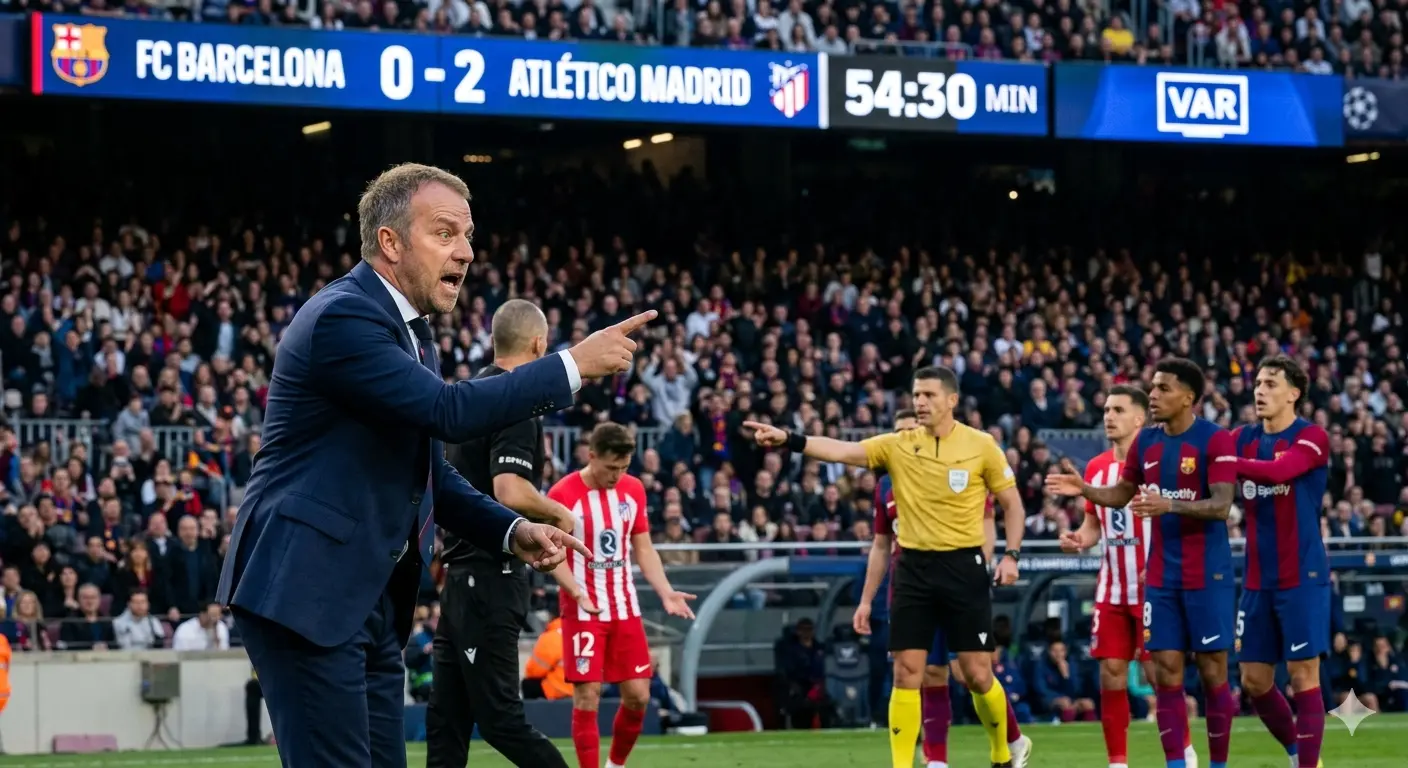
The world of European football has been rocked by a shocking administrative blow. Following the heated quarter-final clash at the Spotify Camp Nou, UEFA’s Control, Ethics and Disciplinary Body has officially declared FC Barcelona’s formal protest regarding their match against Atletico Madrid as "inadmissible." This decision effectively silences the Catalan giants' outcry over a controversial handball incident that many believe altered the course of their European season.
For Barcelona, this isn't just a rejected piece of paperwork; it’s a stinging dismissal of their pursuit of justice. The match, a high-stakes 2-0 defeat, was defined by a moment of pure chaos that left players, fans, and coaching staff in a state of unbelievable disbelief. As the dust settles, the football world is left asking: Did the system fail, or is Barcelona simply grasping at straws?
What Happened at the Camp Nou: The Scandal Explained
The focal point of this Barcelona VAR controversy occurred in the 54th minute. With Barcelona trailing and desperately searching for an equalizer, a sequence unfolded that felt more like a glitch in the matrix than a professional football match.
Atletico Madrid defender Marc Pubill appeared to handle the ball inside his own penalty area following a goal-kick sequence involving goalkeeper Juan Musso. While the Barcelona players immediately appealed for a penalty, Referee Istvan Kovacs and VAR Christian Dingert remained unmoved. The logic from the officiating team was that the ball was "not yet in play." Barcelona’s camp, however, argued that under the current Laws of the Game, a goal-kick is in play as soon as it is kicked and clearly moves.
For fans seeking exclusive match insights, the technicality of the "ball in play" rule has become the most debated paragraph in the 2026 rulebook.
Why Barcelona Protested: A Quest for Technical Justice
Barcelona’s legal team didn't just file a complaint out of spite; they built a case based on a "technical error" by the officials. In footballing law, a technical error can sometimes be grounds for a match to be replayed—though such instances are extremely rare.
The club's reasoning was two-fold:
- Rule Misapplication: They argued that the officials failed to apply the fundamental rules of the goal-kick.
- Competitive Imbalance: The error denied Barcelona a penalty and a numerical advantage, directly influencing the 0-2 result.
The Champions League refereeing controversy deepened when the club requested access to the audio recordings between Kovacs and the VAR room. They wanted to know if there was a fundamental misunderstanding of the rules or a simple lapse in judgment.
UEFA’s Official Response: Why the Protest Failed
Despite the noise coming from Catalonia, UEFA’s response was clinical and swift. By declaring the protest "inadmissible," the governing body exercised its right to uphold the "referee's field of play decisions."
"According to UEFA Disciplinary Regulations, decisions taken by the referee on the pitch are final and cannot be reviewed by the disciplinary bodies unless there is evidence of a 'mistake of identity' or a clear 'manifest error' that falls outside the scope of sporting judgment."
Essentially, UEFA ruled that while the decision might be debated, it was a "fact of the game." For those following the latest football updates, this ruling highlights the rigid nature of football's governing bodies when it comes to admitting officiating failures.
Hansi Flick’s Reaction: From Fury to Focus
Hansi Flick is usually a man of stoic German composure, but the Hansi Flick reaction VAR saga showed a different side of the manager.
"I cannot understand it," Flick told reporters. "We have VAR for a reason. If a player handles the ball in the box after it is in play, it is a penalty. It’s not about opinion; it’s about the law." However, following the UEFA rejection, Flick has pivoted, urging his players to overcome the "injustice" through sheer performance in the second leg.
Match Impact Analysis: A Night of Misfortune
While the Barcelona vs Atletico Madrid handball dominated the headlines, the match was also a tactical masterclass from Diego Simeone.
- Pau Cubarsi Red Card: The young defender was sent off just before halftime, leaving Barça vulnerable.
- Julian Alvarez & Alexander Sorloth Goals: Clinical finishes that exploited a depleted Barcelona defense.
The Atletico Madrid vs Barcelona analysis suggests that while the VAR decision was a massive decision, Barcelona's lack of clinical finishing also played a significant role. For more detailed breakdowns, visit our sports breaking news platform.
VAR Controversy in Modern Football: A Growing Divide
The football VAR controversy 2026 season has been defined by a growing disconnect between technology and common sense. The Marc Pubill incident draws comparisons to past "stop-start" handball errors that have plagued the sport. Was this a clear VAR failure? Many pundits believe so, arguing that technology was introduced to eliminate these exact "clear and obvious" errors.
Second Leg Preview: Can Barcelona Mount a Miracle?
The tie now moves to the Metropolitano for a Metropolitano second leg preview that promises to be a furnace. Barcelona faces a 2-0 deficit, a task that feels Herculean against a Simeone-led defense.
- Barcelona Strategy: High-intensity pressing and reliance on Lamine Yamal.
- Atletico Strategy: Deep block and lethal counter-attacks.
The exclusive match insights suggest that Barcelona has a history of European comebacks, but the mental hurdle of the UEFA rejects Barcelona protest may be their toughest opponent yet.
Expert Opinion: Who Benefited?
From a pundit’s perspective, the big winner here is the status quo. UEFA’s refusal to entertain the protest protects the "sanctity" of the referee’s decision, but at the cost of transparency. Barcelona has every right to feel aggrieved, but in the eyes of UEFA, the referee's whistle is the final word.
A Bitter Pill for the Blaugrana
The UEFA disciplinary decision explained in this article leaves no room for doubt: the result stands. Barcelona will travel to Madrid with a sense of "us against the world." Whether this controversy becomes the fuel for a legendary comeback or the final nail in their season remains to be seen.
1. What exactly was the "handball" incident in the Barcelona vs. Atletico Madrid match?
In the 54th minute, Atletico goalkeeper Juan Musso took a short goal-kick to Marc Pubill.Pubill then touched the ball with his hand inside the penalty area, apparently attempting to reposition it for a "restart."Barcelona argued the ball was already in play.
2. Who was the referee for the match?
The on-field referee was Istvan Kovacs (Romania), and the Lead VAR official was Christian Dingert (Germany).
3. Why didn't VAR intervene during the handball incident?
The officiating team reportedly deemed the goal-kick was not "legally" in play when the touch occurred, classifying it as a dead-ball moment rather than an active handball in the box.
4. Has referee Istvan Kovacs been punished by UEFA?
Reports indicate that UEFA has sidelined Kovacs for the remainder of the 2025-26 Champions League season, though he remains on the preliminary list for the 2026 World Cup.
5. Why did UEFA reject Barcelona’s official protest?
UEFA declared the protest "inadmissible," stating that field-of-play decisions made by referees are final and cannot be overturned by disciplinary bodies unless there is a mistake of identity.
6. What is a "technical error" in football law?
A technical error occurs when an official misapplies the Laws of the Game (e.g., miscounting yellow cards). Barcelona argued that misinterpreting the goal-kick rule was a technical error that warranted a replay.
7. Can a Champions League match ever be replayed due to VAR errors?
While the IFAB and UEFA protocols allow for protests, they explicitly state that a match is not invalidated by wrong decisions involving VAR, as VAR is considered a match official.
8. Did UEFA explain the specific reason why the handball wasn't given?
No. In their official statement on April 13, 2026, UEFA only addressed the legal admissibility of the protest rather than providing a technical breakdown of the handball itself.
9. What was Hansi Flick’s specific complaint after the game?
Flick was furious that VAR didn't prompt an on-field review, stating it should have been a "penalty and a second yellow card" for Marc Pubill, which would have resulted in a red card.
10. How did Atletico Madrid respond to the controversy?
Diego Simeone maintained a neutral stance, emphasizing that "decisions go for you and against you," and focused on the team's defensive discipline throughout the match.
11. Does this ruling affect Pau Cubarsi’s red card?
No. The UEFA decision upheld all on-field calls, meaning Pau Cubarsi remained suspended for the second leg at the Metropolitano.
12. What were Barcelona’s "legal grounds" for the protest? The club’s legal team demanded the release of audio records between the referee and VAR, citing a violation of current regulations that directly affected the match outcome.
13. What happens to the 2-0 scoreline following the UEFA verdict?
The 2-0 result is officially finalized and cannot be changed. Atletico Madrid entered the second leg with their two-goal advantage intact.
14. Was there any other controversy in the match?
Yes, the red card for Pau Cubarsi was also heavily debated. It was originally a yellow card before VAR intervened to upgrade it to a straight red for a foul on Giuliano Simeone.
15. Is this the biggest VAR controversy of the 2026 season?
Many pundits believe so, as it involves a potential "technical error" regarding a fundamental rule (the goal-kick) in a high-stakes Champions League quarter-final.