

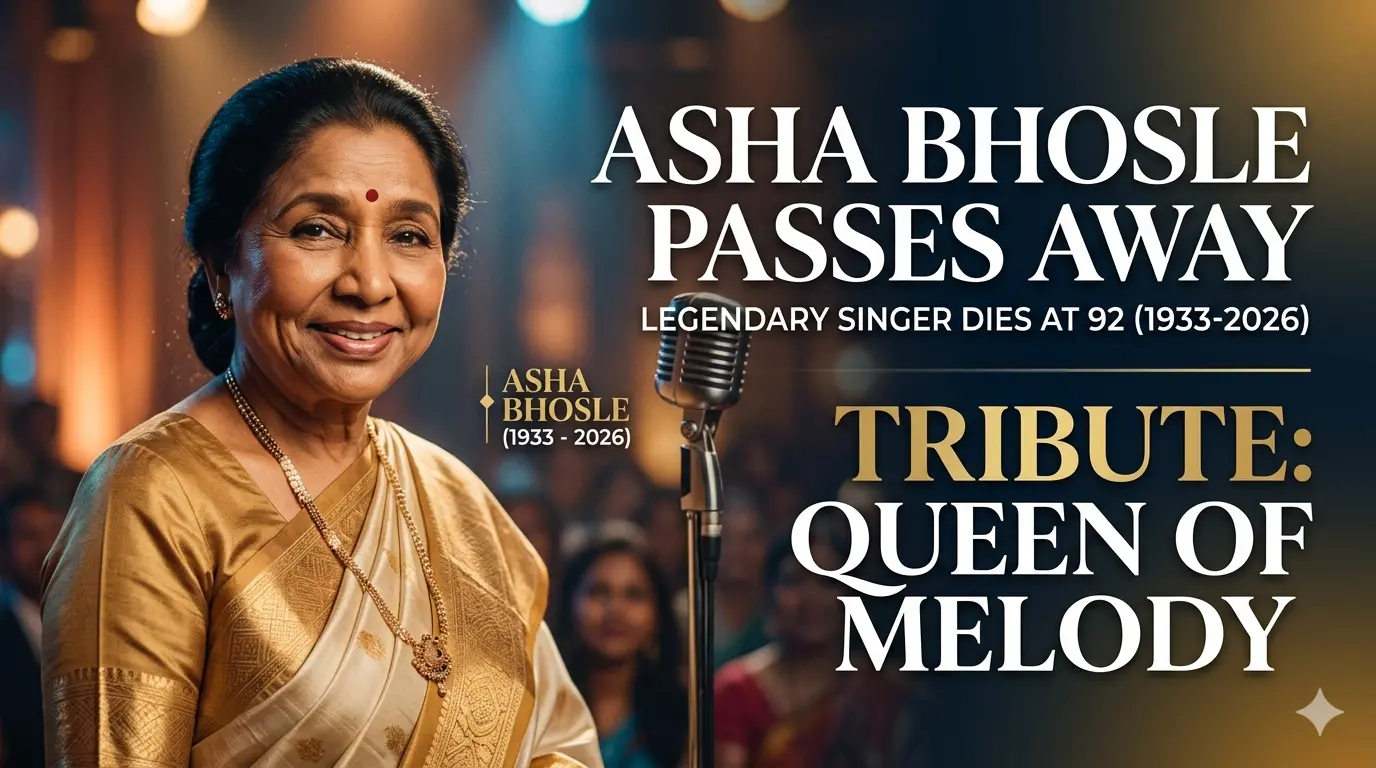
The world of music has fallen silent. A voice that defined nearly eight decades of Indian cinema, a rhythm that pulsated through the hearts of billions, and a spirit that remained eternally youthful has finally moved into the realm of legends. Asha Bhosle, the "Queen of Melody" and the ultimate "Diva of Bollywood," has passed away at the age of 92.
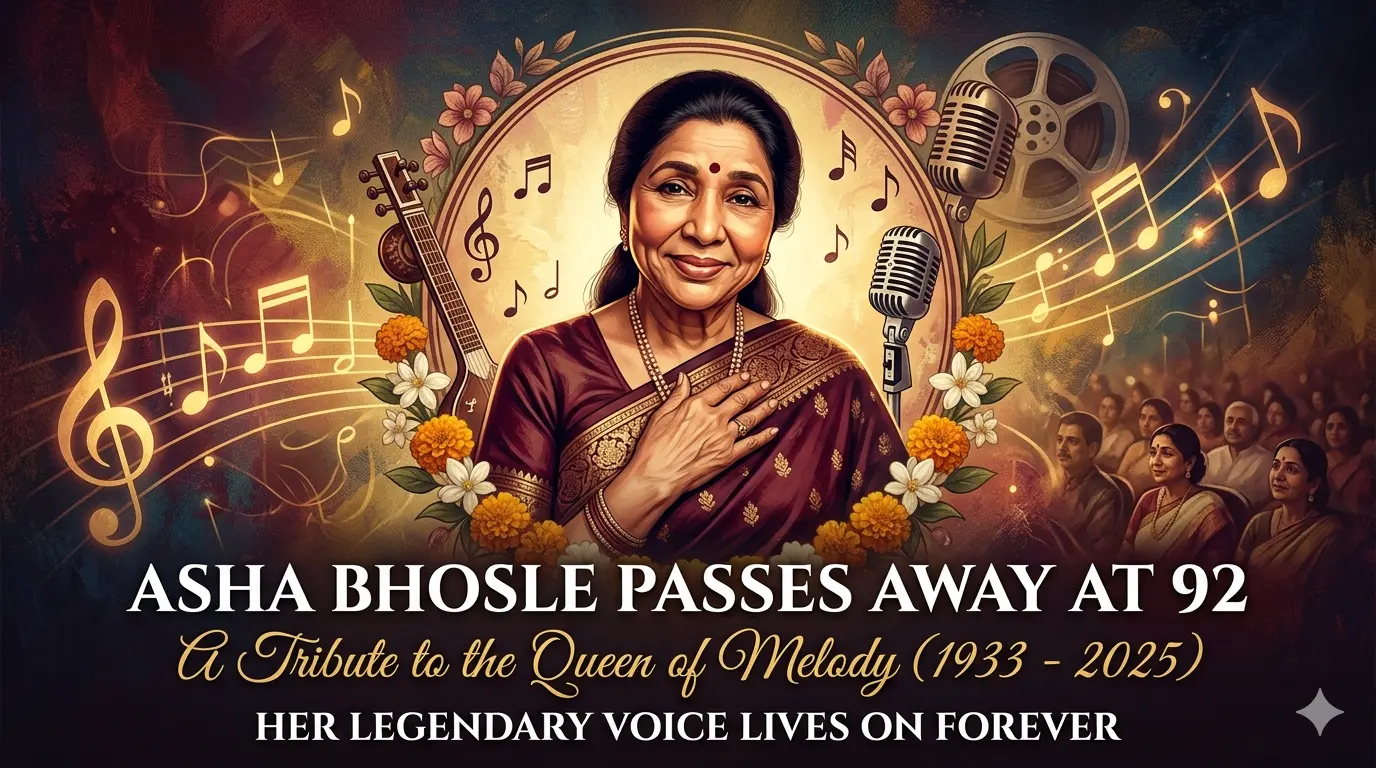
The End of a Golden Era
Can you imagine Indian cinema without the playful "Piya Tu Ab To Aaja" or the soulful "In Aankhon Ki Masti"? Today, that imagination has become a somber reality. The news of Asha Bhosle’s passing has sent shockwaves across the globe, marking the definitive end of the "Golden Age" of Indian playback singing.
For many, Asha Tai was more than just a singer; she was an emotion. While her elder sister, the late Lata Mangeshkar, was considered the "Goddess of Music," Asha was the versatile firebrand who proved that music knew no boundaries. From classical thumris to cabaret, pop, and ghazals, she conquered every genre she touched.
Topic Overview: Why Her Legacy Matters More Than Ever Today
Asha Bhosle’s journey wasn't just about singing; it was about resilience. Stepping out from the massive shadow of her sister, she carved a niche that was entirely her own. Today, as we mourn her loss, we aren't just looking at a list of songs—we are looking at the evolution of the Indian identity through sound.
In an industry that often pigeonholed female singers into "saintly" or "vamp" categories, Asha broke the mold. She gave a voice to the modern, independent, and expressive woman. Her passing is a monumental loss for cultural history, leaving a void that no AI or modern talent can ever truly fill.
Key Highlights: The Life and Times of a Legend
- Guinness World Record: Formally recognized as the most recorded artist in music history.
- Versatility King: Recorded over 12,000 songs in more than 20 Indian and foreign languages.
- Dadasaheb Phalke Award: Recipient of India’s highest cinematic honor in 2000.
- Padma Vibhushan: Awarded India’s second-highest civilian honor in 2008.
- Collaboration Queen: Worked with legends ranging from O.P. Nayyar and R.D. Burman to Boy George and Kronos Quartet.
- The Survivor: Overcame personal tragedies and professional rivalries to remain relevant for over 75 years.
Deep Analysis: The Tactical Brilliance of Her Voice
What made Asha Bhosle's voice so distinct? It was the texture and the "harkats." Unlike the linear purity of many classical singers, Asha’s voice possessed a "grain" that allowed her to express sensuality, heartbreak, and playfulness simultaneously.
1. The O.P. Nayyar Phase: Finding the Rhythm
Before Asha met R.D. Burman, it was O.P. Nayyar who realized she wasn't just a "backup" for Lata. He utilized her breath control and rhythmic precision. Songs like "Aao Huzoor Tumko" showcased a sophisticated, jazz-inflected style that was decades ahead of its time.
2. The Pancham Revolution: The Ultimate Power Couple
When she teamed up with R.D. Burman (Pancham), the world witnessed a musical explosion. Together, they brought rock, disco, and Latin influences to Bollywood. "Dum Maro Dum" became the anthem of a generation, and Asha’s voice was the fuel for that fire.
3. The Ghazal Transformation: Umrao Jaan
Just when critics thought she was only for "peppy" numbers, she delivered Umrao Jaan. Under Khayyam’s direction, she lowered her pitch to sing ghazals like "Dil Cheez Kya Hai." This performance remains a masterclass in vocal adaptation and emotional depth.
Key Factors That Decided Her Iconic Status
- Range: She could sing a bhajan in the morning and a club dance number in the evening without losing authenticity.
- Adaptability: While her contemporaries struggled with the changing sounds of the 90s and 2000s, Asha collaborated with Adnan Sami and A.R. Rahman, staying at the top of the charts.
- Live Performance: Her energy on stage at age 80 was higher than most performers in their 20s. She understood the psychology of the audience.
Expert Analysis: What to Expect Next for Her Catalog
The passing of a legend usually triggers a "Legacy Spike" in digital consumption. Here is what we expect to see in the coming weeks:
- Streaming Surge: Expect Spotify and YouTube charts to be dominated by "Best of Asha Bhosle" playlists.
- Tribute Concerts: Global musical icons will likely host televised tributes, especially in the UK and US where she had a massive following.
- Unreleased Gems: There are rumors of hundreds of unreleased tracks in various regional languages that may now see the light of day.
Stats, Records & Historical Trends
Category | Statistic / Detail |
|---|---|
Total Songs | Estimated 12,000+ |
Languages | 20+ (including English, Russian, and Malay) |
Filmfare Awards | 7 (She eventually stopped accepting them to give younger talent a chance) |
First Song | "Chala Chala Nav Bala" (1943) |
Major Milestone | First Indian singer to be nominated for a Grammy (2006) |
Fan Reactions: The Global Digital Wake
Social media is currently a sea of nostalgia. From #AshaBhosle to #QueenOfMelody, the trending hashtags show a cross-generational grief.
- Bollywood Stars: Virtually every major actor, from Amitabh Bachchan to Shah Rukh Khan, has shared personal anecdotes of her warmth.
- The Global Impact: Fans from Pakistan, Bangladesh, and the UK are sharing clips of her live concerts, proving that her music transcended borders.
- The "Asha Tai" Memes: Fans are celebrating her "savage" wit and love for cooking (her famous restaurants) alongside her musical genius.
A Voice That Will Never Fade
Asha Bhosle didn't just sing songs; she provided the soundtrack to our lives. Whether it was the rebellion of youth, the pain of a broken heart, or the joy of a new beginning, Asha Tai had a melody for every moment.
While her physical presence is gone, her voice remains etched in the digital and spiritual ether of India. She taught us that age is just a number and that passion is the only true fountain of youth.
What is your favorite Asha Bhosle memory? Share your favorite song in the comments below and let's celebrate the life of the greatest ever.
People Also Ask
Q: What was Asha Bhosle’s age at the time of death?
A: Asha Bhosle passed away at the age of 92, leaving behind a legacy that spanned over eight decades in the music industry.
Q: What is the cause of Asha Bhosle’s death?
A: According to official reports, she passed away due to age-related complications at her residence, surrounded by family members.
Q: How many songs did Asha Bhosle sing?
A: She is credited with recording over 12,000 songs, making her one of the most prolific singers in human history according to the Guinness World Records.
Q: Who is Asha Bhosle’s famous sister?
A: Her elder sister was the legendary "Nightingale of India," Lata Mangeshkar, who passed away in February 2022.
Q: Where can I watch Asha Bhosle's last interview?
A: Her final major interviews are available on platforms like YouTube (Lehren Retro and Prasar Bharati archives) and select OTT platforms like SonyLIV.
Q: Did Asha Bhosle win a Grammy?
A: While she didn't win, she was the first Indian singer to be nominated for a Grammy Award in the Best Contemporary World Music Album category in 2006.
Q: What are Asha Bhosle’s most famous songs?
A: Some of her iconic tracks include "Dum Maro Dum," "Piya Tu Ab To Aaja," "Chura Liya Hai Tumne," and "Dil Cheez Kya Hai."
Q: Was Asha Bhosle married to R.D. Burman?
A: Yes, she was married to the legendary music composer Rahul Dev Burman (Pancham) from 1980 until his death in 1994.
Q: How many National Awards did Asha Bhosle win?
A: She won two National Film Awards for Best Female Playback Singer for the films Umrao Jaan (1981) and Ijaazat (1986).
Q: Is there a movie about Asha Bhosle’s life?
A: While a formal biopic hasn't been released, several documentaries and her acting debut in the film Mai provide deep insights into her life.
Q: Where to stream Asha Bhosle's hit songs?
A: You can stream her entire catalog on Spotify, Apple Music, Gaana, and YouTube Music.
Q: What is Asha Bhosle's net worth?
A: While figures vary, her wealth came from a lifelong singing career, global tours, and her successful international restaurant chain, "Asha's."
Q: How many languages did Asha Bhosle sing in?
A: She sang in over 20 languages, including Hindi, Marathi, Bengali, Gujarati, Punjabi, Tamil, and even English.
Q: When is the funeral of Asha Bhosle?
A: The state funeral is expected to take place in Mumbai, with details being updated by the family and local authorities.