

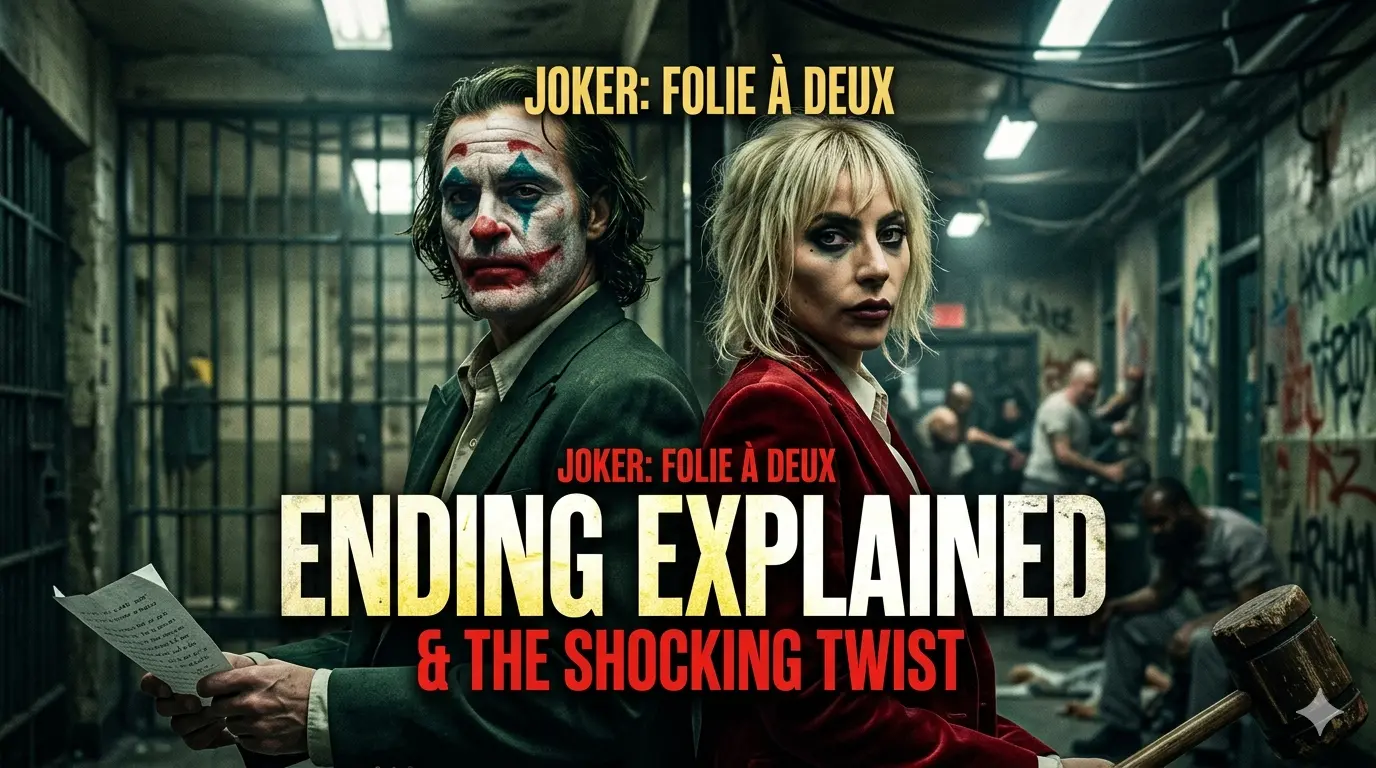
What if everything you thought you knew about the Clown Prince of Crime was a lie? When the credits rolled at the early screenings of Joker: Folie à Deux, the silence in the theater was deafening. No cheers. No standing ovations. Just a collective, audible gasp.
Director Todd Phillips didn’t just make a sequel; he staged a trial for the audience itself. If you’re looking for a traditional comic book movie payoff, you’re in the wrong place. This isn’t a rise-to-power story—it’s a brutal, musical, and psychological deconstruction of a man who never wanted to be a symbol.
In this deep dive, we break down that shocking ending, the fate of Arthur Fleck, and why the internet is currently in a state of absolute meltdown.
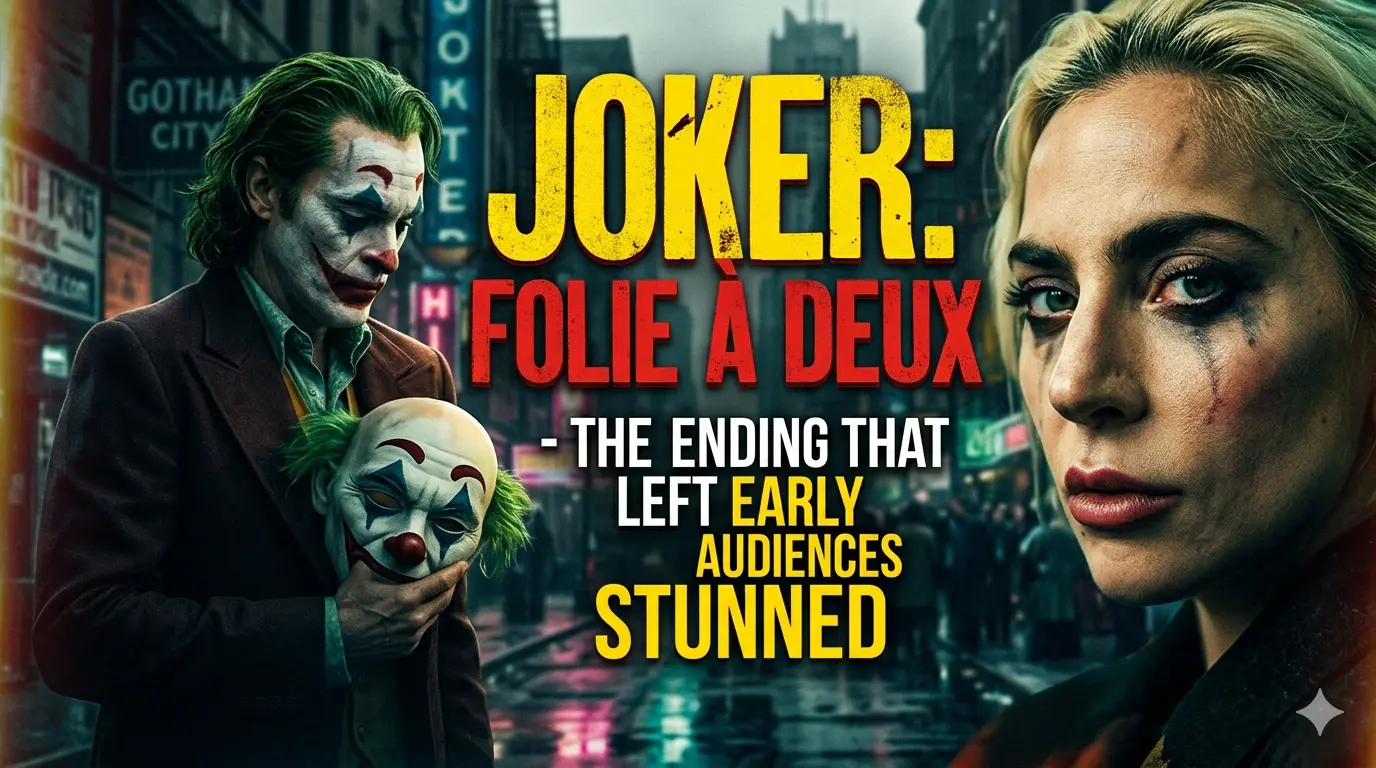
The Joker 2 Phenomenon: Why It Matters Today
The first Joker (2019) was a cultural lightning bolt. it grossed over $1 billion and secured Joaquin Phoenix an Oscar. But Folie à Deux arrives in a different world. It’s no longer just a movie; it’s a litmus test for how we consume "villain" stories.
Today, the sequel is trending not just for its star power—with Lady Gaga joining as Lee Quinzel (Harley Quinn)—but for its sheer audacity. It dares to ask: Do we love Arthur Fleck, or do we just love the chaos he creates?
Key Highlights: The "Folie à Deux" Quick Summary
- The Transformation: Arthur Fleck is no longer "The Joker" for much of the film; he is a broken man facing the legal consequences of the first movie.
- The Musical Element: The film uses musical numbers as a window into Arthur and Lee's shared delusion (Folie à Deux).
- The Courtroom Climax: Arthur fires his lawyer and represents himself, initially embracing the Joker persona before a massive pivot.
- The Final Act: A literal and metaphorical explosion changes the trajectory of the DC multiverse forever.
- The "New" Joker: The film’s ending introduces a twist that redefines who the "real" Joker actually is.
Deep Analysis: The Deconstruction of a Myth
The core of Joker: Folie à Deux is the trial of the century. Arthur Fleck is being tried for the five murders he committed in the first film (plus the off-camera murder of his mother).
The Identity Crisis
While the world outside the courthouse is burning—with protesters wearing clown masks and demanding his "liberation"—Arthur is rotting in Arkham. Lady Gaga’s Lee Quinzel is the catalyst. She doesn't fall for Arthur; she falls for The Joker. This is the film’s most tragic layer.
The Musical Delusion
The musical sequences aren't "real." They are the internal language of Arthur’s madness. When he sings, he is powerful. When the music stops, he is a frail man with a cough and a bad back. The shift from the colorful stage to the grey reality of a prison cell is a tactical move by Phillips to keep the audience grounded in Arthur’s misery.
The Big Twist: The Renunciation
In the final courtroom scene, Arthur does the unthinkable. He drops the act. He admits that there is no "Joker"—it was just him. He confesses to the murders as Arthur Fleck. In doing so, he breaks the "Folie à Deux" (the shared madness) he had with Lee and his followers. He kills the symbol to save his soul, but in doing so, he loses everything.
Key Factors That Decided the Outcome
- Lee Quinzel’s Betrayal: Lee was never a victim. She was a manipulator who wanted a god to worship. When Arthur admits he’s just a man, she abandons him on the very stairs where he once danced.
- The Arkham Environment: The brutality of the guards (led by Brendan Gleeson) pushed Arthur to a breaking point where the "Joker" persona was no longer enough to protect him.
- Public Expectation: The film mirrors the real-world audience. We wanted a riot; Arthur gave us a confession.
Expert Prediction: What Does This Mean for the DCU?
There are two ways to look at this ending:
Scenario A: The Standalone Conclusion Todd Phillips has stated he is done with the DC world. This ending serves as a definitive "The End" for Arthur Fleck. It is a closed loop that critiques the violence of the first film.
Scenario B: The "Real" Joker Begins Without spoiling the final scene's specific action, the film strongly suggests that Arthur Fleck was merely the inspiration for the Joker we see in Batman’s future. He was the spark, but not the fire. This opens a "multiverse-lite" door where the "True Joker" is someone much more nihilistic and younger.
Stats, Records & Historical Context
- Budget: Reportedly $200 million (nearly 4x the original's budget).
- First Movie: 11 Oscar nominations, 2 wins.
- Lady Gaga Effect: Social media mentions for the film spiked 300% following the announcement of her casting.
- Runtime: 138 minutes of psychological tension.
Fan Reactions: The Viral Buzz
Social media is divided. On X (formerly Twitter), the hashtag #Joker2 is filled with fans either praising the "bold deconstruction" or venting frustration over the "lack of action."
- "Todd Phillips just trolled the entire world, and I kind of love him for it," one viral post reads.
- "Gaga deserved more screen time, but that ending... I’m still shaking," says another.
A Legacy of Chaos
Joker: Folie à Deux is not the movie people wanted, but it might be the movie we deserved. It challenges our obsession with "cool" villains and forces us to look at the human being behind the paint. Whether you love or hate the ending, one thing is certain: people will be talking about Arthur Fleck’s final "joke" for decades.
What do you think? Was the ending a masterpiece or a mistake? Join the discussion in the comments below!
People Also Ask
1. Does Arthur Fleck die at the end of Joker 2?
Yes. In a shocking final sequence in Arkham, Arthur is approached by a young, unnamed inmate who tells him a joke and then brutally stabs him to death.
2. Who is the "Real" Joker?
The film suggests that the inmate who kills Arthur is the "true" Joker. As Arthur dies, the inmate can be seen in the background carving a "Glasgow Smile" into his own face with a shiv.
3. Why did Lady Gaga’s Harley Quinn leave Arthur?
Lee was in love with the "Joker" mythos, not the man. When Arthur renounced the persona in court, he became "boring" to her.
4. Is there a post-credits scene in Joker: Folie à Deux?
No, there is no post-credits scene. The story concludes entirely before the credits roll.
5. Where can I watch Joker 2?
The film is currently in exclusive theatrical release. It will likely be available on Max (formerly HBO Max) approximately 45–90 days after its premiere.
6. Is Joker 2 a musical?
It is a psychological drama with musical elements. The songs take place within the characters' imaginations.
7. Why is it called Folie à Deux?
It is a French psychiatric term meaning "madness for two," referring to a delusion shared by two people in close association.
8. Does Batman appear in Joker 2?
No. This remains a character study focused strictly on Arthur Fleck and Lee Quinzel.
9. Will there be a Joker 3?
Director Todd Phillips and Joaquin Phoenix have both indicated that this is the end of Arthur Fleck’s story.
10. Is it available to stream online?
Not legally. It is currently only in theaters. Avoid "free" streaming sites as they often contain malware.
11. What is the age rating for Joker 2?
It is rated R for strong violence, language, and some sexuality/nudity.
12. Did Arthur Fleck actually have a son?
No, that was part of the delusions and false narratives discussed during the trial.
13. What happened to Sophie (Zazie Beetz) from the first movie?
Sophie appears as a witness in the trial, providing a grounded, heartbreaking perspective on Arthur’s actions from the first film.
14. What time does the movie start?
Check your local cinema listings (AMC, Regal, or Cinemark) as showtimes vary by location.
15. Is Joker 2 worth watching in IMAX?
Yes, the cinematography by Lawrence Sher and the musical score by Hildur Guðnadóttir are designed for the largest possible format.