
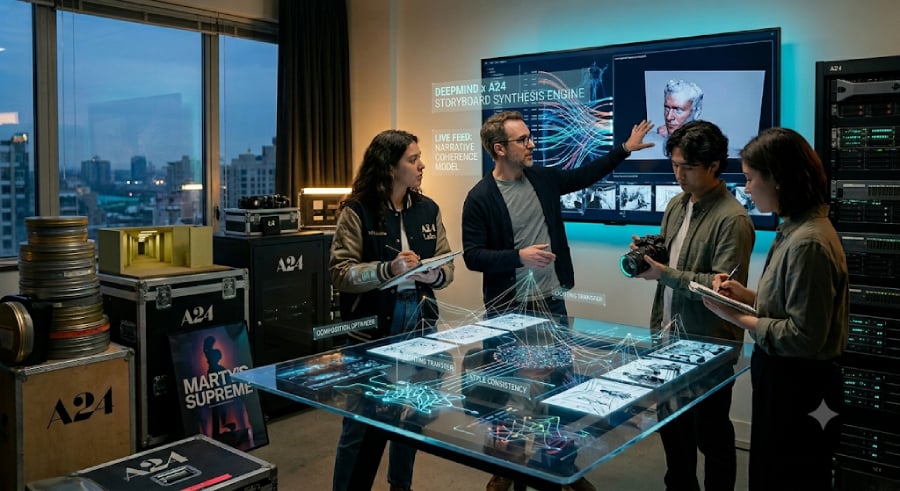
Google has taken a significant step into the entertainment industry by investing approximately $75 million in independent film studio A24. The investment is part of a new artificial intelligence research partnership between Google DeepMind and A24, marking the first time the tech giant has taken a financial stake in a Hollywood studio. The multiyear, nonexclusive agreement is designed to develop AI tools for filmmaking and distribution, with a focus on preserving creative control rather than replacing human artistry. This move signals a deeper integration of Silicon Valley’s AI capabilities into the heart of Hollywood’s creative process, but it also raises crucial questions about the future of filmmaking in an era of rapid technological change.
A24, founded in 2012, has built a fierce following by championing unconventional, auteur-driven stories that resonate deeply with younger audiences. Films like Moonlight, Lady Bird, and Everything Everywhere All at Once have cemented its status as a cultural powerhouse known for elevating marginalized voices and risk-taking narratives. Over the last two years, the studio's revenue has more than doubled as it expands into unscripted television, theater, and international production, including a new office in the United Kingdom. Its most ambitious project to date is a $175 million adaptation of the video game Elden Ring, directed by Alex Garland, which will test the limits of large-scale independent production.
The Partnership and Its Philosophy
The collaboration between Google DeepMind and A24 is structured as a deep research and development initiative, with researchers and filmmakers working side by side to explore new creative workflows. Eli Collins, Vice President of Product at Google DeepMind, explained that the program aims to help artists develop new techniques and ensure that the tools of the future are shaped by the creators who use them. Unlike previous Hollywood deals that emphasized cost reduction and speed, this partnership focuses on enhancing the creative process. A24 Labs, the studio’s 20-person technology division led by Scott Belsky, is building an application dedicated to AI-generated storyboards. These rough draft sketches help visualize scenes, experiment with lighting and camera angles, and identify logistical issues before physical production begins.
Belsky emphasized that the incoming suite of tools will not resemble the prompted-generation type of AI that has made many in the industry uncomfortable. “We think there are better uses that preserve creative control and support risk-taking,” Belsky said, contrasting their approach with tech developers who historically pitched AI as a way to make films cheaper and faster—a concept that alienated many artists. By focusing on pre-production tasks, the AI tool aims to reduce inefficiencies without compromising the director’s vision. For independent filmmakers with limited budgets, the ability to rapidly iterate storyboards could unlock new levels of experimentation and planning.
Hollywood’s Tense Relationship with AI
The alliance comes at a time when entertainment and tech sectors have frequently clashed over generative AI. Models capable of cloning audio, imagery, and video have sparked lawsuits, strikes, and public debates. The 2023 SAG-AFTRA strike included strong language around AI protections, with actors and writers demanding safeguards against digital replication. Other studios have taken varied approaches: Disney had a short-lived partnership with OpenAI, while Lionsgate struck a deal with Runway AI. Mainstream filmmaking has largely resisted widespread AI integration, wary of the reputational and legal risks. A 2023 Pew Research study, cited by Variety, found that roughly half of adults under 30 believe AI will harm society. This poses a particular risk for A24, whose opening-weekend audience for the hit film Backrooms was 85% under 35—a demographic that is both tech-savvy and skeptical of unchecked automation.
However, proponents of AI in film argue that the technology has been used in subtle ways for years. Digital de-aging in films like The Irishman, background generation in The Mandalorian, and AI-assisted script analysis have all become common. The difference now is the speed and accessibility of generative tools, which can produce entire scenes from text prompts. A24’s focus on storyboarding avoids the most contentious applications while still providing tangible benefits. Storyboarding is a time-consuming and often expensive step in pre-production; AI can generate multiple versions in minutes, allowing filmmakers to explore creative choices that might otherwise be impractical due to budget or time constraints.
Broader Implications for Hollywood and Tech
Google’s investment in A24 represents a broader trend of tech companies seeking cultural legitimacy and real-world testbeds for their AI systems. DeepMind, known primarily for its work in protein folding and game playing, has been expanding into creative applications. The A24 partnership gives DeepMind access to top-tier creative talent and a high-profile showcase for its models. In return, A24 gains financial support and technical expertise without sacrificing its independence. The $75 million cash injection is modest by Google’s standards but strategically significant: it marks the first time the search giant has taken a direct financial stake in a film studio.
Historically, tech involvement in Hollywood has been fraught. Early attempts like IBM’s Watson creating a movie trailer or the use of AI in script writing were met with skepticism. The entertainment industry has long feared that AI could commoditize creativity, reducing the value of human intuition and experience. The A24-Google deal attempts to sidestep these fears by emphasizing collaboration over replacement. If successful, it could serve as a template for other studios, demonstrating that AI can enhance the filmmaking process without undermining the artistic vision.
Yet challenges remain. The partnership must navigate ongoing regulatory scrutiny of AI, particularly around copyright and data usage. Training AI models on copyrighted material is a legal gray area that has already led to lawsuits against companies like OpenAI. A24 and Google will need to ensure that their storyboarding tool is trained only on properly licensed or publicly available data. Additionally, the cultural tension between tech efficiency and artistic expression requires constant negotiation. A24’s existing fanbase, known for its passionate loyalty, will be watching closely. Any misstep could damage the studio’s hard-won reputation as a champion of authentic, human-centered storytelling.
Future Milestones and Evolving Goals
DeepMind has indicated that the specific milestones and technical outputs of the partnership will continue to evolve across multiple projects over time. The open-ended nature of the agreement allows for experimentation with different film genres, scales, and production stages. Initially focused on storyboarding, the collaboration could later expand into AI-assisted editing, sound design, or even distribution analytics. For now, A24 is eager to demonstrate that technology can be a tool for empowerment rather than a threat. The studio’s expansion into the UK and its largest-ever budget project, the Elden Ring adaptation, will provide early test cases for AI-assisted workflows.
In parallel, Google benefits from real-world feedback that can improve its AI models for broader creative applications. The partnership also positions Google as a more friendly player in Hollywood compared to competitors like Microsoft or Amazon, which have faced criticism for their AI strategies. As the line between technology and entertainment continues to blur, the A24-Google deal may be remembered as a pivotal moment when an indie studio helped define the ethical use of AI in film. The ultimate measure of success will not be the technical sophistication of the tools, but whether they enable filmmakers to tell more ambitious stories with greater confidence and creative control.
Source: TechRepublic News