

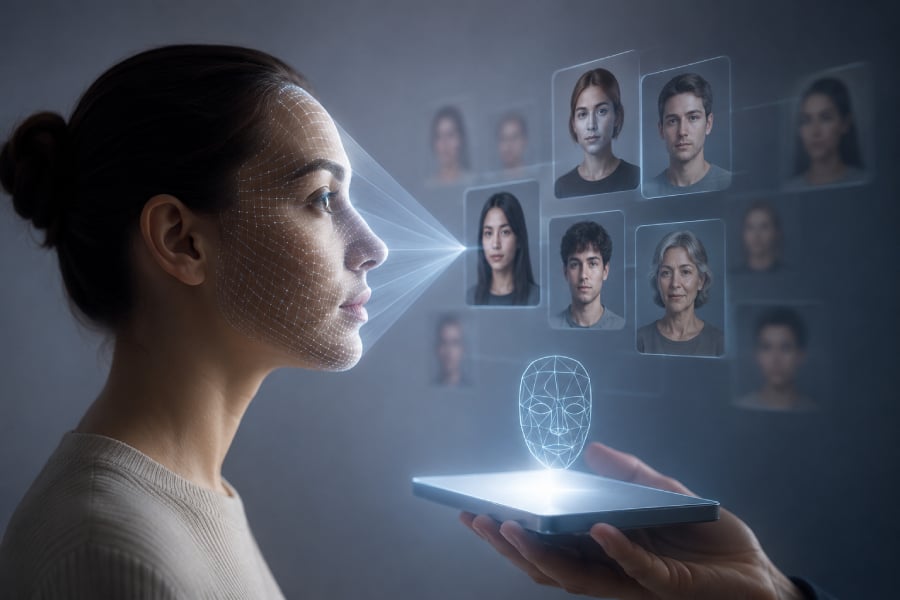
China's generative AI boom has spawned an unexpected side hustle: renting out your face. A growing number of online platforms are now compensating individuals for the right to use AI-generated versions of their likeness in films, commercials, and short-form videos. Instead of hiring actors for every production, content creators can browse a catalog of pre-approved digital identities and license them for a single project or for continuous use.
Key Facts
- Chinese platforms ActID and New Claw pay people to license their faces for AI-generated videos.
- Participants can earn between $15 and $700 depending on the licensing terms and type of project.
- Over 95% of the 128,000 microdramas released in China in the first three months of 2026 featured AI.
- ActID monitors the internet for nonconsensual use of participants' images and provides legal assistance when misuse is detected.
- Netflix has used generative AI in around 300 productions.
The Rise of AI-Generated Microdramas
Microdramas are short serialized videos, often just a few minutes per episode, designed to be consumed on mobile devices. They have become wildly popular across Chinese social media platforms thanks to their punchy storytelling and low production costs. The format is also uniquely suited to generative AI, since it requires many episodes of visual content with relatively simple sets and characters. As a result, AI has flooded this corner of the entertainment industry.
In the first three months of 2026, more than 95 percent of the 128,000 microdramas released in China reportedly incorporated AI-generated elements. That statistic signals how quickly synthetic media has moved from experimental to mainstream. It also explains the growing backlash from people who discovered their faces being used in AI-generated videos without permission. In response, a new type of platform has emerged to provide a consent-based alternative: a legal marketplace where individuals can voluntarily license their facial likeness.
How Face Licensing Works
The process begins when an individual signs up on a platform such as ActID or New Claw. They can upload photos of themselves directly through an app, or they can visit a partner studio where high-quality images of their face are captured under controlled conditions. Once the images are in the system, the participant decides how their likeness may be used. They can impose limitations on the types of projects that can feature their face, set geographic or time-based restrictions, and define how long the license remains valid.
After the participant approves the terms, their likeness is placed into a searchable catalog. Producers working on AI-generated videos can browse that catalog and select digital performers based on traits such as age, appearance, and style. Each time a likeness is selected, the platform handles the licensing agreement and payment. For producers, this reduces the cost and logistical burden of hiring human actors. For participants, it transforms their own face into a digital asset that can generate income while they sleep.
Earnings and Demand
The financial rewards vary widely. According to reports, people participating in these programs can earn anywhere from $15 to $700, depending on the scope of the license, the duration of the project, and the distribution audience. A retiree who rarely makes public appearances might earn a modest fee for a niche advertisement, while a model with a distinctive look could command hundreds of dollars for an exclusive licensing deal.
In an interview about the business model, Long Lyu, operations head at New Claw, explained that licensing a person's face for AI-generated films is significantly less expensive than hiring someone to appear on set. That economic reality is reshaping production budgets. A company that would have previously paid for several days of filming, hair and makeup, wardrobe, and talent fees can now license a digital likeness for a fraction of the cost and insert it into a scene with a few clicks.
Consent, Monitoring, and Legal Protection
Face-licensing platforms position themselves as ethical alternatives to nonconsensual deepfakes. ActID, for example, says it monitors the internet for unauthorized uses of its participants' images. If someone's licensed face is detected in a video they did not approve, the platform offers legal help to stop the misuse. This monitoring function is critical because the threat of deepfakes has grown rapidly. Unauthorized videos can damage reputations, spread disinformation, or be used in fraudulent schemes.
Still, no platform can guarantee perfect security. The very biometric data that makes face licensing valuable is also a high-value target for hackers. If a database containing thousands of facial scans is breached, those faces could be used for identity theft, extortion, or the creation of explicit content without the individual's knowledge. Contractual safeguards and monitoring provide some protection, but they cannot eliminate every risk. Digital likenesses, once leaked, can be copied and manipulated almost infinitely.
A Changing Entertainment Landscape
The move toward licensed AI performers is not limited to China. Netflix has already revealed that it used generative AI in about 300 of its titles, demonstrating the technology's mainstream appeal. Yet China's face-rental marketplaces go further by creating a structured commercial infrastructure around synthetic actors. In this emerging ecosystem, a digital performer can be reused across dozens of projects, with the person whose face was licensed receiving a payment each time.
This development raises profound questions about digital ownership. If a person's likeness is used to create a character, who controls that character? What happens if the original person changes their appearance, or if they want to revoke consent after a project is released? Can a license be truly revoked once AI-generated content is distributed online? These are unanswered questions that courts and regulators will likely need to address.
The Darker Side of AI Face Swaps
The growth of legitimate face licensing comes at a time when nonconsensual AI image generation continues to thrive. A recent investigation found that Facebook and Instagram served thousands of advertisements promoting AI 'nudify' applications through a China-based advertising partner, despite Meta's policies prohibiting such content. These apps allow users to strip clothing from photos of real people without their permission, fueling harassment, extortion, and gender-based abuse.
The contradiction is striking. On one hand, companies are attempting to build an ethical market for AI-generated likenesses by obtaining clear consent and offering compensation. On the other, the same technology is being used to create deceptive content at massive scale, often targeting women and minors. Both developments highlight the urgent need for transparency, enforcement, and legal frameworks that treat a person's face as uniquely protected biometric data.
As facial likenesses become tradable digital assets, the boundaries between personhood, property, and data begin to blur. Face-licensing platforms illustrate how generative AI is transforming the economics of content creation, but they also expose the fragility of consent in a world where anything can be synthetically reproduced. The future of digital identity will depend not only on innovative business models, but also on the rules societies create to protect individuals from the unintended consequences of their own digital doubles.
Source: TechRepublic News