

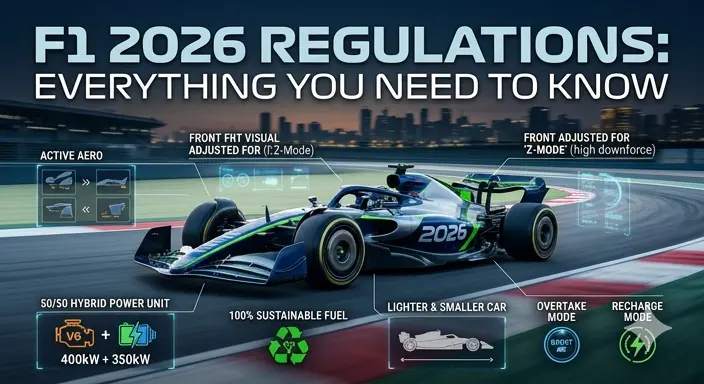
Formula 1 is a sport that never stands still, but every decade or so, it undergoes a transformation so radical that it resets the hierarchy of the entire grid. If you are a new fan looking to understand the future of the sport, you’ve come to the right place. This beginner’s guide to Formula 1 2026 regulations will break down the massive technical, sporting, and aerodynamic shifts that will redefine how the world’s fastest cars compete.
The year 2026 marks a historic turning point. We aren’t just looking at a few minor tweaks; we are looking at a complete overhaul of the F1 hybrid power unit changes, a move toward sustainable fuels, and the introduction of "active aerodynamics." Whether you’re a lifelong "Tifosi" or a newcomer via Drive to Survive, the 2026 season is when the slate is wiped clean.
Quick Summary: The 2026 Rule Changes at a Glance
- Engines: 50/50 split between internal combustion and electric power.
- Fuel: 100% sustainable "drop-in" synthetic fuels.
- Aerodynamics: Active "Movable" wings for straights (low drag) and corners (high downforce).
- Overtaking: DRS is gone, replaced by a "Manual Override" boost system.
- Size: Cars are becoming smaller, narrower, and lighter.
- Grid: Potential for 11 teams and 22 cars on the starting line.
Why 2026 is a Major Turning Point in Formula 1
In the world of Grand Prix racing, regulations act as the "rulebook" that designers and engineers must follow. Historically, these rules change in cycles to keep the sport competitive, safe, and relevant to the automotive industry.
The Formula 1 2026 regulations explained in this guide represent the sport's commitment to "Net Zero" carbon goals while simultaneously fixing some of the racing issues found in the current generation of cars. Fans often complain that the current cars are too heavy and bulky for tight tracks like Monaco. The 2026 rules aim to fix this by creating "nimble" cars that can follow each other closely without losing grip.
Revolutionary Power Unit Changes: The Heart of 2026
The biggest talking point of the new F1 engine rules 2026 is the shift in how the car generates power. Since 2014, F1 has used V6 Turbo Hybrid engines. However, the electric component has always played a secondary role.
The 50-50 Hybrid Power Split
In 2026, the power balance shifts. The 1.6-liter V6 engine will produce less power (dropping from around 550kW to 400kW), while the battery system (the ERS) will triple its output. This creates an almost perfect 50/50 split between the petrol engine and the electric motor.
Sustainable Fuels
F1 is ditching traditional fossil fuels. The 2026 cars will run on 100% sustainable fuels. These are lab-created fuels that don't add new CO2 to the atmosphere. This is a game-changer for the "Future of Formula 1," as it proves high-performance racing can exist without destroying the planet.
Goodbye MGU-H
For the tech-heads: F1 is removing the MGU-H (Motor Generator Unit - Heat). This was a complex piece of tech that recycled heat from the turbo. By removing it, the engines become cheaper and easier for new manufacturers—like Audi and Ford—to join the sport.
Recharge Mode Explained: The Art of Energy Management
Because the electric motor is now so powerful, the battery will drain much faster. This introduces a new tactical layer: Recharge Mode.
How Energy Harvesting Works
In 2026, the car will harvest energy primarily through braking. When a driver hits the brakes, the kinetic energy is captured and stored in the battery. In the 2026 era, "lift and coast" (where a driver lets off the gas before a corner) will be vital to ensure the battery is full for the next straightaway.
Strategic Importance
Drivers will have to choose when to recharge. If a driver defends aggressively and uses all their battery power, they might "derate" (run out of electric juice) on the next lap, making them a sitting duck. You’ll hear engineers on the radio constantly talking about "SOC" (State of Charge).
Boost Button Strategy: Attack vs. Defense
The F1 hybrid power unit changes introduce a "Manual Override" mode. Think of this as a "Boost Button" similar to what you might see in a video game or IndyCar’s "Push to Pass."
- Attack Scenarios: When a driver is trailing another car, they can deploy extra electrical energy to pull alongside.
- Defense Scenarios: The leading car has a limited amount of energy to defend. If they use it too early, they won’t have anything left for the end of the straight.
This shift makes energy management a core driver skill. It’s no longer just about who has the fastest car, but who uses their "battery budget" most effectively. To learn more about racing insights, fans should watch how drivers manage their energy during qualifying versus the race.
Overtake Mode: Replacing DRS
Since 2011, F1 has used DRS (Drag Reduction System), where a trailing car opens its rear wing to gain top speed. In 2026, F1 overtake mode explained looks very different.
DRS as we know it is being phased out in favor of a power-based system. Instead of just opening a wing, the car behind will be granted extra electrical deployment once they reach a certain speed.
Key Differences from DRS:
- DRS: Relying purely on wind resistance/aerodynamics.
- Overtake Mode: Relying on a surge of electrical horsepower.
- Skill Gap: It requires the driver to be more precise with their timing, rather than just waiting for a "DRS Zone."
Active Aerodynamics: Straight Mode vs. Corner Mode
One of the most sci-fi elements of the F1 2026 rules is "Active Aero." For the first time, both the front and rear wings will move during a lap to optimize performance.
The Two Modes:
- Z-Mode (High Downforce): This is for the corners. The wing flaps open up to push the car into the ground, giving the tires maximum grip.
- X-Mode (Low Drag): This is for the straights. The flaps flatten out, reducing air resistance and allowing the car to reach higher top speeds.
Why It’s a Game Changer
In current F1, teams have to find a "compromise" setup. In 2026, the car adapts to the track in real-time. This prevents the cars from "stalling" on the straights due to the massive drag created by the 2026 engine's energy recovery needs.
Smaller, Lighter Cars: The "Nimble Car" Concept
A major criticism of the 2022-2025 era is that the cars are "boats"—too heavy and too wide. The how F1 cars work 2026 philosophy focuses on a "nimble" chassis.
- Weight Reduction: The cars will be 30kg lighter (dropping from 798kg to 768kg).
- Dimensions: The wheelbase (length) is being shortened by 200mm, and the width is being narrowed by 100mm.
- Tires: While the 18-inch wheels remain, the tires will be slightly narrower, reducing "dirty air" for the car behind.
Safety Innovations
Formula 1 never compromises on safety. The Formula 1 beginner guide 2026 wouldn't be complete without mentioning the structural improvements:
- Two-Stage Nose Cone: Designed to absorb more energy during front-on impacts.
- Stronger Roll-Hoop: Following Zhou Guanyu’s 2022 Silverstone crash, the 2026 cars will feature even more rigid structures to protect the driver's head if the car flips.
- Side-Impact Protection: Improved structures to handle "T-bone" style collisions.
New Aerodynamic Philosophy: Cleaning up the Air
The 2026 regulations are removing the "ground-effect tunnels" that define the 2022 cars. Instead, they are moving toward a partially flat floor and simplified wings.
The goal? Closer racing. By simplifying the aerodynamics, the "wake" (turbulent air) behind a car is reduced. This allows the car behind to follow closely through corners without their front tires overheating or losing grip. This is the ultimate goal of the F1 rule changes impact.
New Teams and Grid Expansion
2026 isn't just about new technology; it’s about new faces.
- Audi: Joining as a full factory team after taking over Sauber.
- Ford: Returning to the sport in partnership with Red Bull Powertrains.
- 11th Team Rumors: With the new regulations, there is significant pressure and interest from groups like Andretti Global to join the grid.
Qualifying Format Changes
While not finalized, there are discussions about adjusting the 11-team qualifying format. With 22 cars on track, the "knockout" segments (Q1, Q2, Q3) may be adjusted to ensure the track doesn't become too crowded during flying laps.
How These Changes Will Impact Racing
If you're asking, "Will the racing be better?" the answer is a resounding yes.
- More Overtakes: The combination of active aero and the manual override boost should create more passing opportunities throughout the lap, not just at the end of long straights.
- Strategy Complexity: Teams will have to decide whether to tune their cars for "Electric Efficiency" or "Mechanical Grip."
- Driver Skill: With less downforce and smaller cars, the cars will be harder to drive. We will see more "sliding," which highlights the incredible reflexes of the world's best drivers.
To explore advanced motorsport strategies, pay attention to how teams like Red Bull, Ferrari, and Mercedes adapt to the first three races of 2026.
A Brave New World
The future of Formula 1 is electric, sustainable, and more competitive than ever. The 2026 regulations represent the most significant engineering challenge in the history of the sport. We are moving away from "heavy" cars toward "nimble" machines that reward strategic thinking and driver bravery.
What fans should watch for:
- The first "fire up" of the 2026 engines in late 2025.
- How Audi performs in their debut season.
- Whether the "Manual Override" creates more natural racing than DRS ever did.
Formula 1 is entering its most ambitious era. It’s time to buckle up.
Frequently Asked Questions (FAQ)
1. Is DRS being completely removed in 2026?
Not exactly, but its traditional form is gone. The 2026 cars use Active Aerodynamics. Instead of just the rear wing opening, both the front and rear wings will move to reduce drag on straights (X-Mode) and increase grip in corners (Z-Mode). The "Manual Override" boost system will handle the overtaking assistance formerly provided by DRS.
2. Why are the 2026 engines called "50/50 hybrids"?
Currently, the electric motor provides a smaller fraction of the car's total power. In 2026, the Internal Combustion Engine (ICE) power drops to about 400kW, while the battery/electric system jumps to 350kW. This creates a nearly equal split between petrol and electric power.
3. What is the "Manual Override" mode?
This is a new overtaking tool. If a trailing car is within a certain distance of the car ahead, the driver is granted a higher burst of electrical energy (up to 350kW) at high speeds, while the leading car’s energy deployment begins to taper off.
4. How will the cars sound compared to the current ones?
They will still feature high-revving V6 engines, but with the removal of the MGU-H (which acted as a silencer for the exhaust), the cars are expected to be slightly louder and have a rawer, more traditional engine note.
5. Why is the MGU-H being removed?
The Motor Generator Unit-Heat was incredibly complex and expensive to develop. By removing it, F1 made the engine rules simpler and more attractive to new manufacturers like Audi and Ford, who wanted to focus on battery technology that is more relevant to road cars.
6. Are the 2026 cars smaller?
Yes. To make the cars more "nimble," the wheelbase is being shortened by 200mm (to 3400mm) and the width is being reduced by 100mm (to 1900mm). This should make racing on tight street circuits much more exciting.
7. What is "Sustainable Fuel" and why is it important?
F1 is switching to 100% carbon-neutral synthetic fuels. These are created using captured CO2 or municipal waste. The goal is to prove that internal combustion engines can be "Net Zero," providing a future for petrol engines without harming the environment.
8. Will the cars be slower?
Initial simulations suggest the cars may be slightly slower in the corners due to lower downforce levels and narrower tires. However, the active aero and electric boosts will ensure they remain incredibly fast on the straights.
9. How does "Recharge Mode" work?
Because the electric motor is so powerful, drivers cannot use maximum electricity for an entire lap. They will have to "harvest" energy during braking or by "lifting and coasting" to ensure their battery is full for an overtake or a qualifying push.
10. What are X-Mode and Z-Mode?
- Z-Mode: The high-downforce setting where wing flaps are open to help the car stick to the track in corners.
- X-Mode: The low-drag setting where wing flaps flatten out to maximize top speed on straights.
11. Are there new teams joining in 2026?
Audi is officially joining the grid by taking over the Sauber team. Ford is returning to the sport in a technical partnership with Red Bull Powertrains. There is also ongoing discussion regarding an 11th entry from the Andretti-Cadillac group.
12. Will the tires change?
The wheels will remain 18 inches, but the tires will be slightly narrower (25mm narrower at the front and 30mm at the rear). This is part of the effort to reduce the overall weight and "dirty air" produced by the cars.
13. How does the weight of the 2026 car compare to 2025?
The 2026 cars will be 30kg lighter, with a minimum weight target of 768kg. This is a direct response to driver feedback that current cars feel too heavy and sluggish.
14. What safety improvements are being made?
The 2026 chassis will feature a two-stage nose cone to better absorb frontal impacts and a significantly stronger roll-hoop structure. Side-impact protection has also been doubled to protect the driver's "survival cell."
15. Does the driver control the active aerodynamics?
The driver will have some manual control, likely via buttons on the steering wheel, but the system will be governed by strict regulations to ensure it is used safely and only in designated sections of the track.