

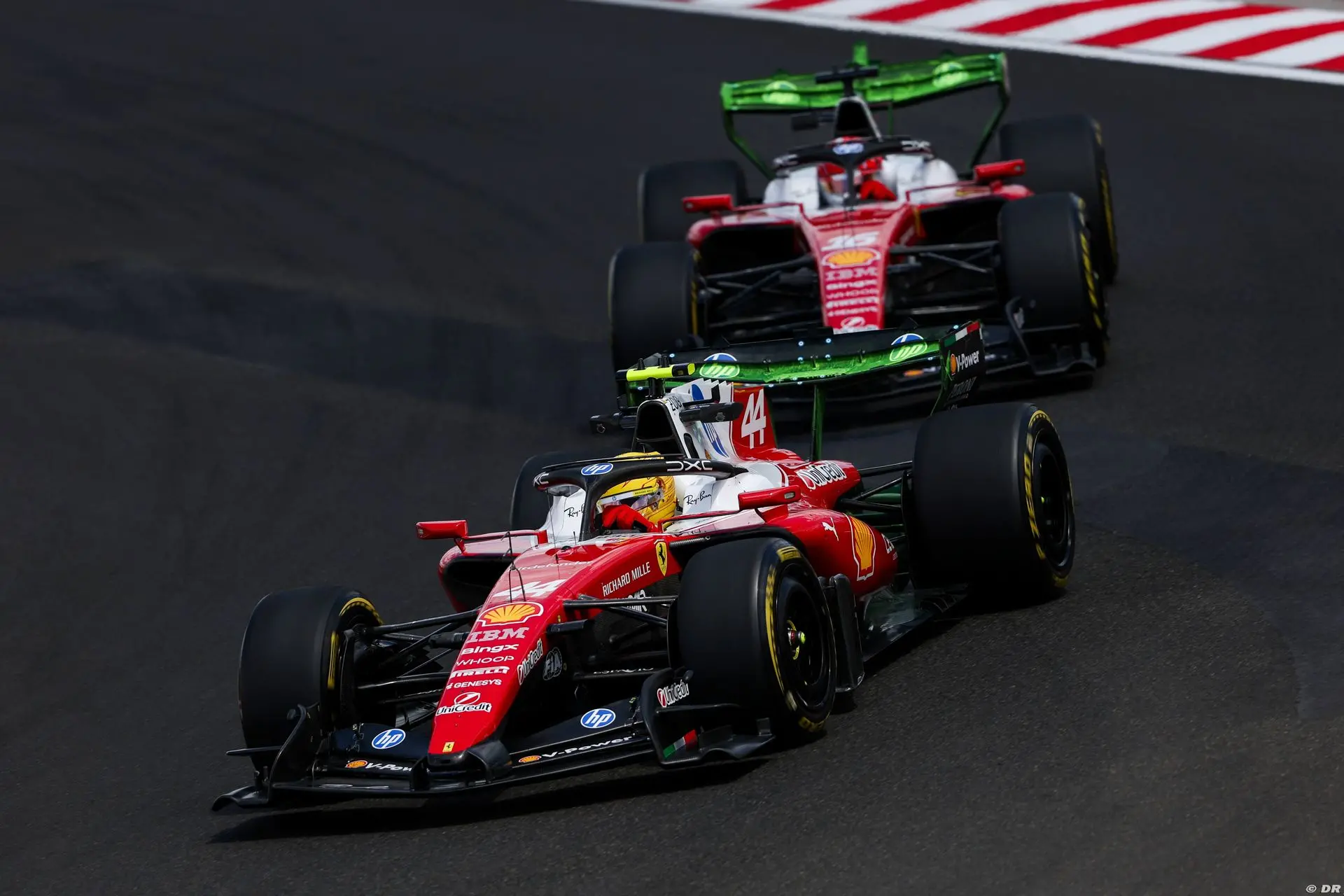
In the relentless pursuit of pole position, where hundredths of a second separate the front row from the midfield, Ferrari has turned to a clever innovation that Mercedes introduced earlier this season. The Scuderia, under the guidance of new leadership and with the experience of Lewis Hamilton and Charles Leclerc, has started testing a method that optimizes the deployment of the hybrid energy system at the precise moment the car crosses the finish line in qualifying. This technique, while fully legal according to the FIA, demands flawless execution; any mistake could result in disqualification.
The Birth of a Clever Workaround
The story begins at the British Grand Prix, where Mercedes revealed a hidden weapon that allowed Andrea Kimi Antonelli to snatch pole position. The trick exploits a specific clause in the technical regulations regarding the discharge of the energy storage system (ESS). Under normal circumstances, as the battery reaches its minimum state of charge allowed for a qualifying lap, teams must implement a gradual reduction in power delivered by the MGU-K (Motor Generator Unit – Kinetic). This reduction must be at least 50 kW per second, preventing the driver from enjoying full electrical assistance all the way to the line. Mercedes, however, found a loophole.
Earlier in the season, Mercedes had attempted a different approach: triggering an emergency shutdown of the MGU-K to bypass the gradual reduction rule. That method was banned by the FIA after the Japanese Grand Prix. Undeterred, the Brackley-based team returned to the drawing board and devised a new version of the trick, first employed successfully at Silverstone. The key lies in a regulatory provision: if the driver lifts off the throttle before the battery is fully depleted, the requirement for progressive power reduction no longer applies. This allows the full 350 kW of electrical power to be maintained until the very last moment before the line.
Mercedes spent countless hours in the simulator perfecting the procedure. Both Antonelli and George Russell now receive an audio cue in their earpieces, telling them exactly when to momentarily lift off the accelerator. Telemetry data from Antonelli's pole lap at Silverstone clearly shows a brief lift just before the finish line, a maneuver that preserves maximum hybrid deployment. The result was a pole position that stunned the paddock. He repeated the feat at Spa-Francorchamps, confirming the technique's effectiveness on certain tracks.
Ferrari's Evaluation in Hungary
It was inevitable that rival teams would attempt to replicate the trick, especially after the FIA confirmed its legality and safety. Ferrari, eager to close the gap to Mercedes and McLaren, decided to evaluate the method during the Hungarian Grand Prix weekend. Data from free practice sessions shows that both Charles Leclerc and Lewis Hamilton experimented with the technique.
On Friday, Leclerc was seen lifting off the throttle as he approached the timing line, causing a slight dip in speed before the car crossed the line. The aim was to measure the potential time gain. However, after analyzing the data, Ferrari concluded that the Hungaroring was not a suitable venue for this strategy. The Hungarian track is considered "energy-rich," meaning there are many opportunities for energy recovery and deployment, and the acceleration zone from the final corner to the finish line is long. In such conditions, the benefit of the trick is significantly reduced.
Telemetry comparisons between Friday's practice and Saturday's qualifying confirmed that Ferrari did not lose time by keeping the throttle fully open to the line. Interestingly, Mercedes itself decided not to use the technique in Hungary qualifying. This highlights a crucial aspect: the trick is only advantageous on specific circuits.
Circuit Dependency and Potential Gains
The effectiveness of this hybrid energy deployment trick varies greatly depending on the circuit layout and characteristics. It proves most valuable on tracks where the available hybrid energy is limited (so-called "energy-limited" circuits) and where the distance from the last corner to the finish line is very short. Examples include Melbourne, Silverstone, and Spa-Francorchamps. On these tracks, the natural regeneration is lower, and the short final straight makes it difficult to deploy all stored energy before the battery hits the minimum charge threshold. The Mercedes trick solves this by allowing the driver to keep full power until the line.
Conversely, on circuits like the Hungaroring, where energy recovery is abundant (from heavy braking zones) and the final straight is long, the technique offers little to no gain. In fact, the brief lift of the throttle can actually cost time if the straight is long enough for the car to regain speed. Therefore, teams must evaluate the trade-off on a race-by-race basis. The FIA also sets different discharge rates: sometimes 50 kW/s, sometimes 100 kW/s, depending on the circuit. This further influences the decision.
The estimated time gain from this procedure is around five hundredths of a second (0.05 s). That may sound trivial, but in the current competitive landscape, it is a game-changer. The top four teams are frequently separated by mere hundredths. At the Hungarian GP, before receiving a three-place grid penalty for impeding Oscar Piastri, Lewis Hamilton missed pole position by just 0.012 seconds. In such a tight championship, an extra 0.05 seconds could mean several places on the grid.
Risks and Championship Implications
For Ferrari, the tests in Hungary represent a first step. The team will likely deploy the trick at upcoming Grands Prix that are more favorable, such as Monza, Singapore, or perhaps a future street circuit. Given that both Leclerc and Hamilton are in the title fight—albeit trailing Max Verstappen and Lando Norris—every thousandth counts. Ferrari's SF-26 has shown strong pace, but inconsistency has plagued their season. Adopting this technique could provide the edge needed to convert front-row starts into victories.
However, the risk cannot be overstated. If the driver misjudges the moment to lift off and allows the battery to fully deplete before the line, they immediately violate the regulation requiring gradual power reduction. The penalty is disqualification from qualifying, effectively sending the driver to the back of the grid. This adds immense pressure on the drivers and the team's systems to execute perfectly. The audio cue and simulator practice are essential to mitigate this risk, but the margin for error is razor-thin.
From a broader perspective, this trick is a fascinating example of how teams exploit the finer details of complex regulations. The hybrid power units in Formula 1 are engineering marvels, with intricate rules governing energy flows. The MGU-K can harvest kinetic energy under braking and then deploy it for acceleration. The battery's state of charge is carefully managed across a lap. The FIA's rules aim to prevent teams from gaining unfair advantages by manipulating the discharge profile, but Mercedes found a legitimate way to maximize performance. Now others are following.
As the season progresses, the battle for both championships remains wide open. Red Bull, McLaren, Ferrari, and Mercedes have all won races. The development race is intense. This hybrid trick is just one of many areas where teams are seeking marginal gains. Ferrari's willingness to test and potentially adopt it shows their determination to fight at the front. Whether it will be enough to help Leclerc or Hamilton secure pole positions in the coming races remains to be seen, but it certainly adds an intriguing layer to the on-track action.
In the high-stakes world of Formula 1, where engineering brilliance can make or break a season, Ferrari's exploration of Mercedes' secret weapon is a testament to the relentless pursuit of speed. The Scuderia will continue to analyze data from every session, ready to deploy the trick on circuits that suit it. If executed cleanly, those five hundredths could be the difference between pole and second place—or between a championship challenge and also-ran status.
Source: Nextgen-Auto.com News