

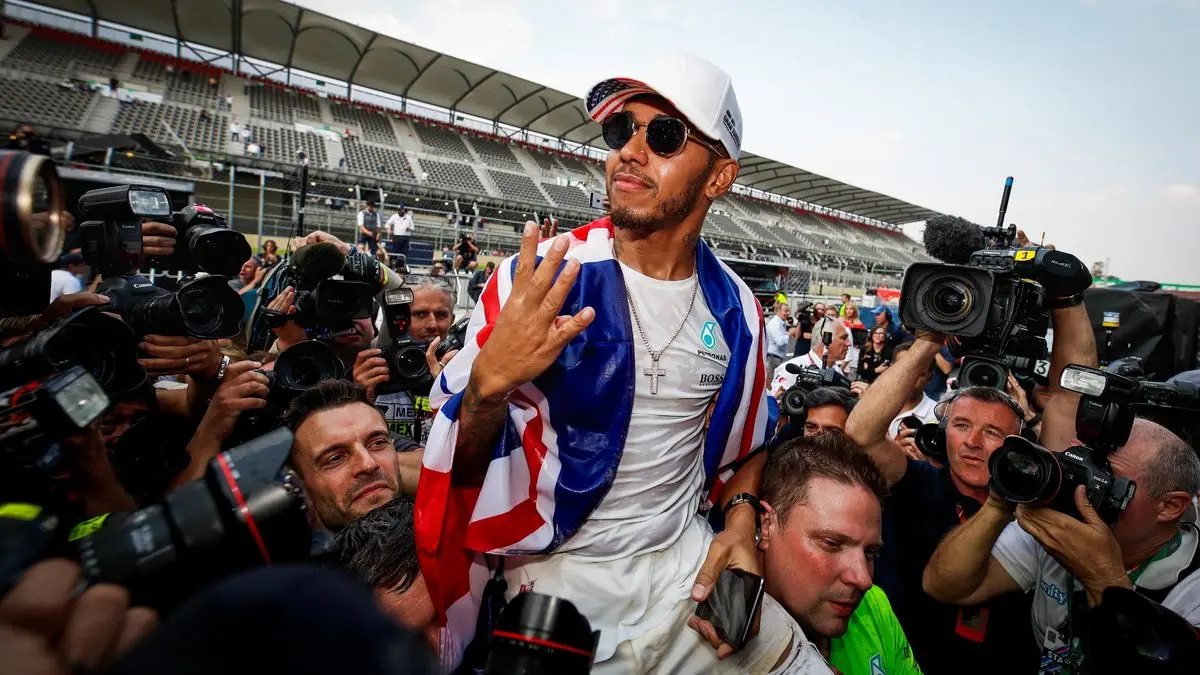
Fresh off securing his fourth Formula 1 world championship, Lewis Hamilton has opened up about the mental transformation that helped him reclaim the title. The British driver, who now boasts 72 pole positions, 62 victories, and four world titles, acknowledged that his mindset has evolved significantly with maturity. In an exclusive interview with As, Hamilton paid heartfelt tribute to tennis superstars Roger Federer and Rafael Nadal, revealing how their approaches to competition have influenced his own racing philosophy.
Hamilton, who lost the 2016 championship to his Mercedes teammate Nico Rosberg in a bitterly fought season, bounced back with a dominant 2017 campaign. His fourth title places him third on the all-time list, behind only Michael Schumacher (seven titles) and Juan Manuel Fangio (five). Yet Hamilton insists that his success is no longer just about raw speed or technical superiority. Instead, he credits a newfound mental fortitude for his resurgence.
“Now I try to eliminate everything that is harmful, without worrying about what people will say or write,” Hamilton explained. “I have managed to build a barrier to fight negativity. I am convinced that love and positivity can help everyone move forward. When you look at the great champions of tennis or golf, you realize what can be achieved with the mind. The head controls everything we do. Stars like Nadal and Federer are an example for everyone, and I try to be inspired by what they do.”
This psychological shift has been central to Hamilton’s dominance since joining Mercedes in 2013. The move from McLaren, where he had won his first title in 2008 (the first by a British driver since Damon Hill in 1996), marked a turning point. Under the leadership of team principal Toto Wolff and technical director Paddy Lowe, Hamilton refined not only his driving but also his off-track discipline. He adopted a rigorous fitness regimen, a plant-based diet, and a daily meditation practice, all of which contribute to his mental clarity on race day.
Hamilton’s admiration for Federer and Nadal runs deep. Federer, who holds a record 20 Grand Slam titles, is celebrated for his elegant style and calm demeanor under pressure. Nadal, with 19 majors, is known for his relentless intensity and never-say-die attitude. Both have defied age and injury to remain at the top of their sport well into their 30s, a feat Hamilton sees as directly applicable to his own career. “What Federer and Nadal have done is remarkable,” Hamilton added. “They show that age is just a number if you take care of your body and mind. I want to have a long career too, like them.”
The comparison raises an interesting question: Can Hamilton, now 32, emulate the longevity of tennis’s greatest rivals? Schumacher won his final title at age 35, and Fangio claimed his last at 46. Hamilton has signed a contract extension with Mercedes through 2020, putting him in the cockpit until at least age 35. With the sport’s technical regulations stabilizing and his team’s continued dominance, another title or two seems plausible. But as he points out, mental resilience will be as crucial as horsepower.
Hamilton’s tribute also underscores a broader trend in elite sports: the growing recognition of sports psychology. In Formula 1, drivers often speak of “the zone” – a state of heightened concentration where time seems to slow down. Fellow drivers like Sebastian Vettel, Fernando Alonso, and Max Verstappen have all worked with mental coaches to improve their focus. Hamilton, however, has taken a more holistic approach, drawing lessons from athletes outside his own discipline. His admiration for tennis champions is not unprecedented; other F1 drivers have cited Michael Jordan, Tiger Woods, and Cristiano Ronaldo as influences.
Beyond mental strength, Hamilton’s 2017 season was a masterclass in consistency. He won nine races, including five in a row from Italy to Japan effectively clinching the championship. His duel with Vettel, who remained in contention until the final rounds, provided a worthy rival. Both drivers pushed their machines to the limit, but Hamilton’s poise in high-pressure moments – such as his stunning recovery drive from last to first in Brazil – demonstrated the very mindset he attributes to Federer and Nadal. “In the past, I might have let a bad qualifying session ruin my weekend,” Hamilton recalls. “Now I see it as a challenge. Federer loses a set and comes back stronger. Nadal saves break points and roars. That’s what I try to do in the cockpit.”
The influence of tennis on Hamilton is not merely philosophical; it has practical applications. He has studied video footage of Federer’s on-court routines, the Swiss maestro’s ability to reset between points, and Nadal’s obsessive pre-serve rituals. Hamilton applies similar techniques before a race start: deep breathing, visualization of the first corner, and a positive internal monologue. “When I’m waiting for the red lights to go out, I tell myself, ‘You’ve done this a thousand times. You’re ready.’ That calmness comes from watching those guys play in the biggest moments.”
Hamilton’s embrace of such mental discipline has made him a more complete driver. He has cut down on mistakes, improved his overtaking efficiency, and become a better teammate to Valtteri Bottas, who joined Mercedes in 2017. The Finn, while a capable driver, has often played wingman to Hamilton, reflecting the team’s confidence in its lead driver. This trust, earned through consistent performance and a mature outlook, has enabled Mercedes to channel its resources effectively.
The broader significance of Hamilton’s comments extends to fans and aspiring athletes. By openly crediting Federer and Nadal, he highlights the interconnectedness of elite competitive sports. Tennis and Formula 1 share little in terms of physical demands, but both require split-second decisions, emotional control, and resilience. Hamilton’s ability to extract lessons from another domain underscores his intellectual approach to racing. He is not only a driver but a student of performance.
As the 2017 season concluded with a star-studded victory celebration at the FIA Prize Giving in Paris, Hamilton showed no signs of slowing down. “I already have my eyes on a fifth title,” he declared. “But it’s not about the number; it’s about how I get there. I want to race with joy, with passion, and with the kind of humility that champions like Federer and Nadal represent.” His words resonated across the paddock, drawing praise from rivals and fans alike. Even Vettel, who had lost the championship, acknowledged, “Lewis has grown a lot. He’s a genuine champion on and off the track.”
Hamilton’s tribute to Federer and Nadal is more than a feel-good quote; it is a strategy for sustained excellence. By aligning himself with two of the most mentally resilient athletes in history, he signals his intention to remain at the pinnacle of Formula 1 for years to come. Whether he catches Schumacher’s seven titles remains to be seen, but with a clear mind and an ever-expanding toolkit of psychological weaponry, Hamilton is equipped to keep writing his own legend.
Source: Le10Sport News