

First Real-World Victory for AI Watermarking
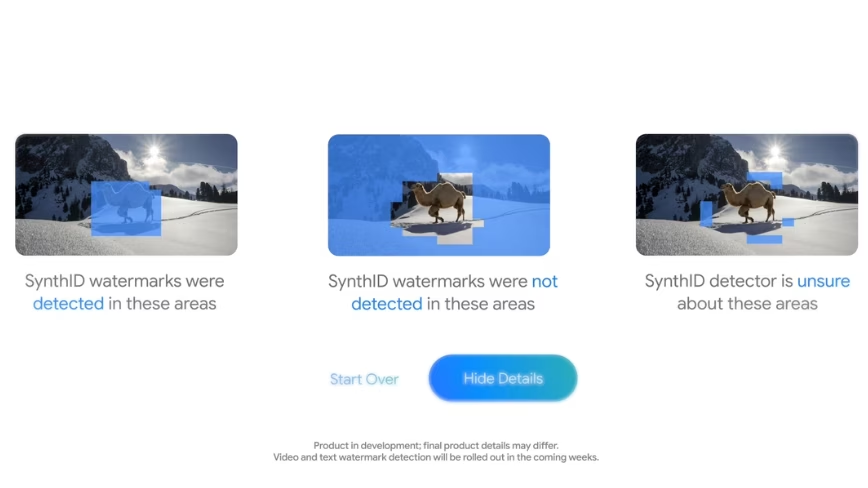
Google’s SynthID watermarking technology achieved a notable milestone this week when fact-checking site Snopes used it to debunk a rapidly spreading deepfake image of Senator Mitch McConnell. The image, which depicted the Kentucky Republican covered in medical tubes and looking extremely distressed in a hospital bed, was shared widely on Reddit and X (formerly Twitter) before investigators confirmed its artificial origin. The watermark, embedded invisibly into the image data, remained intact even after the image was screenshotted and re-uploaded multiple times, providing irrefutable proof that it was created by an AI model participating in the SynthID programme.
This event represents the first high-profile real-world application of SynthID since its launch at Google I/O in 2025. While the technology had been tested in controlled environments, this was the first instance where it directly influenced a public fact-checking effort. The deepfake targeted McConnell at a time of heightened scrutiny over his health, following his hospitalization after an emergency call on June 14. He has been largely out of the public eye since, fueling speculation and making him a prime target for disinformation.
How SynthID Works
SynthID is a watermarking system designed to embed an invisible, cryptographic signature directly into the pixel data of AI-generated images. Unlike visible watermarks, which can be cropped or overlaid, SynthID’s signature is imperceptible to the human eye but detectable by specialized algorithms. The signature is integrated into the image's underlying data structure, meaning it can survive common transformations such as resizing, compression, and even screenshots. This durability was critical in the McConnell case: the image had been screenshotted from its original source and shared across multiple platforms, yet the watermark persisted without degradation.
The technology relies on a collaboration between Google DeepMind and Google Research. It works by subtly modifying the pixel values in a way that does not affect visual quality but creates a unique pattern that can be read by a decoder. The system is designed to be robust against typical editing operations, including color adjustments, blurring, and re-encoding. However, it is not foolproof; aggressive modifications or deliberate attempts to remove the watermark could potentially break it, though such efforts would require significant technical skill and might still leave traces.
The McConnell Deepfake: Context and Impact
The image in question appeared to show a frail, unconscious-looking McConnell in a hospital setting, surrounded by medical equipment. It first surfaced on Reddit in a subreddit dedicated to political memes and quickly spread to X, where it garnered thousands of shares and comments. Many users expressed alarm, believing it to be a leaked photograph from the senator’s medical team. McConnell’s office declined to comment on the image, but Snopes, a long-standing fact-checking organization, decided to investigate.
Using a combination of visual analysis and Google’s new verification tool, Snopes was able to confirm that the image carried the SynthID watermark. The verification tool, which is available to the public, allows users to upload an image and check for the signature. Snopes also noted that the image lacked typical signs of photorealistic AI generation, such as anatomical inconsistencies, but the watermark provided a more definitive answer. The fact-check concluded that the image was “AI-generated and not a real photograph.”
McConnell’s health has been a subject of intense speculation since he fell and suffered a concussion earlier this year, and more recently after his June hospitalization. The 82-year-old senator’s absences from the Senate floor have triggered rumors about his ability to serve. While the deepfake did not cause lasting damage, it underscores how AI-generated content can exploit public anxieties around a vulnerable figure. The speed at which the image spread demonstrates the ease with which deepfakes can circulate before being debunked.
Adoption and Limitations of SynthID
SynthID is currently supported by Google’s Gemini models, which have included the watermark since their launch. In May 2026, OpenAI joined the programme, embedding SynthID alongside C2PA metadata in outputs from its image generation tools. C2PA (Coalition for Content Provenance and Authenticity) adds another layer of metadata that records the origin and edit history of an image. The combination of SynthID and C2PA makes it harder for malicious actors to claim an AI-generated image as real without leaving a trace.
However, the system has a critical limitation: it only works when the image-generation tool actively participates. If content is created using open-source models like Stable Diffusion, or by tools from companies that have not adopted SynthID, no watermark is present. Anthropic, for example, has not joined the programme. This means that deepfakes generated outside the ecosystem remain undetectable by SynthID unless other forensic methods are used. As of now, adoption is voluntary, and only a fraction of AI image generators include the watermark.
The challenge is further compounded by the rise of open-source models that can be run locally, giving users complete control over the output. Without a centralized authority enforcing watermarking, a large portion of AI-generated imagery will continue to be unmarked. Experts argue that for watermarking to be effective, it must be mandated by regulation or adopted by all major platforms. The European Union’s AI Act, which includes provisions for transparency, may push for such requirements in the future.
Broader Implications for Deepfake Detection
The McConnell case is a proof of concept that invisible watermarking can work in real-world scenarios. It provides a glimmer of hope in the ongoing battle against AI-generated disinformation. However, it also highlights the arms race nature of the problem. As watermarking technology improves, so too will efforts to remove or circumvent it. Researchers are already exploring adversarial attacks that could strip watermarks without degrading image quality.
Beyond still images, YouTube has separately moved to auto-label AI-generated videos, and platforms like Facebook and X are experimenting with content provenance labels. But these efforts are fragmented. Without a universal standard, fact-checkers must juggle multiple tools and techniques. The SynthID win is significant, but it is only one piece of a much larger puzzle.
The incident also raises questions about public awareness. Even when a tool like Snopes debunks an image, the debunking may not reach all those who saw the original. Misinformation often spreads faster than corrections. Education and media literacy remain essential complements to technological solutions. Users must be encouraged to question viral images, especially those related to sensitive topics like health.
In the political arena, deepfakes pose a particular threat because they can be weaponized to undermine trust in individuals or institutions. The McConnell deepfake was relatively crude, but future versions could be more sophisticated. The ability to detect them reliably will become a cornerstone of democratic resilience. Google’s SynthID, while not a silver bullet, has taken an important step toward that goal.
Looking ahead, the adoption of SynthID and similar systems will likely accelerate, especially if more companies follow OpenAI’s lead. The technology’s success depends on widespread participation and ongoing refinement. The McConnell debunking proves that when the pieces align, watermarking can be a powerful tool for truth.