

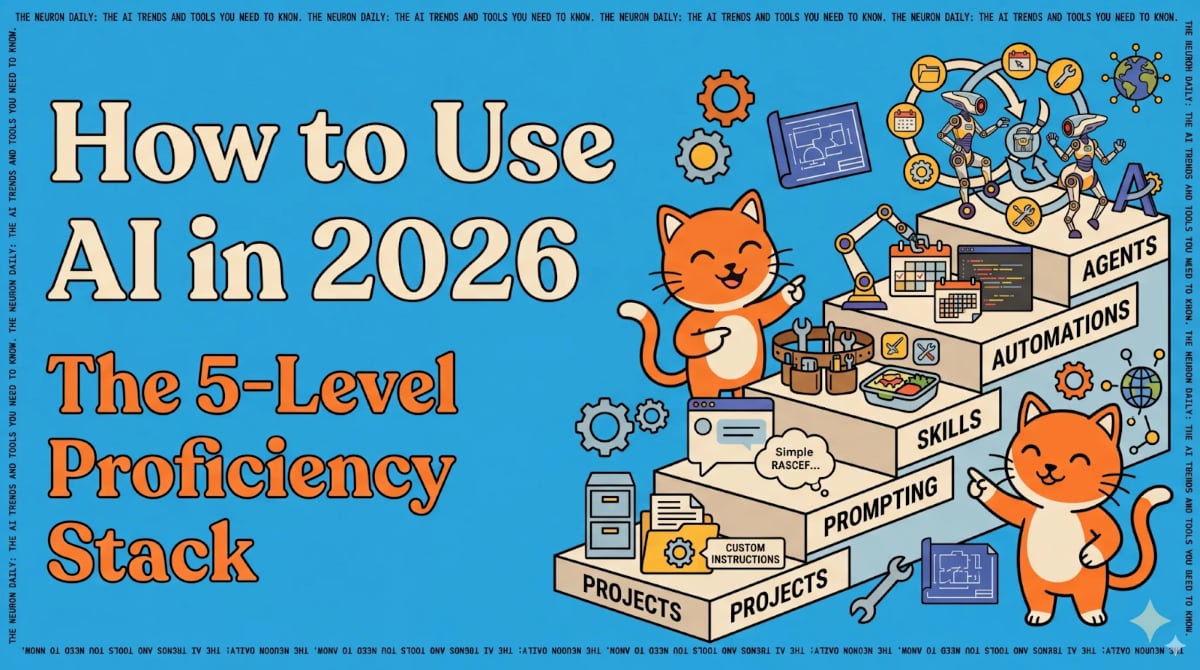
In the ever-evolving landscape of AI, many users still approach it with outdated methods, akin to how we used search engines in the early 2000s. As we progress into 2026, it’s crucial to shift our paradigm from merely asking questions to utilizing AI as a powerful tool for productivity. This article presents a structured five-level proficiency stack to help users maximize their AI capabilities.
The Proficiency Stack
Level 1: Projects. The first step is to create a dedicated project folder within your AI platform, whether it’s ChatGPT, Claude, or Gemini. This involves setting up custom instructions, uploading reference documents, and establishing memory settings so that the AI can retain relevant information. This foundational setup is essential before undertaking any significant work.
Level 2: Prompting. After establishing your project, the next focus is on effective prompting. A simple yet effective formula to remember is: Persona + Task + Context + Format. For instance, you might instruct the AI: "You are a senior content strategist. Create a content plan for a tech blog targeting AI beginners. Present as a bulleted list." This structure provides clarity and direction for the AI.
Level 3: Skills. Once you have refined your prompting technique, the next step is to package those interactions into reusable skills. This allows you to call upon these skills in the future without needing to remember or rewrite the prompt. You can ask the AI to convert a previous conversation into a skill by saying, "Reverse-engineer this conversation into a skill using your skill creator skill I can call anytime." This feature can significantly reduce the time spent on repetitive tasks.
Level 4: Automations. With established skills, you can start automating tasks. Platforms like Claude’s Cowork, OpenAI’s Codex, and Gemini’s Scheduled Actions allow users to schedule these skills for recurring tasks. This automation helps streamline processes and enhances efficiency.
Level 5: Agents. The pinnacle of AI proficiency is the use of intelligent agents that can reason, act, and utilize tools autonomously. Unlike automations that execute tasks on a schedule, agents operate with a goal in mind, determining the necessary actions and making decisions without constant human input. For example, you might set an agent to maintain your email inbox under a certain limit, allowing it to manage filtering, replying, and archiving independently.
Applications of AI Proficiency
- For personal use: Implement an agent like OpenClaw or Claude Code to manage your calendar, sort your inbox, and handle expense filings autonomously.
- For customer support: Use a support agent that can analyze tickets, access account information, resolve issues, and only escalate complex matters.
- As a product: Develop an AI tutor, financial advisor, or research assistant, where the agent itself is the service offered to clients.
The distinction between Levels 4 and 5 is significant. At Level 4, you control the tasks and their schedule, while at Level 5, the AI takes the initiative, deciding the actions necessary to achieve predefined goals.
Importance of Adapting to AI
The journey from casual AI usage to leveraging it for substantial productivity improvements hinges on progressing through these proficiency levels. Many users remain stuck at Level 2, missing out on the potential of Levels 3 to 5, which offer significant time savings and efficiency gains.
To effectively utilize AI, it’s essential to view it not just as a tool but as a collaborative partner that requires proper onboarding. Initiating projects serves as the onboarding process, while developing skills constitutes training, automating tasks represents daily job functions, and agents embody the collaborative coworkers that help achieve your objectives.
By embracing this framework, users can transform their interaction with AI, moving beyond basic queries to fully harnessing its capabilities for enhanced productivity and innovation.
Source: eWEEK News