

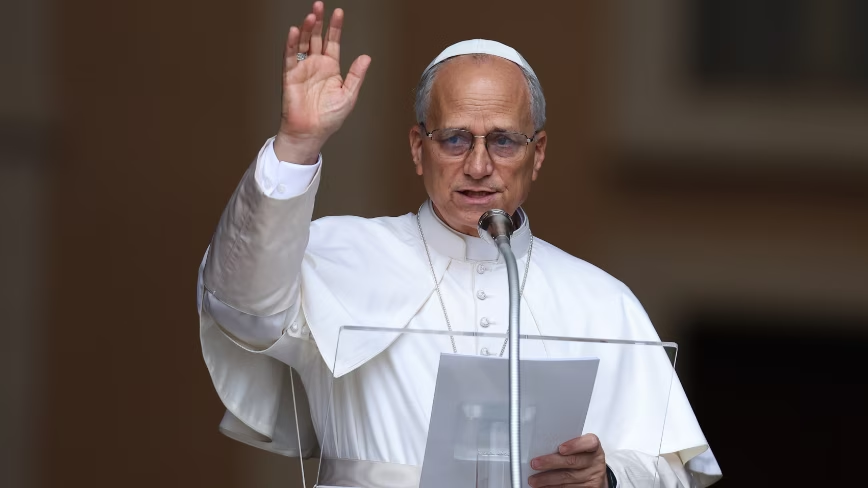
Pope Leo XIV used the first encyclical of his pontificate, published in Rome on Monday, to call for the disarmament of artificial intelligence. The 245-paragraph document, titled Magnifica humanitas, frames AI as a technology that has begun to dominate the people it was built to serve, and argues that disarming it means restoring the moral primacy of the human over the algorithm.
“To disarm means discrediting the assumption that technical power automatically confers the right to govern,” the pope wrote. “To disarm does not mean rejecting technology, but preventing it from dominating humanity.”
The encyclical is the most consequential act of his year-old papacy, and the first time a pope has organised an entire foundational letter around an emerging technology rather than a doctrinal or social question. Leo, the first American pope and a former Villanova mathematics major, signed it on May 15, the 135th anniversary of Leo XIII’s Rerum novarum, which set out Catholic social teaching for the industrial age. The framing is deliberate: this encyclical is offered as its successor for the AI age.
Its central targets are concentration and warfare. The pope called for AI to be made more “human-friendly” and freed from “monopolistic control”, language that lands directly against the half-dozen US firms that now define the technology’s frontier. On war, he was sharper. “No algorithm can make war morally acceptable,” he wrote. “AI does not remove the intrinsic inhumanity of conflict, indeed it can only bring about conflict more quickly and render it more impersonal.”
The choice of speaker for the launch underlined the line. Christopher Olah, Anthropic’s co-founder and head of interpretability research, presented alongside cardinals at the Vatican Synod Hall on Monday morning. Anthropic has spent the past two months at the centre of a separate global debate over the security implications of Mythos, its autonomous vulnerability-discovery model that has found thousands of zero-days across every major operating system. The company has clashed with the Trump administration over the use of its technology in war and surveillance.
On that last point, the encyclical now sits directly across from the White House. Vice president JD Vance, a Catholic convert close to early OpenAI investor Peter Thiel, was asked about the document at a press briefing on May 19. “When the leader of the world’s largest Christian denomination speaks on an issue like that, it’s certainly going to have some influence,” he said. “And I’m sure it’ll contain a lot of insights, some of which I’ll probably agree with, some of which I may not.” In the same briefing he restated that president Donald Trump “wants us to win the AI race against all other countries in the world”.
The proximate tension is older than this week. Thiel spent part of March in Rome delivering closed-door lectures at Palazzo Taverna on the figure of the Antichrist, drawing on a thesis that a one-world technocratic government would emerge under the pretext of averting AI, nuclear, or climate-driven catastrophe. Father Paolo Benanti, the Vatican’s adviser on AI, responded in an op-ed describing the lectures as “a sustained act of heresy” against the liberal consensus. Leo and Trump have separately sparred over the war in Iran.
An encyclical, by design, is not a policy document but a moral framing under which subsequent policy gets argued. Magnifica humanitas places “human dignity” and “shared standards of social justice” at the centre of any future regulatory architecture and rules algorithmic warfare out of it. Pope Leo XIV presented it personally rather than delegating it to cardinals, a break with tradition. He addressed the world’s 1.4 billion Catholics. The wider audience was understood.
Historical Context of Papal Encyclicals on Technology
Encyclicals have long addressed emerging technologies. Pope Leo XIII’s Rerum novarum (1891) tackled the industrial revolution, labor rights, and the moral limits of capitalism. Pope John Paul II’s Laborem exercens (1981) updated those teachings for the late 20th century workplace. Pope Francis’ Laudato si’ (2015) focused on environmental ecology and the technocratic paradigm. Now, Magnifica humanitas continues that tradition by applying Catholic social teaching to artificial intelligence—a technology that, in its current form, concentrates power, erodes privacy, and threatens human dignity.
The Vatican’s engagement with AI is not new. In 2020, the Pontifical Academy for Life launched the “Rome Call for AI Ethics,” endorsing principles of transparency, inclusion, accountability, impartiality, reliability, and security. The document was signed by Microsoft, IBM, FAO, and the Italian government. However, the encyclical goes further by rooting these principles in theological anthropology: the human person is created in the image of God and cannot be reduced to data or optimized by algorithms.
A Deep Dive Into the Encyclical’s Core Themes
The title Magnifica humanitas (“Magnificent Humanity”) signals a positive vision: AI should serve human flourishing, not replace it. The pope argues that disarming AI does not mean abandoning innovation but rather redirecting it. He critiques the “idolatry of efficiency” that treats human beings as bottlenecks in automated systems. The document also addresses algorithmic discrimination, warning that biases embedded in training data can perpetuate social injustices, especially against the poor and marginalized.
On warfare, the encyclical is unequivocal. It rejects the notion that autonomous weapons can ever be morally permissible. Citing the Catholic just war tradition, the pope states that only humans can discern proportionality and discrimination in conflict. Delegating life-and-death decisions to machines removes the possibility of mercy, which is the essence of Christian ethics.
The economic dimension is equally important. The encyclical condemns the monopolistic practices of Big Tech, calling for a distributed AI ecosystem that empowers small businesses, civil society, and developing nations. It echoes the concept of the “common good” from Catholic social teaching: technology must be accessible and accountable.
Reactions and Implications
The document has drawn praise from ethics researchers, religious leaders, and digital rights advocates. Francesca Rossi, AI ethics expert at IBM, called it “a timely moral compass.” The Catholic Church’s network of universities and charities may now use the encyclical to shape curricula and procurement policies. Some conservative Catholics have expressed concern that the encyclical aligns too closely with left-wing critiques of capitalism, but the Vatican has stressed that its aim is neither left nor right but the dignity of the person.
On the geopolitical stage, the encyclical adds a powerful voice to debates over AI regulation. The European Union’s AI Act, the United Nations’ proposals for a treaty on autonomous weapons, and national strategies in the UK, Japan, and India will all be influenced by this moral framework. The pope explicitly calls for international governance mechanisms that include the Global South, where AI’s harms—such as job displacement and surveillance—are often most acute.
The involvement of Anthropic’s Chris Olah highlights a growing alliance between the Vatican and certain tech companies that prioritize safety and interpretability. Anthropic’s focus on “constitutional AI” and transparency aligns with the encyclical’s call for human-centred development. However, the presence of Thiel’s libertarian ideology in Rome reveals a deeper philosophical struggle over the soul of AI: will it be a tool of liberation or a new form of domination?
As the encyclical circulates through Catholic parishes, seminaries, and interfaith dialogues, it promises to reshape the global conversation on technology. The pope’s simple but radical message—that human beings must remain in control—challenges the determinism of Silicon Valley. It also invites all people, regardless of faith, to consider what it means to build a future that is not merely intelligent, but wise.