

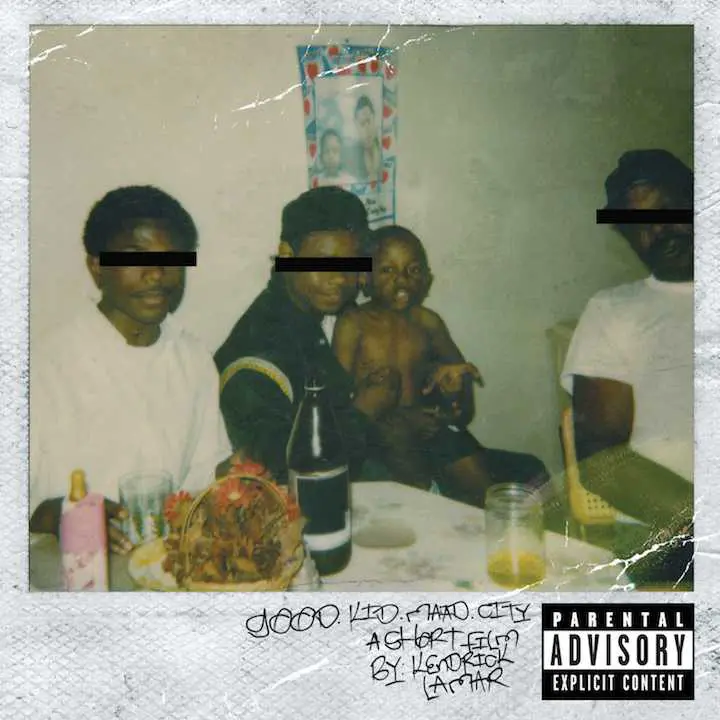
Kendrick Lamar's debut major-label album, Good Kid, mAAd City, released on October 22, 2012, remains a benchmark in hip-hop storytelling. The album not only solidified Lamar's place in the rap pantheon but also shifted the culture, being incorporated into university curricula and inspiring countless artists. Its narrative structure, character development, and thematic complexity set a new standard for concept albums in the genre.
The Cover Art as a Visual Preamble
The cover art of Good Kid, mAAd City is a childhood Polaroid of Kendrick with his uncles and grandfather. The image contains layered symbolism: a baby bottle, a 40-ounce bottle, one uncle flashing a gang sign, and a background picture of Kendrick with his father. Everyone's eyes are blacked out except for Kendrick's, which remain innocent, reflecting his perspective as someone trying to understand his environment. Lamar explained, "That photo says so much about my life, and about how I was raised in Compton, and the things I've seen, just through them innocent eyes." The subtitle on the cover reads "a short film by Kendrick Lamar," signaling the album's cinematic ambition.
Narrative Structure: A Day in the Life
The album is structured as a cohesive narrative, tracing a single day in the life of the protagonist, K Dot, as he evolves into Kendrick Lamar. Through a series of songs and skits, the story follows K Dot's interactions with his girlfriend Sherane, a night of crime with friends, and his internal struggle with hood politics. The skits, featuring Lamar's actual family members, ground the story in reality and advance the plot.
"Sherane a.k.a. Master Splinter's Daughter"
The opening track sets the stage without being the literal beginning. Like the iconic monologues in Quentin Tarantino films, it establishes the world and tone. K Dot is meeting Sherane, and the narrative is nonlinear, filled with fits and starts. The skit that follows—where Kendrick's mother and father discuss the family van—introduces a key plot device later referenced in the deluxe edition's artwork.
"Bitch, Don't Kill My Vibe"
This single serves as both an introduction to the album's themes and a commentary on the state of hip-hop. Originally titled "Partynauseous" and featuring Lady Gaga, the collaboration fell through due to timing issues, and she later released her version independently. The skit at the song's end pushes the narrative forward, with K Dot's friends calling him to join them in the car with a beat CD.
"Backseat Freestyle" and "The Art of Peer Pressure"
The two tracks flow seamlessly together. "Backseat Freestyle" captures the youthful bravado of K Dot and his friends hotboxing a car and dreaming of success, with lines like "Martin had a dream / Kendrick have a dream." However, "The Art of Peer Pressure" subverts this energy, revealing the darker consequences of that caravan. A night of smoking and drinking escalates into robbery, forcing K Dot to confront the internal conflict between following his peers and staying out of trouble. The tension leads directly into "Money Trees," where he weighs his options.
"Poetic Justice"
This track, featuring Drake, brings the story back to Sherane. After the robbery, K Dot is jumped by a group of men from a different neighborhood, realizing that the predator can become the prey. This moment underscores the cyclical nature of violence in his environment.
"Good Kid" and "mAAd City"
These two tracks are thematically linked. "Good Kid" explores the impossible position of growing up in the hood: forced to choose between gang affiliation for protection or isolation that makes one a target. Engineer MixedByAli noted that being a "good kid" means being stuck inside the box, with no choice but to participate in drive-bys and robberies because of one's surroundings. "mAAd City" is split into two parts, beginning with a slow intro that builds into a hard-hitting club beat. The track features legendary West Coast MC Eiht, a nod to Compton's hip-hop history, and deepens the dilemma: gang life offers protection but also makes one more vulnerable to violence.
"Swimming Pools (Drank)"
On the surface, a party anthem, but the lyrics reveal a cautionary tale about alcoholism and peer pressure. At this point in the story, K Dot's friends seek revenge for his earlier beating, resulting in the death of his friend's brother, Dave. The song's duality highlights Lamar's skill in embedding social commentary within accessible music.
"Sing About Me"
This track is a turning point. Lamar speaks from multiple perspectives—first, the deceased Dave; second, the sister of a sex worker he rapped about in his earlier work; finally, Kendrick himself questions his life as K Dot. The song represents a baptism and the beginning of self-realization. It is followed by the skit where Lamar's mother asks him about his father, further grounding the narrative.
"Real"
By this point in the album, the listener understands that the pursuit of "money, power, respect" is a dangerous code. Lamar reflects, "That's the start of me recognizing everything I was doing throughout that day, it wasn't real. Everybody has their own perception of what a 'real n—a' is. Most of the time a real n—a is a street cat or someone putting in some type of work and doing violence. That's what we thought they was. But on that record, it was me getting an understanding of what real is." This track features vocals from Lamar's cousin, adding personal authenticity.
"Compton"
The closing track could have appeared early in the story but instead serves as an ending credits sequence. It features a guest verse from Dr. Dre and signifies both closure and the possibility of the cycle repeating, or a new chapter beginning. The upbeat production contrasts with the album's darker themes, suggesting hope or irony.
Cultural Impact and Legacy
Good Kid, mAAd City redefined how hip-hop albums could be constructed as cohesive narratives. Its influence can be seen in later concept albums by artists like J. Cole, Drake, and even non-rap genres. The album was nominated for seven Grammy Awards and won Best Rap Album at the 2014 ceremony. Critics praised its detailed storytelling, production (by Dr. Dre, Pharrell Williams, and others), and Lamar's lyrical prowess. It has since been certified triple platinum by the RIAA and is often cited as one of the greatest albums of the 2010s.
The album's integration into university curricula—such as at the University of California, Riverside, and other institutions—demonstrates its academic value as a text for studying narrative, race, and identity. Lamar's ability to transform personal experience into universal themes has made the album a timeless piece of art.
Source: uDiscover Music News