

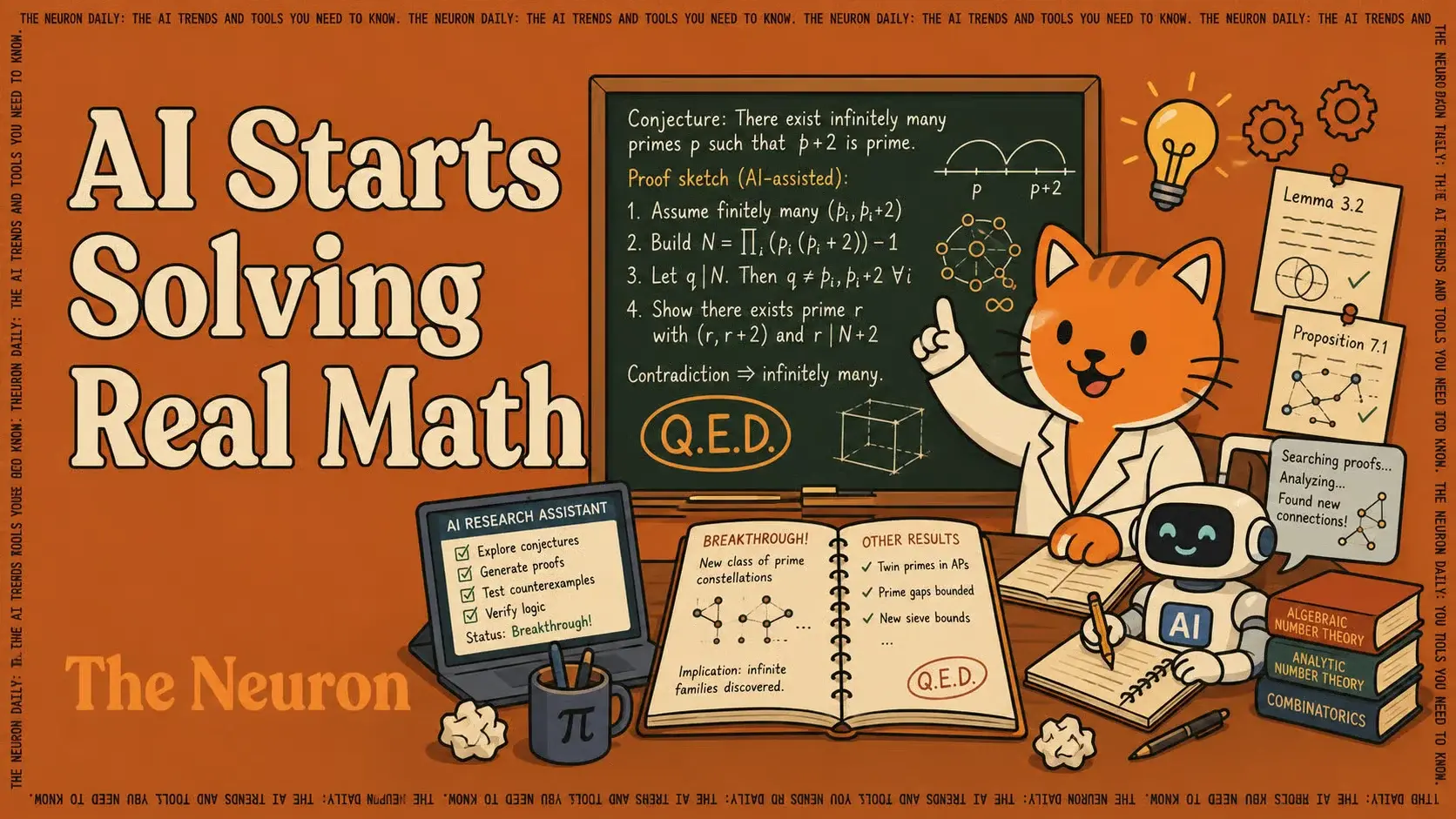
OpenAI has unveiled Astra, a new AI model built specifically to advance mathematical reasoning. The model is being described as one of the most ambitious efforts to combine the pattern-matching ability of large language models with the rigor of formal mathematics. Astra's release comes at a time when researchers are looking for AI systems that can do more than answer math questions — they want systems that can explore open problems, check their own reasoning, and produce work that can withstand verification. According to the announcement, Astra represents ten major advances in mathematical AI.
Key facts
- Astra is a new OpenAI model focused on mathematical reasoning.
- The model is credited with ten advances in areas such as formal proof, symbolic manipulation, and self-correction.
- Astra can work with a combination of symbolic and numeric methods, making it useful for both pure and applied mathematics.
- Each advance is designed to bring AI closer to reliable, verifiable mathematical work.
A new direction for AI in mathematics
For years, AI models have been evaluated on math benchmarks like GSM8K, MATH, and advanced competition datasets. These benchmarks measure a model's ability to produce final answers, but they do not always capture the quality of reasoning. Astra is different. It is designed to produce intermediate steps that can be inspected, corrected, and verified. This shift matters because mathematics is not just about answer generation; it is about justification. A correct answer without a valid proof is often worthless in research, while a flawed proof can mislead for years. By focusing on the reasoning process, Astra aims to address one of the deepest weaknesses of earlier AI systems.
Mathematics also provides an ideal testbed for AI safety and interpretability. Unlike open-ended conversations, math problems have clear rules and checkable solutions. This means a model's reasoning can be evaluated step by step, making it easier to identify where and how it fails. Astra's design leverages this property: it is built to be more transparent, more self-aware, and more aligned with the standards of human mathematical practice.
The ten advances
1. Step-by-step proof generation
Astra can generate complete proof chains for a wide range of theorems, rather than just giving numeric answers. Each step in the chain is tied to a rule of inference, making it possible to follow the model’s reasoning from problem statement to conclusion. This is especially useful in domains like number theory and real analysis, where intermediate steps matter as much as the final result. The model’s ability to produce these chains in natural language and formal syntax opens the door to AI-assisted theorem discovery.
2. Formal verification integration
One of the biggest problems with AI-generated mathematics is that a plausible-looking proof can be subtly wrong. Astra addresses this by integrating formal verification tools into its reasoning loop. When the model produces a proof, it can translate the argument into a formal proof language and check it with an automated proof assistant. This reduces the risk of hidden errors and gives researchers a higher level of trust in the model's output. It also allows the system to backtrack and revise when verification fails.
3. Symbolic-numeric hybrid reasoning
Many mathematical problems require both algebraic manipulation and numerical approximation. Astra is equipped to move between these modes fluidly. It can simplify an expression symbolically, approximate a solution numerically, then combine both results to guide the next step. This hybrid approach makes the model useful for applied mathematics, where exact closed-form solutions are often impossible and researchers rely on numerical evidence to support conjectures.
4. Improved generalization
Benchmark models often memorize patterns from training data. Astra was designed to generalize beyond problem types seen in training. In internal evaluations, the model performed well on unfamiliar problem families, including newly constructed conjecture-style questions and problems from recently published research papers. This suggests that Astra is not simply matching responses from a database; it is applying abstract rules in new and meaningful ways.
5. Self-correction and backtracking
Mathematical reasoning is rarely a straight line. Astra includes a self-correction mechanism that detects errors in its own reasoning and backtracks to an earlier state. Instead of committing to a flawed path, it can revise assumptions, experiment with alternatives, and continue. This capability is critical for long proofs, where a single mistake can invalidate dozens of steps. It also makes the model more transparent: users can see where a path was abandoned and why.
6. Abstract algebra and structure discovery
Advanced levels of algebra require recognition of structures such as groups, rings, and fields. Astra brings new capabilities to this area by recognizing algebraic structures and using their properties to guide problem-solving. The model can propose proofs for properties of finite groups, identify invariants, and test whether a given operation satisfies a particular axiom set. This is a step toward using AI as a genuine research assistant in pure mathematics.
7. Calculus and analysis
Astra also shows significant gains in calculus and real analysis. It can handle limit arguments, continuity proofs, and complex integrals with greater reliability than earlier systems. The model can reason about epsilon-delta definitions and construct counterexamples to false statements. In analysis, where subtle assumptions matter, the model’s improved precision is important. These capabilities could change how calculus is taught and how mathematical software is written.
8. Probability and statistics
Mathematical reasoning is not limited to pure symbols. Astra has made advances in probability and statistics, including rigorous treatment of random variables, convergence properties, and hypothesis tests. The model can derive distributions from assumptions, verify conditions for central limit theorems, and identify flaws in statistical arguments. This makes Astra relevant to data science and scientific research, where statistical rigor is essential.
9. Multi-modal mathematical understanding
Mathematical knowledge is often presented through equations, graphs, and diagrams. Astra can process mathematical content in multiple forms: it reads LaTeX, interprets plots, and connects geometric diagrams to algebraic representations. This multi-modal capacity allows the model to solve geometry problems that require visual intuition, as well as parse handwritten mathematical notation in research notes. The result is a more complete mathematical understanding that goes beyond text alone.
10. Efficient inference for large computations
The final advance is computational efficiency. Astra is optimized to perform long chains of reasoning without losing coherence, even when the mathematics becomes large and unwieldy. It can allocate more computation to difficult steps and less to straightforward ones. In tests, Astra maintained strong performance while using fewer computational resources than previous models. This makes it practical for embedding in proof assistants, educational platforms, and research workflows where budget constraints are real.
Implications for research, education, and industry
These ten advances are not isolated improvements. Together, they point to a future in which AI systems can participate actively in mathematical discovery. Research mathematicians might use Astra to test conjectures, generate examples, and verify candidate proofs. Teachers could use it to provide detailed feedback to students. Engineers could rely on it to reason about algorithms and data structures.
OpenAI has not disclosed all of the benchmarks behind the model's performance, but the company says Astra's improvements were measured against a range of challenging problem sets, including competition problems, graduate-level exercises, and formal proof corpora. The model is also designed to explain its reasoning, which should help researchers evaluate the quality of its work.
One important caveat is that advanced math AI still requires careful oversight. Models can suggest plausible but incorrect paths, and mathematical verification remains a human responsibility. Nevertheless, Astra’s integration of formal verification and self-correction is a meaningful step toward reducing errors. The development also raises questions about the role of AI in mathematics education: will students rely on AI too heavily, or will it free them to work on harder problems?
The next few years will reveal whether these ten advances lead to a new era of human-AI collaboration in mathematics.
Source: eWeek News