

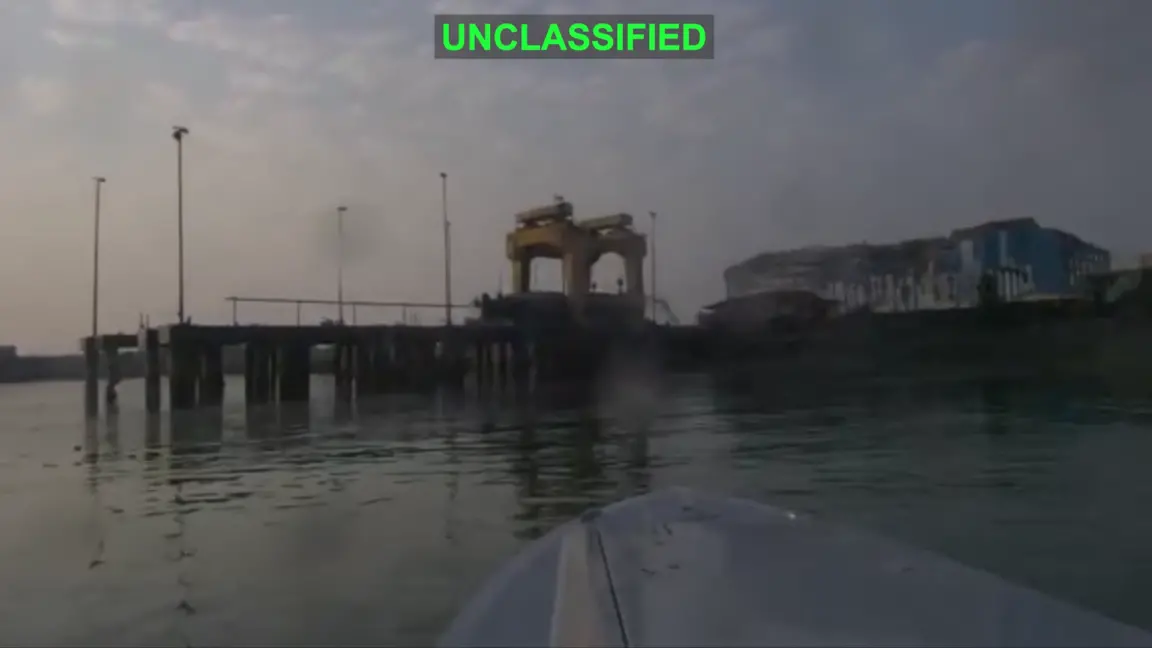
For the first time in its history, the US military sent explosive-laden drone boats into combat by attacking an Iranian midget submarine and naval port. The unprecedented use of such kamikaze sea drones by the United States comes nearly a decade after Iranian and Houthi forces first demonstrated such weapons. The US military shared a video showing three “one-way attack surface drones” exploding after approaching an Iranian midget submarine and ship maintenance facility at Iran’s Bandar Abbas Naval Base on the night of July 12. US Central Command, the US military combat command responsible for Middle East operations, described the strikes in a social media post as the “first time American forces have employed sea drones in combat operations.”
The US drone boats were able to “make a low-speed, uncontested approach” to their targets before exploding, according to USNI News, a news service from the nonprofit US Naval Institute. USNI News also identified one of the targets as an Iranian Ghadir-class midget submarine that was out of the water while being suspended from a gantry. The technology behind the strikes involved Saronic Corsair autonomous surface vessels developed by Saronic Technologies, a defense company based in Austin, Texas. The company’s website describes the drone boat as being 24 feet in length and capable of carrying up to 1,000 pounds over 1,000 nautical miles at a top speed surpassing 34 knots.
Such Corsair drone boats supposedly have the capability to operate autonomously without direct human control, including long-range navigation and patrol missions along with regulating power consumption and engine use to loiter at a specific position, according to a Saronic blog post. They are designed to perform a wide variety of missions and were likely equipped with explosives for this specific strike. This marks the second notable US military use of drone boats during the war, which began with the United States and Israel attacking Iran on February 28, 2026. The US military already used a Corsair sea drone to rescue two US Army helicopter pilots in the waters off the coast of Oman on June 8, after their US Army AH-64 Apache helicopter was taken down by a cheap Iranian Shahed drone.
A history of drone boat violence
The United States is far from the first country to have used exploding drone boats, also colloquially described as kamikaze or suicide drone boats. The first confirmed use of such weapons occurred on January 30, 2017, when the Houthi faction based in Yemen struck the Royal Saudi Naval frigate Al Madinah using an uncrewed remote-controlled boat. A US Navy commander told Defense News that the Houthi weapon was likely developed with the technical assistance of Iran, which has long supported the Houthis. This attack demonstrated the vulnerability of traditional naval forces to cheap, expendable drone boats and set a precedent that other nations would soon follow.
In more recent years, the Ukrainian military has also developed and deployed drone boats for asymmetric warfare at sea since Russia launched a full-scale invasion of Ukraine in February 2022. Despite lacking a traditional navy, Ukraine has used a combination of flying drones and explosive drone boats to strike Russian warships and tankers, forcing Russia to withdraw its Black Sea Fleet to bases farther from Ukraine and cutting off vital Russian shipping routes. Ukrainian drone boats have also achieved several milestones in military history by using missiles to shoot down Russian helicopters and acting as surface platforms to deploy small flying drones to strike Russian air defenses. Most recently, a Ukrainian drone boat even deployed an armed ground robot onto contested coastal territory in an unprecedented amphibious operation.
The evolution of these weapons has been rapid. Early Houthi drone boats were little more than speedboats packed with explosives and controlled via radio, akin to the terrorist attacks on the USS Cole in 2000 but with enhanced guidance. Iran, a state sponsor of the Houthis, soon developed more sophisticated variants, including the Shahed-derived surface drones that could loiter and attack autonomously. Ukraine, facing Russia’s naval dominance, innovated with a range of designs from jet-ski-based kamikaze boats to larger vessels carrying naval mines or anti-ship missiles. The US military’s entry into this domain reflects a broader strategic shift: the world’s most powerful navy is now embracing the same asymmetric tactics it has historically countered.
Strategic implications and future use
It’s unclear how the US military may continue deploying drone boats as President Donald Trump once again ramps up the war with Iran following the collapse of a supposed ceasefire. The US drone boat strikes came as part of a broader attack by conventional US military forces on Iranian targets in recent days, including strikes by US fighter aircraft and warships. The US military has also been using one-way aerial attack drones for the first time during its war with Iran—LUCAS drones based in large part on Iranian-developed Shahed drones. Along with the drone boats, the United States is following the example of less powerful countries or factions that have used inexpensive drone weapons to pursue asymmetric warfare. The US military is currently trying to procure a new generation of cheaper surveillance and strike drones, especially after losing dozens of costly hunter-killer Reaper drones collectively worth more than $1 billion in the war against Iran.
The use of drone boats represents a potentially transformative shift in naval power projection. Historically, navies relied on large capital ships such as aircraft carriers, destroyers, and submarines to project force. However, these vessels are expensive to build and maintain, and they require significant logistical support. Drone boats offer a low-cost, expendable alternative that can be mass-produced and deployed in swarms. They can saturate enemy defenses, conduct reconnaissance, and strike with precision at a fraction of the cost of a single missile. This technological change mirrors the transition from battleships to aircraft carriers in the early 20th century, where the ability to deliver ordnance at range became paramount.
Moreover, the psychological impact of drone boats cannot be overstated. The sight of a small, unmanned vessel calmly approaching a billion-dollar warship and detonating can demoralize crews and challenge traditional doctrines. The US military’s adoption of such tactics signals an acknowledgment that future conflicts will increasingly be fought with unmanned systems, where speed and stealth outweigh raw firepower. The Corsair drone boat, with its 1,000-pound payload capacity, can carry enough explosives to severely damage or sink a small naval vessel, and its autonomous navigation system allows it to penetrate defended waters without endangering human operators.
Technical details of the Corsair indicate it is a modular platform capable of being reconfigured quickly for different missions. Its endurance of over 1,000 nautical miles means it can operate far from shore, loiter for hours, and strike at a time of its choosing. The US Navy has not disclosed the full specifications of the weaponized version used in the July 12 strike, but defense analysts suggest it may have been fitted with a shaped charge or blast fragmentation warhead designed to maximize damage to soft targets like the Ghadir-class submarine, which is a small coastal submarine often used for special operations and minelaying in shallow waters.
The Ghadir submarine, a compact diesel-electric vessel with a crew of around 10 to 15, is particularly vulnerable to drone boat attacks because it lacks the heavy armor and defensive systems of larger submarines. When out of the water for maintenance, it presents an easy target. The attack on the Bandar Abbas base also targeted a ship maintenance facility, likely to degrade Iran’s ability to repair its naval assets. This coordinated strike with drone boats and other conventional forces demonstrates the US military’s ability to integrate unmanned systems into combined arms operations, a capability that has been honed in exercises for years but never tested in combat until now.
The precedent set by the US strikes could accelerate a global arms race in drone boats. China, which already operates a large fleet of unmanned surface vessels for surveillance and potentially offensive roles, will likely take note. Russia, despite its recent setbacks in the Black Sea, has also experimented with drone boat designs. Iran, already a pioneer in this field, will seek to counter US drone boats with new electronic warfare systems or kinetic defenses. The proliferation of such weapons increases the risk of escalation in maritime disputes, especially in the South China Sea, the Persian Gulf, and the Baltic Sea.
For the time being, the US military appears committed to expanding its drone boat arsenal. The Navy’s Unmanned Maritime Systems program has allocated billions of dollars for the development of large and small unmanned vessels, including the Sea Hunter medium-displacement surface ship and smaller expendable boats like the Corsair. The successful combat debut of the Corsair will likely lead to accelerated procurement and more frequent operational use. As the war with Iran grinds on, drone boats may become a staple of American naval tactics, offering a cheap, lethal option that reduces risk to US personnel.
Source: Ars Technica News