

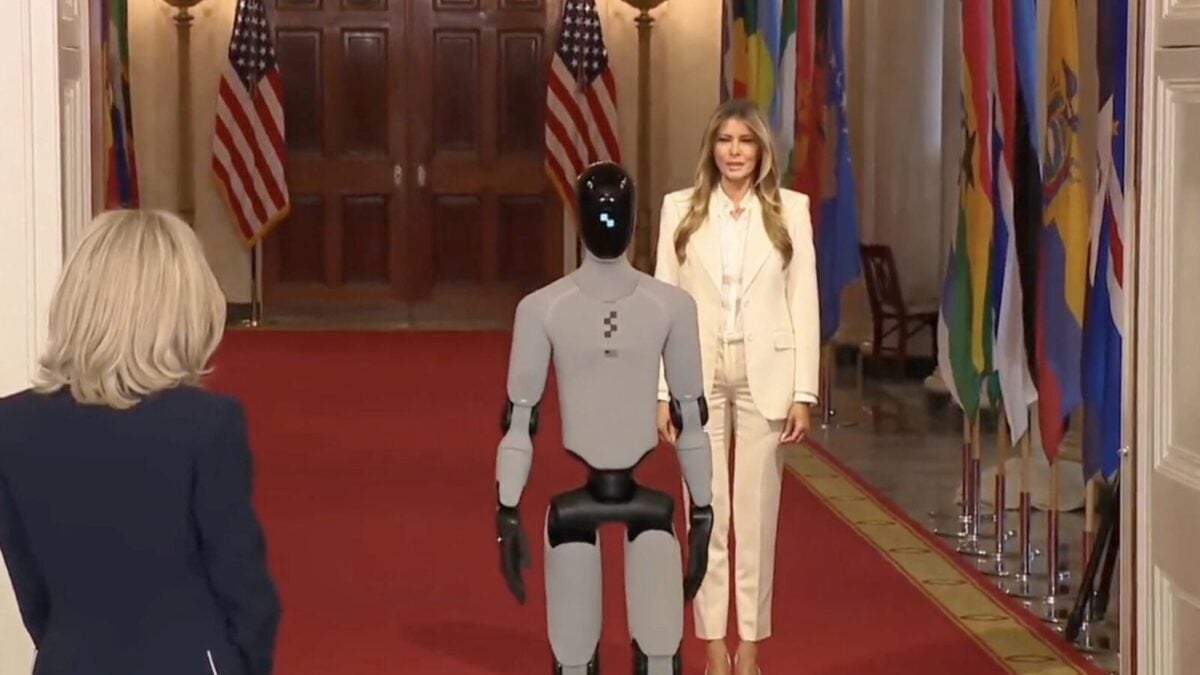
On March 25, 2026, CEO of Figure AI, Brett Adcock, made an intriguing announcement on social media, proclaiming that one of his company’s F.03 concept robots had made history as "the first humanoid robot in the White House." This milestone coincided with a two-day summit linked to First Lady Melania Trump’s "Fostering the Future Together" initiative, designed to integrate technology into education.
The F.03 robot, lacking a face, walked into the venue, delivered a few lines of appreciation to the First Lady, greeted foreign dignitaries in multiple languages, and then awkwardly retreated into silence. This unusual performance sparked a debate about whether this really marks the first visitation of a humanoid robot in the historic residence.
To address this question, it's essential to consider previous encounters with robots at the White House. In 2015, President Barack Obama interacted with a telepresence robot while meeting disability advocate Alice Wong. However, this robot, essentially a screen on a long neck connected to a mobile base, does not fit the definition of humanoid.
Additionally, Honda’s Asimo, a widely recognized humanoid robot, has met numerous global leaders, including President Obama, who practiced soccer with Asimo during a visit to Japan's Museum of Emerging Science and Innovation. Yet, this meeting did not occur on White House grounds. Similarly, at the 2005 Asia-Pacific Economic Cooperation summit in South Korea, George W. Bush encountered Albert HUBO, another humanoid robot, which featured an animatronic Albert Einstein head. Again, this interaction was not within the White House.
Interestingly, Ronald Reagan may have introduced a humanoid robot to the White House. In 1987, he received a Tomy Omnibot 2000 while visiting Purdue University, which was later displayed at the Reagan Presidential Library. Although Tomy Omnibots were sophisticated toys designed for affluent children and often featured in media as futuristic robots, they have wheels, not legs, leading to ambiguity in classification as humanoid. If Reagan did bring his Omnibot to the White House, it would predate the F.03's visit by nearly 40 years.
Establishing a clear milestone in humanoid robot history at the White House could be simplified if President Trump formally greeted a robot in the Oval Office. This would definitively make him the first U.S. president to interact with a humanoid robot in that iconic setting. The possibility of such an event seems plausible, considering Trump’s previous remarks about robots and technology, especially during a December press conference where he discussed the potential for robots to assist in various projects while also emphasizing the need for human oversight.
Given the current context, Adcock’s assertion that the F.03 is the first humanoid robot in the White House holds water. It will be interesting to see if the White House Historical Association, which has been contacted for their insights, provides further clarity on this claim. As technology continues to evolve and integrate deeper into society, these milestones may reshape our understanding of robotics and their role in prestigious environments like the White House.
Source: Gizmodo News