

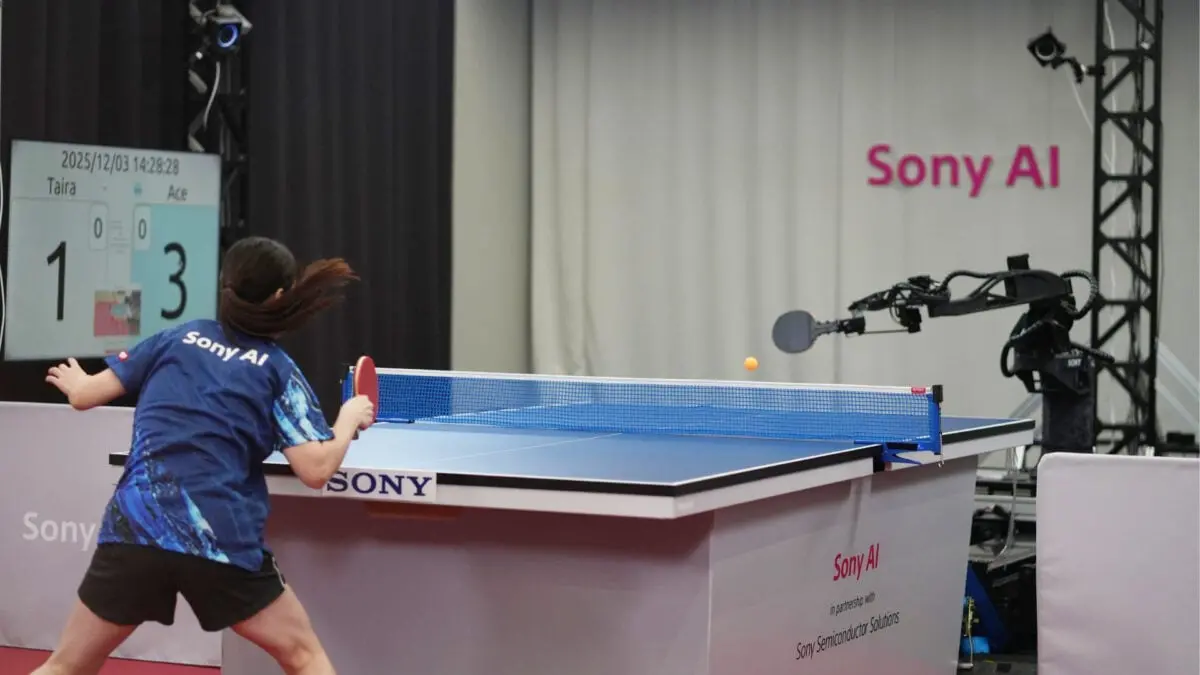
Watch out, human table tennis champions—there is a new contender on the court, and it does not have a pulse. Sony AI has unveiled an autonomous robotic system named Ace that can match and even defeat elite human players in table tennis. The research, published in the journal Nature, demonstrates a significant leap in both artificial intelligence and robotics, showing that machines can now perform complex, real-time interactive tasks in the physical world with remarkable skill.
The Ace system is the result of years of development by Sony's AI division. It combines cutting-edge hardware—including high-speed cameras, precision actuators, and a lightweight robotic arm—with sophisticated software that uses reinforcement learning and real-time sensor fusion. The robot can serve, return, and rally with high-speed, high-spin balls, adapting its strategy based on the opponent's movements. Unlike previous table tennis robots, Ace was tested under official International Table Tennis Federation (ITTF) rules, with licensed umpires overseeing the matches.
In the initial study conducted in April 2025, Ace faced five elite players—defined as individuals with at least 10 years of playing experience and regular 20-hour weekly training routines. The robot won three out of five matches against these players. It also competed against Minami Ando and Kakeru Sone, two professional players from Japan's professional table tennis league. Ace managed to win one game against the professionals but ultimately lost both matches. However, the robot's performance improved dramatically in subsequent tests.
By December 2025, Ace had refined its tactics and hardware. It defeated both elite and professional players in rematches, winning one of the two professional matches. The most striking achievement came in March 2026, when Ace won three matches against professional players, including Miyuu Kihara—ranked in the top 25 of the World Table Tennis women's singles rankings. During these later matches, Ace demonstrated the ability to shoot balls faster and more aggressively, often aiming for the table edges to exploit human reaction limits.
The lead author of the study explained that the project was designed to push the boundaries of physical AI. "The results of our work on Ace highlight the potential of physical AI agents to perform complex, real-time interactive tasks, suggesting broader applications in domains requiring fast, precise human-robot interaction," he said. The research team emphasized that table tennis provides a perfect testbed for AI because it demands rapid decision-making based on noisy sensor data and adversarial human behavior—far more challenging than simulated environments.
Historically, table tennis robots have existed since the 1980s, but they were largely limited to stationary serving machines or rudimentary return systems. Ace represents a paradigm shift because it operates fully autonomously, without pre-programmed opponent models. The system uses a combination of visual perception from multiple cameras to track the ball's trajectory, spin, and speed, then computes the optimal return within milliseconds. The robotic arm moves with six degrees of freedom, capable of generating spin rates exceeding 5,000 rpm—comparable to top human players.
The implications extend far beyond sports. The same technologies that power Ace—real-time control, sensor fusion, and adaptive learning—could be applied to industrial automation, elderly care, search and rescue, and even surgical robotics. For instance, Ace's ability to safely interact with humans in a fast-paced environment is crucial for collaborative robots that work alongside people in factories or hospitals. The researchers noted that the challenge of balancing strength and safety was a key focus during development.
Despite its successes, Ace is not yet unbeatable. The robot still struggles with certain types of spin and very low or wide shots. Its movement is limited by a fixed base—unlike humans who can move around the table. However, the iterative improvements between April 2025 and March 2026 suggest that Ace's capabilities will continue to grow. The study also noted that the robot's performance against Miyuu Kihara was a major milestone, as she is one of the fastest and most strategic players in the world.
The broader context of this achievement places Sony alongside other tech giants investing in physical AI. While most research in this field has focused on chess, Go, or video games, physical sports present unique challenges: imperfect information, unpredictable opponents, and the need for real-time physical action. Ace's success demonstrates that these barriers are surmountable, opening the door to a new generation of robots that can play, work, and interact with humans in natural environments.
As for the human players who faced Ace, reactions have been mixed. Some expressed admiration for the robot's precision and consistency, while others noted that the lack of human intuition made the matches feel different. However, all acknowledged that Ace forced them to play at their highest level. The future of table tennis may well include regular matches between humans and machines, much like chess has seen with AlphaZero and other AI systems.
The study also raised questions about fairness and the role of AI in competitive sports. The International Table Tennis Federation has yet to comment on whether robotic players could ever be sanctioned for official tournaments. For now, Ace remains a research tool, but its rapid improvement suggests that the line between human and machine athleticism will continue to blur.
Beyond competition, the AI architecture behind Ace could revolutionize how robots learn complex physical tasks. The reinforcement learning framework allows the robot to improve through millions of simulated rallies—equivalent to years of human practice—without risking injury. This approach could be applied to other sports or to tasks like assembly line work, where precision and speed are critical.
The researchers are already planning the next generation of Ace. Future versions may incorporate bipedal mobility, allowing the robot to move around the table like a human player. They also aim to improve Ace's ability to read opponent intentions through subtle cues, such as body language and racket angle. These advances could bring Ace closer to parity with the world's top professional players.
In the meantime, table tennis enthusiasts can watch Ace in action through videos released by Sony AI. The robot's matches have garnered millions of views online, sparking debates about the future of sports and AI. Some jest that Ace is the first step toward robot overlords, while others see it as a harmless demonstration of engineering prowess. Either way, Ace has already made its mark as a remarkable feat of science and technology.
The journey from the 1980s serving machines to Ace's high-speed rallies underscores the exponential progress in robotics and AI. Each decade brings new breakthroughs, and Ace represents the current frontier. As the lead researcher summed up, "The project was devised to push the individual technologies driving Ace as far as possible. The lessons learned will allow us to create better robotic systems for applications across sports, entertainment, and other safety-critical physical domains."
With each victory, Ace is not just winning—it is rewriting the rulebook on what machines can do in the physical world. Whether or not it ever dethrones the human world champion, Ace has already secured its place in the history of AI and robotics.
Source: Gizmodo News