

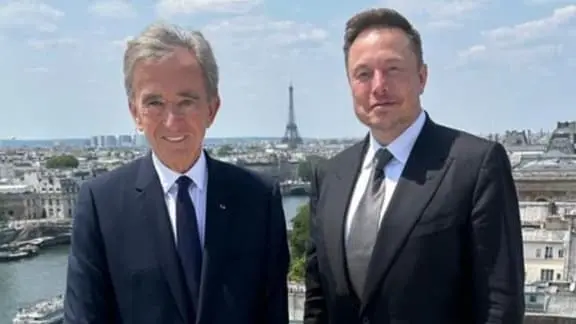
Bernard Arnault, the chairman and CEO of the world's largest luxury goods conglomerate LVMH Moët Hennessy Louis Vuitton, has publicly called for the establishment of a free trade zone between the European Union and the United States. Speaking at LVMH's annual general meeting of shareholders on Thursday, Arnault expressed his strong desire for a zero-tariff environment across the Atlantic, aligning himself with a similar proposal made recently by tech billionaire Elon Musk. His comments come at a time of heightened trade tensions following the return of Donald Trump to the White House, who has imposed new tariffs on a wide range of imports, including luxury goods.
Arnault's remarks were both strategic and critical. He described ongoing negotiations between Europe and the US as "vital" for many companies in France and across the continent, but lamented that the European Union's approach has been too slow and bureaucratic. "I have the impression that our British friends are more concrete in advancing negotiations," Arnault said, noting that the United Kingdom, no longer part of the EU, seems to be making faster progress in talks with Washington. He urged EU leaders to resolve trade disputes "amicably" and to avoid a full-blown tariff war that would harm industries ranging from automotive to viticulture.
The LVMH CEO was particularly vocal about the influence of EU regulators. "The EU is not led by a political power but by a bureaucratic power that spends its time issuing regulations," Arnault stated, arguing that excessive red tape makes it difficult to achieve a meaningful free trade agreement. His criticism of Brussels reflects a broader frustration among European business leaders who feel that the EU's complex regulatory framework puts them at a disadvantage compared to more agile competitors in the US and Asia.
Arnault's proposal echoes a statement made by Elon Musk on April 7th, during a video appearance in which Musk said he would advise President Trump to pursue a free trade zone between Europe and North America with zero tariffs. "Europe and the United States should ideally evolve, in my opinion, toward a situation of zero tariffs, thereby creating a free trade zone between Europe and North America," Musk said. He added that people should be free to work on either side of the Atlantic without barriers. Musk, who serves as a senior advisor to Trump on efficiency and technology, has been a prominent voice in shaping US trade policy.
The push for a transatlantic free trade zone is not new. Similar efforts, such as the Transatlantic Trade and Investment Partnership (TTIP), were attempted during the Obama administration but collapsed in 2016 due to widespread opposition from civil society groups in Europe who feared lowered standards on food safety, labor, and the environment. However, the current economic climate—marked by high inflation, supply chain disruptions, and the aftermath of COVID-19—has revived interest in reducing trade friction.
For LVMH, the stakes are enormous. The group, which owns iconic brands such as Louis Vuitton, Dior, Givenchy, Moët & Chandon, and Hennessy, generates a significant portion of its revenue from the US market. In 2024, LVMH reported over €86 billion in sales, with the Americas accounting for roughly a quarter of that total. New tariffs on French wine, Champagne, and luxury handbags could drastically increase costs for American consumers and squeeze LVMH's margins. Arnault warned that if high tariffs persist, his company will be "forced to increase its American production"—a move that would shift jobs and investment away from France and the rest of Europe.
This is a realistic threat given that LVMH already has manufacturing facilities in the US. The company operates perfume and cosmetics factories in New Jersey, California, and Texas, as well as a Louis Vuitton leather goods workshop in California. Expanding these operations would allow LVMH to bypass tariffs by producing goods directly in the US market. Such a shift would have significant implications for the European luxury industry, which prides itself on craftsmanship and the "Made in France" or "Made in Italy" labels.
Arnault's comments also highlight a growing divide between European business leaders and the EU bureaucracy. While Ursula von der Leyen, President of the European Commission, has proposed a mutual zero-tariff agreement on industrial goods including cars, progress has been slow. Arnault's call for a broader free trade zone that includes agricultural products like wine is particularly urgent for French winemakers, who have already been hit by US tariffs in the past. During Trump's first term, a 25% tariff was imposed on French wine in retaliation for EU subsidies to Airbus, causing a sharp decline in exports.
The prospect of a tariff war also raises broader questions about global trade architecture. The United States and the EU together account for nearly half of global GDP and about 30% of world trade. A breakdown in relations could destabilize the entire multilateral trading system. Conversely, a successful agreement could serve as a model for standard-setting and regulatory cooperation, benefiting both sides.
Elon Musk's involvement adds a layer of complexity. As the CEO of Tesla and SpaceX, and a key figure in the Trump administration's advisory circle, Musk has the ear of the president. His support for a free trade zone could influence US negotiating positions. However, Musk's own companies have benefited from protectionist policies in the past—Tesla has lobbied for electric vehicle subsidies that favor domestic producers. Critics argue that a true free trade zone would require the US to drop its Buy American provisions and other local content requirements.
In the context of global economic uncertainty, Arnault's intervention is a reminder that the world's business elite are actively shaping trade policy behind the scenes. LVMH's shareholders largely supported Arnault's stance, given that the company's stock has faced headwinds in recent months due to slowing demand in China and the uncertain US tariff landscape. The next few weeks will be crucial as EU trade commissioner Maroš Šefčovič is expected to hold further talks with US trade representative Jamieson Greer.
Bernard Arnault's vision of a transatlantic free trade zone may be ambitious, but it reflects a pragmatic desire to de-escalate tensions and stabilize the global economy. Whether Brussels can overcome its bureaucratic inertia and Washington can move beyond its tariff-first approach remains to be seen. What is clear is that the luxury magnate is prepared to make tough decisions—including shifting production overseas—to protect his empire. For now, all eyes are on the negotiators in Brussels and Washington to see if they can deliver the deal that both Arnault and Musk are advocating for.
Source: BFM BUSINESS News