

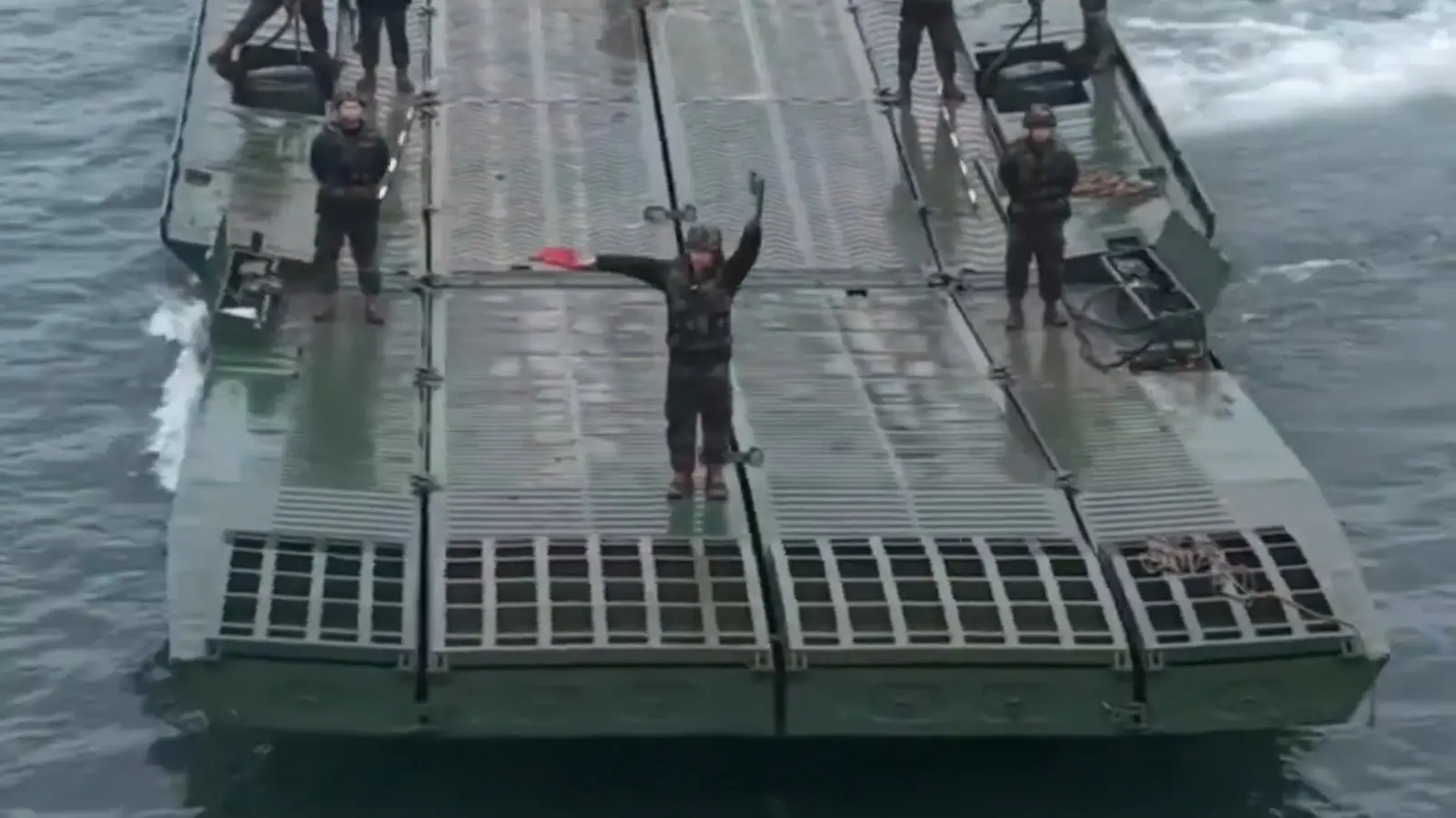
As extreme rainfall continues to batter multiple regions globally, China has demonstrated the effectiveness of its rapidly-deploying pontoon bridge technology in a major rescue operation. In the Guangxi Zhuang Autonomous Region, severe flooding left tens of thousands of people stranded in the Guigang education park. The emergency response agency China Anneng Construction Group deployed what officials call "transforming" pontoon rafts—modular floating devices that unfold on water like real-life Transformers. These rafts have successfully moved hundreds of people at a time to safety, showcasing a unique tool in China's disaster response arsenal.
The concept of pontoon bridges is not new. Military forces have used floating bridges for centuries to cross rivers and bodies of water quickly. However, China Anneng's technology represents a significant evolution. The rafts are divided into sections that travel by truck to the disaster site. Once deployed into the water, each section automatically unfolds, expanding from a compact transportable unit into a full-sized raft. Emergency personnel can then connect multiple sections to form a larger raft or even a continuous bridge spanning a major waterway. This modularity ensures adaptability to different rescue scenarios, from individual extractions to mass evacuations.
The engineering behind these rafts is surprisingly straightforward. Each section contains buoyant chambers and a self-propulsion system, typically a small motor that allows the raft to navigate floodwaters independently. The unfolding mechanism relies on hydraulic or pneumatic systems, enabling deployment within minutes. This speed is critical in flood situations where water levels rise rapidly and survivors may be trapped on rooftops or in buildings. The rafts are designed to carry dozens of people at once, with some configurations reportedly accommodating up to several hundred.
During the Guangxi operation, China Anneng worked alongside other emergency assets. SAR helicopters and standard helicopters have been used to rescue survivors from inaccessible areas, while heavy-duty drones have delivered vital supplies such as food and medicine. This multi-pronged approach underscores the comprehensive nature of China's disaster response. The pontoon rafts, however, are the stars of the show due to their visibility and effectiveness. They have been in use since around 2020, and their performance in the current floods has drawn international attention, including a video posted by the Chinese Embassy in the United States that went viral on social media.
The floods in Guangxi result from multiple rounds of extreme rainfall, which have also caused landslides and infrastructure damage. The region's terrain complicates rescue efforts, as many areas are hilly and prone to rapid runoff. In this context, the ability to rapidly deploy a mobile platform for evacuation is invaluable. The rafts can navigate shallow, debris-laden waters where traditional boats might struggle. Their low draft and robust construction allow them to operate in flooded streets and fields.
Globally, pontoon bridges are used by many military and civilian agencies, but China's version stands out for its self-propelled, unfolding design. For comparison, the US military uses the Ribbon Bridge system, which requires significant manual assembly and heavy equipment. While effective, it is slower to deploy. China's system integrates modern materials and automation to reduce setup time from hours to minutes. This advantage can mean the difference between life and death in fast-moving disasters.
The success of this technology also highlights China's investment in innovative emergency response solutions. Over the past decade, the country has emphasized the development of specialized equipment for natural disasters, which have increased in frequency and severity due to climate change. Flooding, in particular, poses a persistent threat to large populations living in low-lying areas. The pontoon rafts are part of a broader fleet of rescue gear, including amphibious vehicles, air-cushion vessels, and advanced communication systems.
From a historical perspective, pontoon bridges have evolved from simple wooden rafts used by ancient armies to sophisticated floating structures made of steel and aluminum. The Chinese innovation pushes the envelope by combining transportability, rapid assembly, and self-propulsion. Engineers at China Anneng likely drew on lessons from previous floods, such as the 2020 Yangtze River floods, where slower boats struggled to reach isolated communities. The result is a device that can be stored and maintained with minimal effort, yet deployed at a moment's notice.
Looking ahead, this technology may see wider adoption beyond China. Other countries facing flood risks, from Southeast Asia to North America, could benefit from similar systems. However, the specific design and manufacturing expertise remain with Chinese firms. The Guangxi operation serves as a proof-of-concept, demonstrating that modular, unfolding rafts can handle large-scale evacuations effectively. As the world grapples with climate change, innovations like these offer a glimmer of hope for saving lives in increasingly common extreme weather events.
The breadth of the ongoing rescue effort cannot be overstated. According to reports, tens of thousands of people were initially stranded in the Guigang education park alone. The pontoon rafts, working in conjunction with helicopters and drones, have reduced that number significantly. Water levels in some areas have receded, but new rainfall warnings are in effect, keeping emergency teams on high alert. China Anneng's ability to redeploy the rafts quickly to new hotspots is a testament to the system's operational flexibility.
In the wider context of disaster management, the use of such technology aligns with modern best practices that emphasize speed, scalability, and multi-agency coordination. The rafts are not a silver bullet, but they are a powerful addition to the toolbox. Their success in Guangxi will likely lead to further investment and refinement, potentially inspiring similar solutions for other types of natural disasters, such as landslides or earthquakes where collapsed structures block waterways.
Ultimately, the story of these transforming pontoon rafts is one of human ingenuity applied to an age-old challenge. By turning a simple engineering concept into a practical, life-saving device, China Anneng has demonstrated that sometimes less is more. As the floodwaters slowly subside, the rescued survivors and grateful communities serve as a living testament to the value of innovation in emergency response.
Source: SlashGear News