

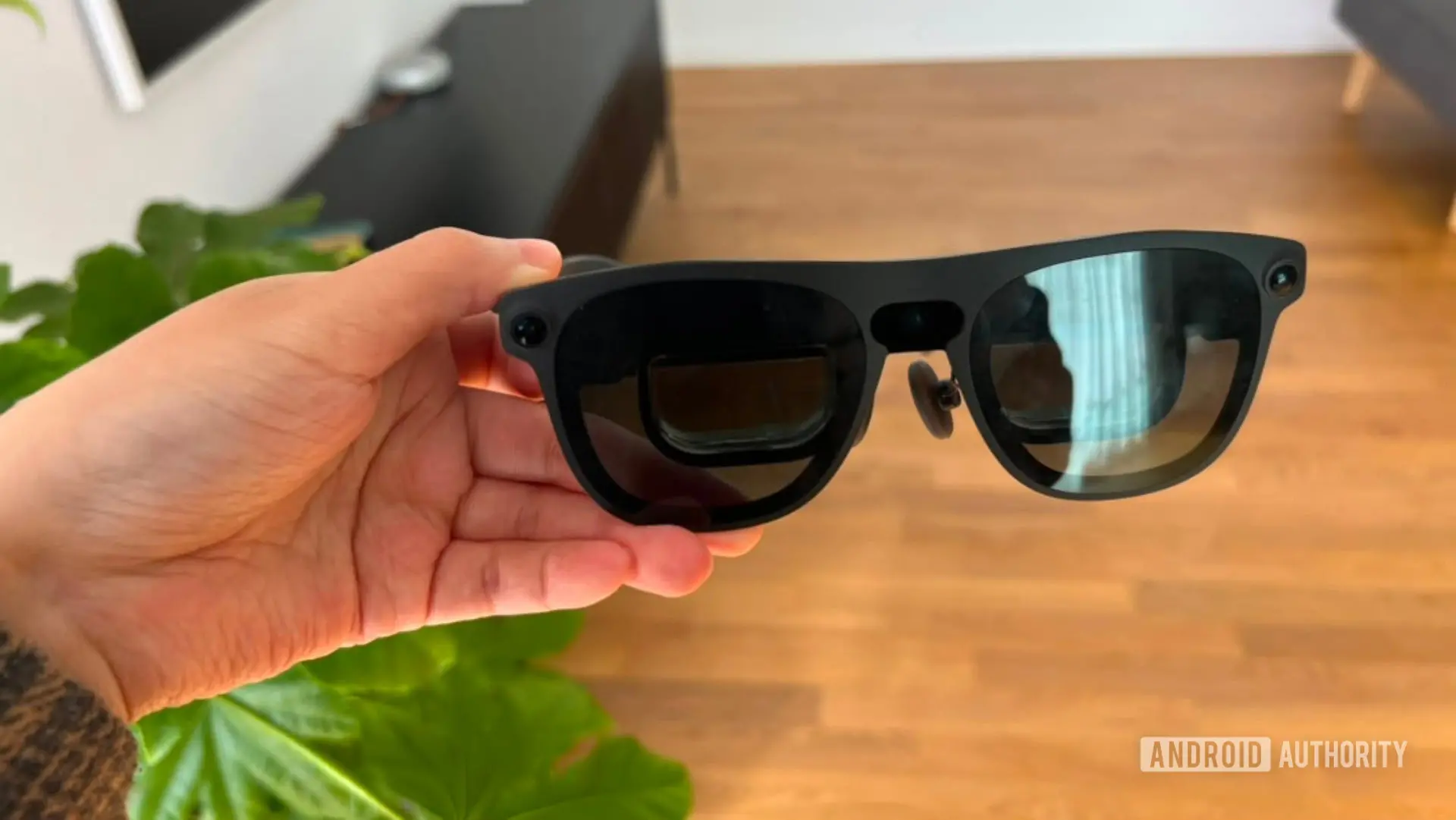
For months, XREAL has teased its first pair of Android XR glasses, and the anticipation around Project Aura has grown with every new detail. I have to admit that I was skeptical at first. Android XR is a brand-new computing modality, and plenty of early AR and VR efforts have stumbled when it comes to making the experience feel approachable. But after spending hands-on time with XREAL's Aura glasses, I find myself eagerly looking forward to launch day.
The company has repeatedly pointed to a fall release, and its recent communications suggest a concrete deadline: Aura will land before the end of 2026 and cost less than $1,500. The exact number remains a bit fuzzy. XREAL representatives at IFA were careful not to imply that “under $1,500” means $1,499, so there may be room for a more aggressive price. Even so, the combination of timing and price means we are closer than ever to a consumer-friendly Android XR product.
Android, but on your face
If you have been following XR, you know that the hardest part is not demonstrating what the technology can do. Companies have been building impressive AR and VR headsets for years. The real challenge is making the experience feel natural enough that you can imagine wearing the device every day. After my time with Aura, I believe XREAL is getting surprisingly close.
The core pitch for Android XR is simple: take the Android experience you already know from your phone and bring it into the space around you. Instead of looking down at a rectangular display in your hand, apps, screens, and digital objects appear on a large suspended display in the physical world. You can watch YouTube on a virtual cinema-sized panel, explore Google Maps on an immersive city view, or interact with content without holding a screen.
What impressed me most is that the interaction does not feel alien. My demo started with a quick introduction to hand gestures: pinch to select, tap to open, drag to move, and a scrolling motion with your hand. I naturally had to think about each movement at first, but after about ten minutes I stopped concentrating on the controls and simply started using them. XREAL told me that this was only a fraction of the full onboarding sequence. First-time wearers will go through a more detailed gesture-training process, which should help newcomers adapt even more quickly.
That familiarity extends beyond gestures. If you have used an Android phone for years, you are not learning an entirely new operating system. The apps, navigation patterns, and basic interactions come from an ecosystem you already understand. For people who have never touched an XR headset, that will almost certainly make the transition easier.
The hardware is more complicated than it looks
Putting a tiny Android computer inside a pair of spectacles is an enormous engineering challenge. Aura is the result of a close collaboration between XREAL, Google, and Qualcomm. Google contributes the Android XR platform and its services, Qualcomm provides the Snapdragon Reality Elite computing platform, and XREAL brings years of experience in AR optics and spatial computing to the hardware. XREAL has also developed its own X1S Spatial Coprocessor, which the company says may be built by TSMC just like the Qualcomm chip.
The glasses use two Sony Micro OLED displays, one for each eye, with a resolution of 1,920 x 1,200 per eye, a refresh rate of up to 120Hz, and a 70-degree field of view. XREAL's X Prism optical system delivers those displays in an form factor reminiscent of traditional eyewear. The design is a little chunky, and not everyone will love it, but I do not find it offensive. More importantly, XREAL is planning to offer prescription lens inserts, so people who wear glasses will not have to double up.
Google Maps might be my favorite use case
The most impressive part of my demo was Google Maps. I have used Maps on my phone for years, but on Aura it felt like a completely different experience. I could zoom in and out of cities and landmarks with remarkable clarity and precision. Exploring different parts of the world this way feels almost magical, and I could easily see myself spending hours browsing neighborhoods and dive bars and parks.
The experience becomes even more compelling for locations with Google's immersive views. In some supported places, a small bubble appears that lets you enter a building and explore its interior as if you were actually there. I tried this with a restaurant in New York. I could see everything from the arrangement of tables to the entire floor plan, with realistic ambient lighting. I had to be careful not to bump into furniture in the demo room while moving around, but the ability to navigate a real space digitally was genuinely eye-opening.
One of the cleverest hardware touches is electrochromic dimming. The lenses automatically darken when you want to focus on digital content, reducing distractions from your peripheral vision. During the more immersive parts of the demo, the glasses darkened enough to make the virtual content feel substantial, but I could still look down and see the physical world beneath me. That balance is important, because no one wants a pair of glasses that completely isolates them. Whether you are walking through an airport or watching an immersive video in your living room, being able to remain aware of your surroundings is essential. Aura handled that balance very well.
YouTube convinced me these could be fantastic for travel
Another portion of my demo revolved around watching YouTube. The standalone YouTube app crashed due to a bug, but I was still able to load videos in Chrome. The virtual display can be made absolutely huge, creating a floating screen that feels more like a projector than a phone or tablet. It is the kind of experience you have to see to fully appreciate: a massive video panel hanging in the air, with crisp Micro OLED colors and smooth motion.
If entertainment is your primary reason for considering Android XR glasses, this is the easiest use case to understand. I can picture myself on a long flight, wearing Aura and making the virtual screen as large as I want, without being dependent on the tiny seatback display in front of me. The same applies at home. Watching a movie while lying in bed and seeing it on what feels like a huge TV is a compelling proposition, especially if you do not have room for a massive television in your bedroom.
Battery life is always a concern for standalone XR wearables. XREAL did not share every detail, but the company told me that Aura should last around four to five hours for streaming tasks. The 4,455mAh battery is housed in an external compute unit rather than inside the glasses themselves, which keeps the eyewear lighter. The glasses connect to that compute unit with a cable, and while that is not an ideal long-term solution, I did not find it distracting or uncomfortable during my demo. It is the kind of thing that you would need to live with for a while to judge fairly, but early impressions are positive.
What about other apps?
I also spent some time with Google Photos, and it provided another example of how a mundane smartphone experience becomes more interesting on Aura. Instead of flicking through small thumbnails, my photos appeared in a giant slideshow reminiscent of a television screen. That is not necessarily the feature that will persuade someone to spend $1,500, but it highlights the broader potential of the platform.
Since Aura has access to the Google Play Store, XREAL does not need to build an entirely new ecosystem from scratch. Android developers already have a familiar set of tools and services to work with. Still, there is a lingering question around app compatibility. XREAL did not offer many specifics about specialized apps or partnerships planned for launch, though the company says announcements will accompany the release. A successful XR platform requires apps that are designed specifically for a spatial interface, not just existing Android apps stretched onto a virtual screen.
Google is clearly serious about Android XR, and Samsung is also working on its own lineup of Android XR hardware. While Samsung and Google have partnered with eyewear brands like Warby Parker and Gentle Monster for non-display glasses, Samsung Display has shown extremely small RGB OLEDoS panels that could eventually make Aura-like visual experiences even more common. This broader momentum makes me wonder whether XREAL is deliberately waiting for Google and Samsung to make their moves before Aura hits the market.
Regardless of the competitive timing, XREAL's glasses are a strong example of what happens when you combine Android with capable displays, spatial tracking, and a glasses form factor. The days of awkward XR prototypes feel increasingly behind us. Aura represents a step toward a future where digital content lives in your field of view without demanding that you disappear into a virtual world. After my relatively short demo, I walked away eager to see what else this platform can do. With a launch window before the end of 2026, I hope my wait is not much longer.
Source: Android Authority News