

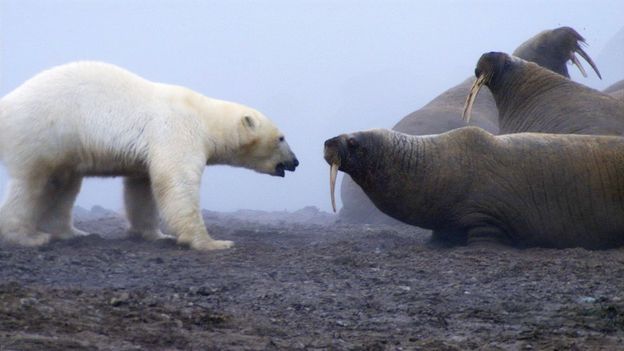
A polar bear's fierce battle against a herd of walruses has been captured on film, showcasing the stark realities of survival in the Arctic. This dramatic encounter was featured in the 'Ice Worlds' episode of a renowned nature documentary series, illustrating the lengths to which polar bears must go in their quest for food amid changing environmental conditions.
The scene is nothing short of extraordinary: a lone male polar bear is seen attacking hundreds of walruses, attempting to penetrate their thick blubber in search of a meal. Using the foggy Arctic landscape as cover, the bear approaches the walrus colony, where adult walruses protect their young by creating a barrier of blubber and hide. The bear begins its ambush by tentatively jumping onto a walrus's back, looking for a weakness to reach the vulnerable pups. Despite his efforts, the female walrus he targets fiercely defends her calf, making it nearly impossible for the bear to succeed.
As the herd starts to flee into the sea, desperation drives the bear to confront the adult walruses directly. His hope of securing a meal after months of hunger is slipping away when he attempts to latch onto an adult walrus, only to be thwarted as the powerful animal manages to escape his grasp. By the end of this intense sequence, the bear is seen limping away, defeated and wounded from the walruses' tusks.
This dramatic scene was filmed by award-winning underwater cinematographer Adam Ravetch in 2004 during his two-year stint in the Arctic. Ravetch captured this moment while filming for the 'Ice Worlds' episode, aiming to document the effects of climate change on polar bears. He recalls the high tension of the moment, stating, 'I've never felt more in danger and alive in my life.' While polar bear attacks on humans are rare, Ravetch found himself in a unique and perilous situation, closely observing the bear's struggle.
Ravetch's aim was not only to capture stunning visuals but also to highlight the polar bear's adaptation to its harsh environment. The footage revealed a significant shift in hunting behavior, as polar bears typically prey on walrus pups but rarely take on adult walruses due to the risk. The cinematographer noted that witnessing the walruses band together to protect their young was an extraordinary display of maternal instincts and social behavior.
As the footage unfolds, it becomes clear that this battle is not just a struggle for survival between predator and prey; it symbolizes the broader challenges facing both species in an era of climate change. The narrative crafted by the filmmakers emphasizes the impact of warming temperatures on Arctic wildlife, particularly the polar bears' reliance on sea ice for hunting seals. With diminishing ice, these apex predators are forced to adapt their hunting strategies, often leading to more dangerous encounters.
Vanessa Berlowitz, the producer and director of the episode, commented on the scene's profound representation of the polar bear's plight. 'It was actually a very balanced scene. No one's a winner here. Everyone's struggling,' she said, emphasizing the shared vulnerabilities of both the walruses and the polar bear.
As climate change causes the Arctic to warm nearly four times faster than other regions, the survival of these majestic creatures hangs in the balance. Sir David Attenborough narrates the gravity of the situation, stating, 'If the global climate continues to warm, and the Arctic ice melts sooner each year, it's certain that more bears will share this fate.' The film serves as a powerful reminder of the urgent need to address climate issues affecting wildlife.
While the sight of the polar bear struggling against the walrus herd may be a rare occurrence, it sheds light on the harsh realities faced by these species as they navigate their changing habitat. Researchers have noted that while some polar bear populations appear to adapt to land-based hunting, the overall decline in sea ice poses significant threats to their survival.
Ravetch's remarkable footage and the story it tells continue to resonate, serving as a visual testament to the resilience and adaptability of polar bears. As he reflects on the iconic scene, he notes, 'It is a generational legacy of our planet earth at this time, archived for future generations to see.' This powerful narrative invites viewers to consider the far-reaching impacts of climate change on the natural world, urging a collective response to protect these extraordinary creatures.
Source: Bbc News