

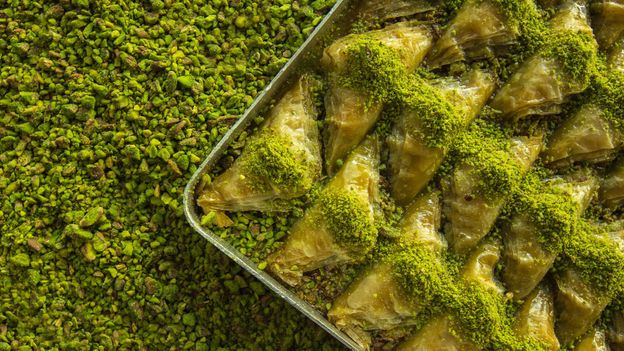
For centuries, pistachios have defined Gaziantep, a city in Turkey renowned for its culinary excellence. Today, these vibrant green nuts remain the most prized ingredient in this culinary capital, playing a crucial role in creating the region's legendary baklava.
As summer fades into autumn, bakers in Gaziantep venture into the sun-drenched orchards that blanket the southeastern plains of Turkey. Known locally as 'green gold', this valuable crop is more than just an economic asset; it is the heart and soul of Gaziantep's culinary landscape.
While the pistachio harvest typically peaks in September, some farmers begin hand-picking the nuts as early as late August. These early-season pistachios boast an extraordinary flavor that bakers eagerly seek. Aylin Öney Tan, editor of the cookbook 'A Taste of Sun and Fire', notes that bakery owners taste the nuts from various trees and often purchase entire orchards when the harvest nears readiness.
These early pistachios are essential for crafting local delicacies, such as katmer, a creamy breakfast pastry, and baklava, which is celebrated as the best in Turkey. For Gaziantep's residents, these sweets are far more than mere desserts; they are integral to their cultural identity and daily life.
Hatice Pekmez, an associate professor at Gaziantep University, emphasizes the significance of sweets in local customs: "Sweets go beyond desserts here – they mark nearly all of our milestones." From welcoming newborns with trays of syrupy pistachio baklava to serving soft, buttery halva at funerals, the act of sharing these dishes fosters community bonds.
Before dawn, bakers in Gaziantep ignite their oak-fired ovens, prized for their ability to produce a pure, smokeless heat. By 8 AM, the family-owned bakery Katmerci Zekeriya Usta is bustling with locals savoring freshly made katmer, which is filled with sweet pistachios and clotted cream. Mehmet Özsimitçi, the bakery's third-generation owner, shares that this dish is traditionally enjoyed by newlyweds for their first breakfast together, symbolizing a sweet start to their new lives.
Özsimitçi has spent his life in the bakery, starting as a child alongside his father. Now at 65, he continues to uphold the tradition of using locally sourced ingredients, such as pistachios from nearby orchards and clarified butter from mountain herds. "In Gaziantep, we have great respect for the ingredients," he asserts.
The scents emanating from Katmerci Zekeriya Usta waft through the narrow streets of Gaziantep's historic district, believed to be inhabited for over 10,000 years. Visitors can even explore the small, free-to-visit Pistachio Museum, where they discover the long history of pistachios in the region, with remains dating back to the 3rd millennium BCE found at nearby archaeological sites.
For travelers, Gaziantep offers an unofficial pistachio trail, with shops in ancient markets displaying pyramids of fresh nuts. The Bakırcılar Çarşısı, or Coppersmiths' Bazaar, features stalls selling pistachio-dusted Turkish delight and sweet rolls of pistachio paste. Neon signs emblazoned with the word fıstık (pistachio) light up the storefronts.
Locals also celebrate the annual pistachio harvest during the GastroAntep Festival each September, featuring workshops and pop-up dinners. The region produces over 70% of Turkey's pistachios, thriving in rocky soil that encourages deep root growth and summer heat that perfects the nut's ripeness.
Mustafa Özgüler, executive chef at the Gaziantep bakery-restaurant Orkide, explains, "Gaziantep pistachios are sweeter and greener than those grown elsewhere." His establishment showcases an array of pistachio treats, including cookies and baklava, and features a katmer maker who crafts pastries to order. A visit to a local pistachio orchard reveals trees decades old, gifted to the city after the previous owner passed away in the tragic Turkey-Syria earthquakes of 2023.
In Gaziantep, having a bağ evi, or a country house with pistachio and walnut trees, is a cherished tradition, reflecting a lifestyle intimately connected to the land. Wealth in this city was historically measured by the amount of pistachio land one owned.
Among the various pistachio desserts, baklava reigns supreme. Güllüoğlu, established in 1871 within the Elmacı Bazaar, claims to be the oldest continuously operated baklava bakery in Turkey, offering a dazzling display of classic baklava, şöbiyet, and havuç dilimi baklava, each filled with a brilliant pistachio mixture.
Güllü Çelebi, the founder of Güllüoğlu, was inspired by walnut baklava he encountered while on a pilgrimage to Mecca and adapted the recipe to utilize the abundant local pistachios, a change that would forever alter Gaziantep's culinary heritage.
Filiz Hösükoğlu, a gastronomy expert from Gaziantep, remarks on the pride residents take in baklava production, likening it to the craftsmanship of Michelangelo in Florence. As a child, she recalls her father bringing home trays of pistachio baklava to celebrate the end of Ramadan, emphasizing the enduring loyalty families have towards their preferred bakers.
Travelers to Gaziantep can indulge in the city's rich variety of baklava. After sampling a selection at Güllüoğlu, visitors often venture to Koçak Baklava, an elegantly appointed eatery that attracts a fashionable crowd. At İmam Çağdaş, a bakery-restaurant founded in 1887, bakers skillfully roll dough into translucent sheets and bake them in stone ovens, ensuring the perfect texture for baklava.
Burhan Çağdaş, the bakery's fourth-generation owner, shares that many bakers have dedicated their lives to this craft, starting their training as children. "It takes a minimum of five years to educate a great baklava master," he explains.
In Gaziantep, the art of baklava making is not merely a profession; it is a profound connection to the culture and rituals of the city, intertwining food with the essence of life itself.
Source: Bbc News