

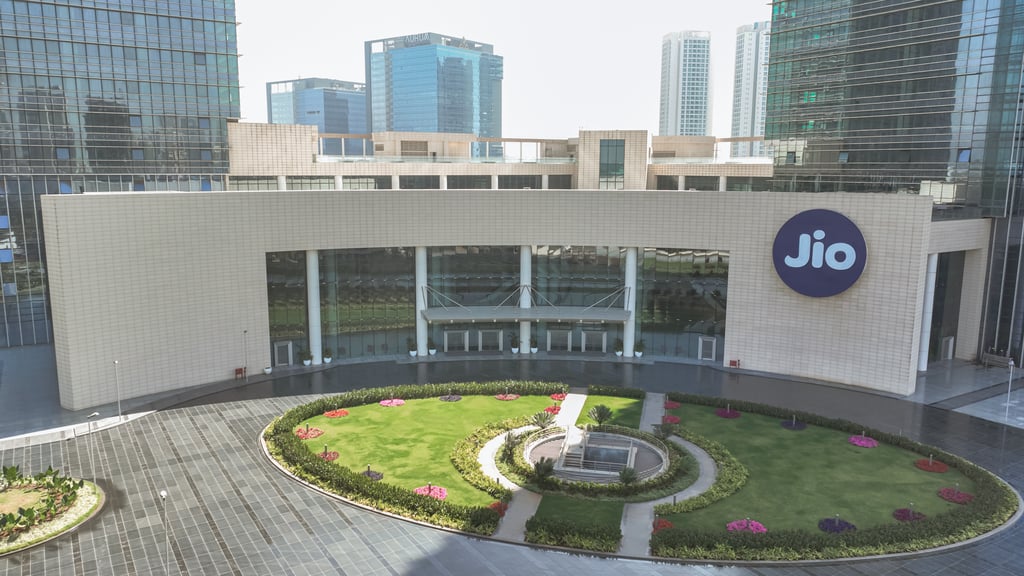
Reliance Industries wants artificial intelligence to start where hundreds of millions of Jio users already spend time: on the phone call. At the company’s annual general meeting on June 19, 2025, Chairman Mukesh Ambani outlined an ambitious AI roadmap built around Jio CallAgent, Reliance Intelligence, and a planned compute buildout in Jamnagar. The strategy is designed to embed AI deeply into telecom workflows, offer local-language services, and build lower-cost infrastructure for India and similar markets in Asia-Pacific.
The announcement marks a critical moment for Reliance as it attempts to replicate the disruptive success of Jio’s 2016 entry into the telecom sector. Back then, Jio’s ultra-cheap data plans transformed India’s internet landscape, bringing hundreds of millions online for the first time. Now, Ambani is betting that AI can follow a similar path — not through standalone apps, but by integrating intelligence into existing communication channels that Indians already use daily.
Jio CallAgent: AI Inside Phone Calls
The most immediate product from the AGM is Jio CallAgent, an AI assistant designed to join active Jio calls with user consent and without requiring a separate app or additional phone number. It can transcribe conversations in real time, create summaries and action items, help with bookings or scheduling, and even process payments — though the company emphasized that payment-related actions would require explicit user confirmation. With more than 524 million subscribers, Jio gives Reliance a distribution channel that most stand-alone AI applications cannot match. If CallAgent rolls out as described, AI assistance would sit inside a familiar workflow — the phone call — instead of asking users to adopt a completely new interface.
This approach is particularly relevant for India, where voice communication remains dominant. According to industry reports, Indians spend an average of over 20 minutes per day on voice calls, far more than users in many Western markets. By embedding AI directly into calls, Reliance eliminates the friction of switching between apps or remembering new commands. For small business owners, field agents, and customer support teams, Jio CallAgent could serve as a real-time assistant that captures important details without manual note-taking.
Reliance Intelligence, announced in 2025 as the group’s AI unit, is now being framed as the execution arm for the entire AI buildout. The company says its AI services will support 22 Indian languages, a key requirement for adoption beyond English-speaking users. In addition to CallAgent, Reliance mentioned several other AI tools for its ecosystem: MyJio (the carrier app), JioTeleFrame (a digital photo frame), and AI-powered solutions for merchants, health, education, and agriculture. While these products remain in early announcement stages, they signal a broader ambition to weave AI into every consumer and business channel Reliance operates.
The Jamnagar Compute Backbone
Reliance’s AI roadmap depends on infrastructure as much as product design. The company has described its Jamnagar project as part of a “sovereign AI backbone,” with local compute meant to support AI services across Reliance’s consumer and business platforms. Jamnagar, already home to the world’s largest oil refinery complex, is being repurposed as a massive data center campus that will house GPUs, networking gear, and cooling systems needed for AI workloads. Ambani is positioning AI as a scale-and-cost problem similar to mobile data in 2016, when Jio’s entry changed India’s telecom market and forced competitors to slash prices.
If Jamnagar delivers on its promise, Reliance could lower AI service costs for its own platforms and for Indian enterprises and startups that currently face scarce and expensive compute access. The buildout also reflects a wider shift in AI infrastructure, where power delivery and cooling are becoming as important as chips and models. India’s hot climate and frequent power outages add complexity, but Reliance’s experience in energy and petrochemicals gives it unique capabilities in managing large-scale industrial infrastructure.
Reliance is still leaning on global partners for the model layer, including Google, Meta, and NVIDIA. The company’s strongest local-control claim lies around compute and distribution rather than full model development — a tension that mirrors the broader sovereign AI debate across Asia-Pacific. Many governments want to reduce dependence on foreign technology, but building competitive foundational models from scratch requires vast budgets and scarce talent. By focusing on infrastructure and integration, Reliance takes a pragmatic middle path.
Local-Language AI Services
A standout aspect of the AI roadmap is the emphasis on supporting 22 Indian languages. India’s linguistic diversity is immense — the constitution recognizes 22 scheduled languages, and hundreds of dialects are spoken across the country. For AI to achieve broad adoption, it must work in Hindi, Tamil, Telugu, Bengali, Marathi, and many others. Reliance claims its AI services will be able to understand, transcribe, and generate text in these languages, opening up digital assistance to hundreds of millions of non-English speakers.
This is a key differentiator from most global AI products, which are optimized for English first. Google’s Gemini and OpenAI’s ChatGPT have made strides in multilingual capabilities, but they often lag in accuracy and naturalness for Indian languages. Reliance’s ability to train models on massive amounts of local voice and text data from Jio’s network could give it a unique advantage. The company’s existing investments in digital content, including JioSaavn (music streaming) and JioCinema (video), provide additional data sources for language model training.
For rural and semi-urban users, voice-based AI in local languages could be transformative. Farmers could get weather and market updates via a call to a Jio number that automatically summarizes key information. Students could use the assistant to understand textbooks in their mother tongue. Small shopkeepers could manage inventory and orders without typing. These use cases align with India’s push for inclusive digital growth, as outlined in the government’s Digital India initiative.
However, building accurate language models for all 22 scheduled languages is a monumental engineering challenge. Data scarcity for smaller languages, dialectal variations, and code-switching (mixing languages in the same sentence) are well-known obstacles. Reliance will need to invest heavily in data collection, annotation, and model fine-tuning to deliver on its promise. Early performance benchmarks from other multilingual AI systems show significant accuracy drops for low-resource Indian languages like Maithili or Manipuri. How Reliance addresses this will be closely watched by the tech community.
Enterprise and Compliance Considerations
For IT teams and enterprise buyers, the unresolved issues around Jio CallAgent and the broader AI platform are practical and pressing. Pricing has not been disclosed beyond vague mentions of “affordable” tiers. Service reliability, especially during peak call volumes, remains untested. Language performance across India’s vast dialectal landscape is unproven. And the governance of a call-joining AI agent raises serious questions about multi-party consent, data retention, and compliance with India’s Digital Personal Data Protection Act (DPDPA), which came into force in 2023.
The DPDPA requires explicit consent for processing personal data, and the concept of a third-party AI joining a private call introduces novel privacy risks. Reliance has stated that the AI will join only with user consent, and that payment-related actions will need separate confirmation. But the law also requires data localization and limits on how long data can be stored. For a service that records conversations, these rules have direct implications. IT architects in sectors like banking, insurance, and healthcare will need to assess whether CallAgent meets their compliance requirements before deploying it at scale.
Faster AI adoption across Asia-Pacific is creating new governance and security gaps. Countries like Singapore, Japan, and Australia are rushing to regulate AI while encouraging innovation. In India, the government’s approach has been relatively light-touch so far, but a comprehensive AI law is expected within the next two years. Reliance’s early moves may shape the regulatory conversation, but they also expose the company to scrutiny if privacy incidents occur.
Despite these challenges, the telecom-native AI approach has compelling advantages in markets with large mobile-first populations, heavy voice usage, multiple local languages, and constrained device capacity. In such environments, app-first deployment often fails because users lack high-end smartphones, reliable internet, or digital literacy. By contrast, a voice AI that works on any phone with a cellular connection — Jio’s network covers over 1.2 billion people in India — can leapfrog the app economy entirely.
Reliance is betting that AI adoption at scale depends on distribution, compute, language access, and trust as much as model quality. That thesis should become clearer as Jio CallAgent and the Jamnagar compute hub move from roadmap to rollout. The coming months will reveal whether the company can execute on its vision without stumbling on the technical and regulatory hurdles that have tripped up other ambitious AI projects.
Source: TechRepublic News