
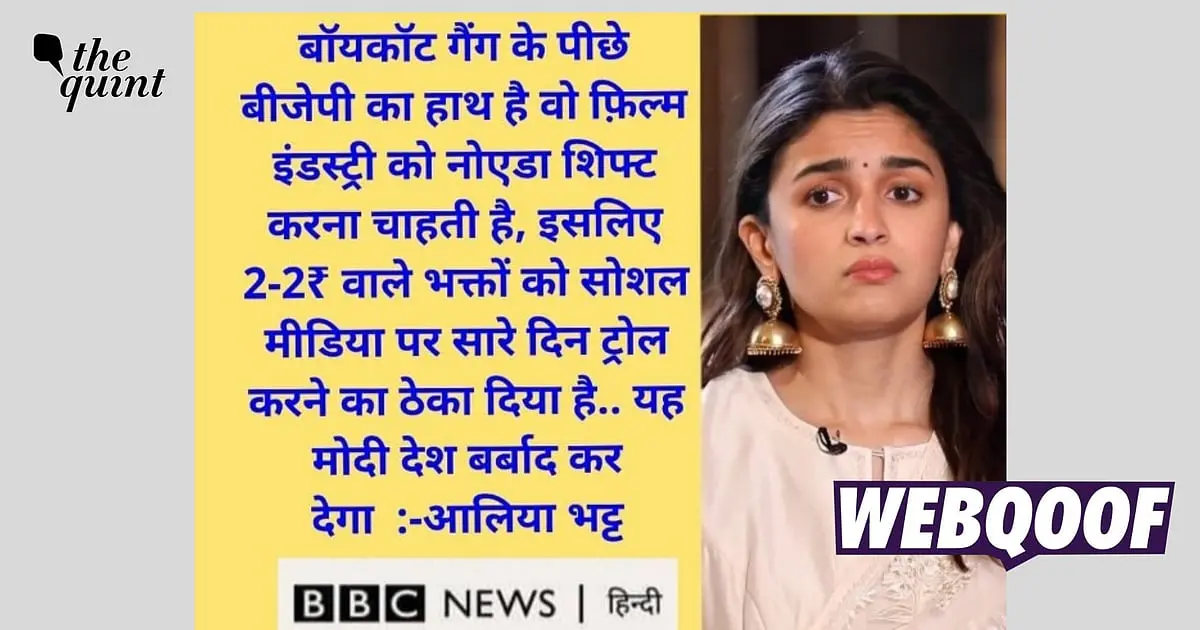
As the Hindi film Brahmastra hit theatres in September 2022, the hashtag BoycottBollywood once again began trending on social media. Amid this atmosphere of online backlash, a screenshot started circulating widely, carrying the logo of BBC News Hindi and showing a statement attributed to actress Alia Bhatt. The purported statement claimed that Bhatt held the Bharatiya Janata Party (BJP) and Prime Minister Narendra Modi responsible for the boycott campaign, alleging that the party wanted to shift the film industry to Noida and accusing the prime minister of ruining the country.
The screenshot looked convincing at first glance. It had the BBC News Hindi logo, the familiar layout of a television graphic, and a quote that seemed to match the political mood of the moment. Social media users shared it with captions expressing either outrage or support, depending on their political leanings. But the problem is that the entire thing is fabricated.
Origins of the Viral Claim
The misleading screenshot began circulating on Twitter, Facebook, and WhatsApp groups in early September 2022, just as the boycott trend peaked around the release of Brahmastra. The film, starring Ranbir Kapoor and Alia Bhatt, faced calls for a boycott over various reasons, including the casting of actors who had reportedly spoken about issues in the past. The boycott calls were amplified by certain social media users, and the hashtag trended for days.
It was in this context that the fake BBC News Hindi graphic appeared. The statement attributed to Alia Bhatt read: “The entire country is watching. The BJP is behind the boycott. They want to shift the film industry to Noida. The prime minister is ruining the country.” No such quote appeared in any credible news report, and no video of Bhatt making these remarks surfaced. Yet the screenshot spread quickly, fooling many users.
BBC News Hindi’s Official Clarification
On 7 September 2022, BBC News Hindi took to its official Twitter account to issue a clear denial. The tweet, written in Hindi, said: “A post in BBC Hindi’s name is being shared on social media that highlights a statement made by actress Alia Bhatt. The logo of BBC Hindi is also used in this. But, this is fake and it has nothing to do with BBC Hindi.” The tweet was accompanied by the hashtag FAKE_NEWS_ALERT, signaling the severity of the misinformation.
The clarification was shared broadly, and screenshots of the BBC tweet were themselves shared as a counter to the viral claim. However, like many debunked pieces of misinformation, the fake screenshot continued to circulate even after the clarification.
This is not the first time that BBC’s name has been misused to spread false statements. In the same week, another fake tweet in the name of BBC had gone viral, claiming that the lead actors and producer of Brahmastra had donated crores of rupees toward flood relief in Pakistan. That claim was also false and was debunked separately.
Alia Bhatt’s Public Statements and Recent Interviews
To check whether Alia Bhatt had ever made any such statement, we looked through her public appearances and interviews from 5 August 2022 to 7 September 2022. In the weeks before the release of Brahmastra, Bhatt gave several interviews to promote the film. She spoke about her role, the visual effects, the direction of Ayan Mukerji, and the experience of working with Ranbir Kapoor. She also addressed the boycott trend in a cautious manner, saying that it was a “sad” thing and that she felt the audience should not be forced into a negative mindset. But at no point did she blame any political party or the prime minister.
In fact, during an interview with an Indian news agency, Bhatt said that she thought the boycott trend was not a reflection of the majority of the audience. She expressed hope that people would watch the film in theatres and form their own opinions. Such neutral and measured comments were far from the provocative statements attributed to her in the fake screenshot.
The fabricated quote about moving the film industry to Noida is particularly outlandish. No actor, let alone one from a prominent film family like Bhatt, has ever suggested such a thing in any public forum. The phrase also bears little resemblance to the kind of language used by Bollywood celebrities in their interviews, which made the claim even more suspicious to careful readers.
The Broader Context of Boycott Bollywood
The BoycottBollywood trend has been a recurring phenomenon since around 2020. It has involved calls to boycott specific films, actors, or the Hindi film industry as a whole. Reasons cited have ranged from alleged disrespect to certain communities, to purported ties with certain political ideologies, to the use of actors who have spoken on sensitive issues. The trend has been fueled by social media, where a small number of highly active accounts can create the appearance of a large movement.
Some political figures have supported the boycott calls, while others have denied any connection. The claim that a political party is orchestrating the trend has been made by various people, but rarely with concrete evidence. In this vacuum, fake statements like the one attributed to Alia Bhatt fill the gap and become a proxy for the political debate.
The effect of these boycott calls on the film industry has been a topic of debate. While films like Brahmastra still performed relatively well at the box office, the constant threats of boycotts have led to changes in how films are marketed, how actors respond to interviews, and how studios handle dissent. Many insiders have expressed concern about the chilling effect on creative expression.
The Role of Fact-Checking in the Digital Age
The rapid spread of the fake BBC screenshot demonstrates the importance of fact-checking. In an era when anyone can create a realistic-looking graphic using simple editing tools, verifying information before sharing is essential. Media outlets and social media platforms have stepped up their efforts to flag false content, but the sheer volume of misinformation makes it an uphill battle.
The BBC News Hindi clarification was a quick and clear response, but such clarifications often receive far less attention than the original fake news. The emotional charge of a claim that a popular actress blamed the ruling party for industrial sabotage is too powerful for some users to resist sharing, even after the claim has been debunked.
Fact-checking organizations and vigilant journalists play a crucial role in this ecosystem. They examine the source, cross-check with official channels, and provide evidence-based conclusions. In the case of the Alia Bhatt screenshot, a simple search of BBC News Hindi’s official social media handles was enough to confirm that no such report existed. Additionally, checking Alia Bhatt’s own verified social media accounts showed no such statement.
What the Fake Screenshot Specifically Said
The screenshot that went viral was styled like a news bulletin. It listed the BBC Hindi logo in the corner and displayed the actress’s photo alongside the fabricated quote. The quote was written in Hindi and translated roughly as: “The BJP is the one running the boycott gang. They want to move the entire film industry to Noida. The PM is ruining the country.” Below the quote, there was a chyron that read “Breaking News,” further adding to its fake urgency.
Several users shared the screenshot with hashtags like BoycottBollywood alongside the claim that “Alia Bhatt has finally spoken the truth.” Others used it to criticize the actor, saying that she was “spreading lies about the party.” The response was divided along predictable political lines, with each side using the fake statement to validate its own narrative.
When the BBC denial was posted, those who had shared the screenshot were forced to retract or remain silent. But some users simply ignored the clarification and continued to circulate the screenshot, proving that misinformation often has a longer life than the truth.
No Evidence Anywhere
A thorough search of news databases, interview transcripts, and social media posts yielded nothing. Alia Bhatt has not made any public statement linking the BJP to the boycott of Bollywood films. Neither has BBC News Hindi issued any such report. The only BBC-related material on this subject is its clarification that the screenshot is fake.
The claim that the BJP wants to shift the film industry to Noida has also been circulated independently of the Alia Bhatt screenshot. Some social media users have posted it in the form of a meme or a status message. It appears to be a baseless rumor, possibly inspired by the fact that the Noida Film City is under development. The Uttar Pradesh government has indeed planned to build a film city in Noida, but this is a separate project that has been in the news for other reasons. There is no evidence to suggest that any political party is trying to force the existing film industry to relocate.
Similarly, the accusation that the prime minister is “ruining the country” is a subjective opinion, not a factual statement. While many people hold critical views of the prime minister, attributing such a statement to a specific celebrity without proof is unfair and constitutes misinformation.
Previous Instances of Forged Media Content
The fake Alia Bhatt screenshot is part of a worrying pattern of forged media content. In the same week, as noted earlier, a fake tweet attributed to BBC claimed that Brahmastra actors had donated to Pakistan flood relief. That tweet was also debunked by BBC News Hindi. Around the same time, other fake screenshots attributed to various news channels were circulating, each containing quotes designed to provoke political response.
These incidents highlight the ease with which digital tools can be used to create convincing falsehoods. A screenshot that appears to come from a trusted news outlet can sway opinions and even influence public discourse. The creators of such fakes rarely come forward, and their motives vary from playful mischief to deliberate political manipulation.
For the average social media user, the best defense is to pause and verify. Check the official website or social media handle of the news outlet. Look for the same story on multiple credible sources. Be wary of screenshots alone, as they can be easily doctored. And if a statement seems too explosive or too fitting to a particular narrative, it is worth a second look.
In the case of Alia Bhatt, the actor herself has chosen not to comment on the fake screenshot, likely because responding to every piece of misinformation would be an endless task. Her team has not issued any formal denial, but the absence of any legitimate source for the quote is proof enough that it is fabricated.
Media Literacy and the Way Forward
The viral nature of the fake BBC screenshot underscores a growing crisis of trust in digital media. With the rise of social media platforms, anyone can become a publisher, but not everyone exercises the same responsibility as professional journalists. The spread of misinformation can have real-world consequences, from shaping electoral outcomes to inciting violence. In this case, the harm was limited to the reputation of an actress and a news organization, but the underlying problem is serious.
Media literacy campaigns, both in schools and online, are essential to combat this trend. Teaching people to identify trustworthy sources, to question suspicious claims, and to seek verification before sharing can go a long way toward reducing the impact of fake news. Social media platforms also have a responsibility to label and limit the reach of false content. While they have made some efforts in this direction, the sheer volume of posts makes it impossible to catch everything.
Journalists and news outlets, too, must continue to debunk fakes quickly and clearly. The BBC’s prompt clarification was a model of how to respond to a viral falsehood, and other organizations would do well to follow that example. At the same time, they must resist the temptation to amplify fake content by giving it excessive attention. A balance must be struck between alerting the public and avoiding undue repetition of the false claim.
Ultimately, the responsibility lies with each individual. Every time we share a post, we are playing a role in the information ecosystem. By choosing to verify before sharing, we can help create a healthier public discourse. The Alia Bhatt screenshot is a reminder that appearances can be deceiving, and that even trusted brand logos can be co-opted to spread lies. The next time you see a shocking quote from a celebrity, take a moment to ask: Is this real? Where did it come from? Can I find it on an official source? The answer might save you from being part of the problem.
Source: TheQuint News