

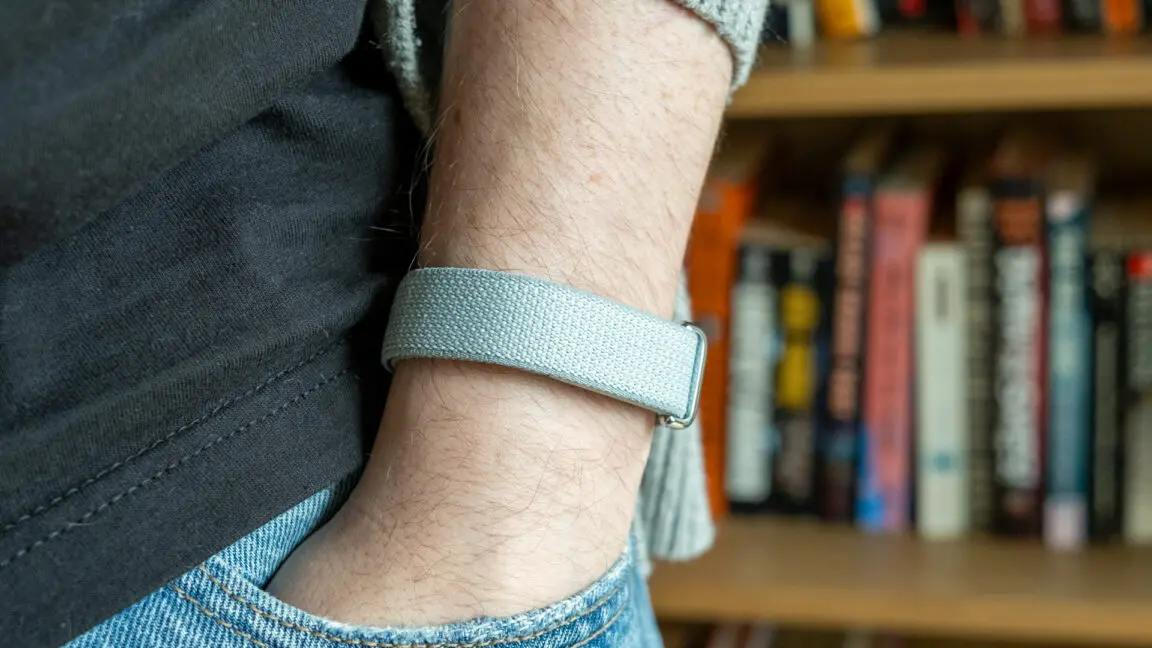
The landscape of fitness wearables has evolved dramatically over the past decade. Smartwatches now dominate the market, packing vibrant screens, app ecosystems, and always-on connectivity. But for those who simply want to track their health without digital distractions, the minimalist tracker remains an appealing alternative. Enter the Fitbit Air – a $100 fitness tracker that strips away the display entirely, leaving behind a small, lightweight sensor module you can wear 24/7. While the hardware is well-executed and comfortable, the experience is increasingly shaped by Google's new health platform, which leans heavily on a generative AI assistant known as the Health Coach. This AI, while occasionally insightful, often feels like an unwelcome chatterbox, detracting from the purity of the tracker's purpose.
The Fitbit Air itself is a small puck, barely larger than the sensor cluster on many smartwatches. It has no speaker, no buttons, and only a single LED on the side to indicate battery level. To check the battery, you double-tap the device, and that is the extent of its on-board interaction. The vibration motor is reserved solely for alarms; it cannot sync with phone notifications, which makes sense given the lack of a screen to tell you what a buzz means. The tracker mounts inside interchangeable bands, and the stock Performance Band is made from polyester yarn with small Velcro pads and a metal loop. It is durable but can absorb moisture, so for swimming or heavy workouts, the optional silicone Active Band ($35) or the more refined Elevated Band ($50) are available. These accessory prices seem steep relative to the tracker's cost, and third-party alternatives are still scarce. The design, however, is undeniably sleek and comfortable, making it easy to forget you are wearing it—a key attribute for all-day and all-night wear.
Sensors and tracking
Despite its minimalist exterior, the Fitbit Air packs an impressive array of sensors. It tracks steps, heart rate, blood oxygen saturation, and skin temperature, though it omits ECG capability. All this data feeds into Google's revamped Health app, which replaces the old Fitbit interface. The Air uses its sensors to automatically detect workouts and log them in the app. Because the tracker has no screen, you must rely on your phone for live statistics during exercise, which might be a drawback for some. The quality of data appears solid: sleep timings are accurately detected, the smart alarm works reliably, and the 'readiness score' often correlates well with how one feels. The battery life is a standout feature, lasting a full week on a single charge, making it ideal for continuous wear.
For long-time Fitbit users, the transition to the Google Health app may bring some disappointments. Features like blood pressure tracking and custom meal creation have been removed, and the app lacks extensive layout customization. Google has promised future updates to address these gaps, but for now, the app offers a more streamlined experience that may satisfy new users but frustrate veterans.
Health Coach: friend or foe?
The most controversial aspect of the Fitbit Air is the integrated Health Coach, an AI model based on Google's Gemini technology. It is included with the Premium subscription (the Air comes with three months of Premium, though you can use the device without it). The Coach is woven into the Health app, providing summaries, suggestions, and words of affirmation for everything from your sleep quality to your daily step count. In theory, a personalized AI health assistant could be valuable. The Coach is tuned specifically for health data, grounded by the metrics your wearable collects. It can offer insights such as suggesting recovery after a heavy workout or explaining patterns in your heart rate variability.
However, in practice, the Health Coach often falls short. It suffers from the same fundamental issues as most generative AI: occasional hallucinations (like inventing workouts from brief heart rate spikes), missing data that is clearly visible elsewhere in the app, and a tendency to produce long-winded, somewhat cloying praise. The AI is primed to be your pal, using 'vibemarking' to generate outputs that feel encouraging but often lack substance. Summaries of workouts and sleep take up a disproportionate amount of screen space, offering platitudes like 'Maybe go for a light walk or something' in far too many words. For users who simply want to glance at their data graphs, this verbose AI feels intrusive.
You can provide the Coach with contextual information, such as 'I have a toddler who wakes me up at night,' and it will adjust its analysis accordingly. It follows instructions well, but the fundamental question remains: do you need an AI summarizing your health data? For casual users, the insights are usually obvious. For serious athletes, the AI lacks the depth of dedicated coaching platforms. Moreover, the Health Coach is always present, always talking. Free users get a more information-dense, less chatty interface, which many might prefer. To disable the Coach, you have to dig into menu settings (Profile > Your data in Google Health > Feature Control > Google Health Coach), and even then, a residual 'Ask Coach' button remains.
The bottom line
The Fitbit Air is a compelling choice for anyone seeking a no-nonsense fitness tracker that prioritizes comfort and battery life over smartwatch distractions. Its hardware is well-designed, accurate, and reasonably priced at $100 (or $130 for a special edition). Compared to subscription-heavy alternatives like Whoop, the Air offers better value with no mandatory ongoing fees. However, the experience is tainted by Google's push to make the chatty Health Coach the centerpiece of its health platform. While the AI can be turned off, its presence—and the effort required to banish it—detracts from what should be a simple, pure tracking experience. The Air itself is excellent, but the software ecosystem around it has yet to find the right balance between helpful intelligence and intrusive noise.
Source: Ars Technica News