

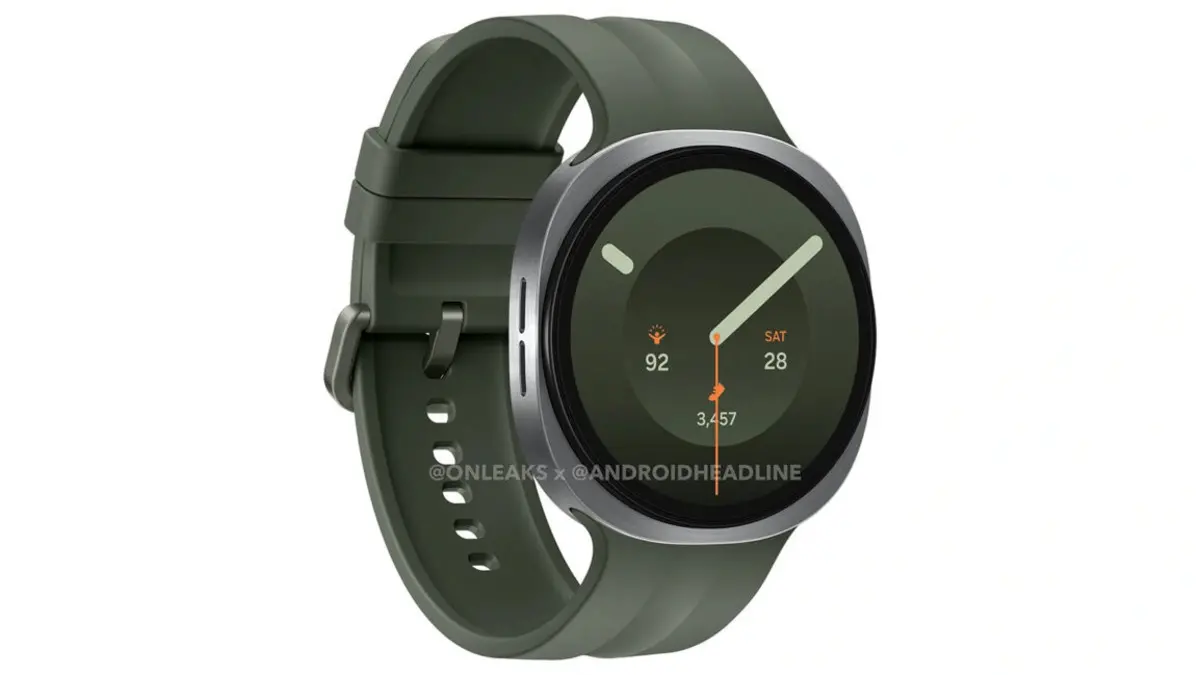
When Samsung holds its next Unpacked event, rumored for July 22 in London, the company is expected to unveil its latest foldable phones, the Galaxy Z Fold 7 and Galaxy Z Flip 7, alongside a new generation of wearable technology. Among the most anticipated products is the Galaxy Watch 9, which will likely share the stage with the Galaxy Watch Ultra 2. Freshly leaked renders, provided by Android Headlines, give us our first clear look at the Galaxy Watch 9, and as many had suspected, the design remains largely unchanged from its predecessor—the Galaxy Watch 8.
The renders show a smartwatch that is almost indistinguishable from the Galaxy Watch 8, down to the arrangement of sensors on the back. This indicates that Samsung is focusing on internal upgrades rather than a radical redesign. The most significant internal change is the processor: Samsung has confirmed that the next-generation Galaxy Watch will be powered by a Qualcomm Snapdragon Wear Elite chipset, marking a departure from the Exynos processors that have been used in previous models. This shift could bring better performance, improved battery efficiency, and enhanced connectivity features.
The leaked materials also detail the size and color options. The Galaxy Watch 9 will reportedly be available in two sizes: a 40mm variant and a 44mm variant. For the 40mm model, buyers can choose between Cream and Graphite finishes, while the 44mm model will come in Silver or Graphite. Interestingly, the same colors—Cream and Graphite—have also been rumored for the upcoming Galaxy Z Fold 7, suggesting a cohesive design language across Samsung's product lineup. Multiple band colors will be offered, allowing users to personalize their devices.
In terms of connectivity, the Galaxy Watch 9 will reportedly be offered in Bluetooth and LTE versions. However, there will be no 5G model, continuing a pattern seen in previous Galaxy Watch releases. This decision likely stems from a combination of cost, battery life considerations, and the current limited need for 5G on smartwatches, as most users primarily use them for notifications, fitness tracking, and health monitoring.
The Galaxy Watch series has been a cornerstone of Samsung's wearable strategy since the original Galaxy Watch launched in 2018. Over the years, the design has evolved from the classic bezel-based interface of the Galaxy Watch and Galaxy Watch Active series to the more refined digital bezel system seen in the Galaxy Watch 8 and now the Galaxy Watch 9. The use of a rotating bezel, once a hallmark of the Galaxy Watch line, has been phased out in the standard models in favor of a touch-based digital bezel, though it remains on the "Classic" variants. The Galaxy Watch 9 appears to continue this trend, with no physical bezel visible in the renders.
Under the hood, the Qualcomm Snapdragon Wear Elite chipset represents a significant departure from Samsung's Exynos processors. Exynos chips have historically faced criticism for being less power-efficient than Qualcomm's offerings, particularly in the US market where many users previously experienced lower battery life with Exynos-powered Galaxy watches. The move to Qualcomm is expected to address these concerns, offering better performance for demanding tasks like GPS tracking, heart rate monitoring, and app responsiveness. Additionally, the Snapdragon Wear Elite is designed to support advanced health features, such as improved sleep tracking, blood oxygen monitoring, and ECG capabilities—many of which were already present on the Galaxy Watch 8 but may see refinements in the Watch 9.
The Galaxy Watch 9 will run on Google's Wear OS with Samsung's One UI Watch interface. This partnership, which began with the Galaxy Watch 4, has proven successful, combining the extensive app ecosystem of Wear OS with Samsung's polished user experience. One UI Watch offers seamless integration with Samsung phones, tablets, and other Galaxy devices, allowing users to control media, answer calls, and manage notifications directly from their wrist. The upcoming watch is expected to ship with One UI Watch 7, based on the latest version of Wear OS, which could bring new watch faces, improved health tracking algorithms, and deeper integration with Samsung Health.
Health and fitness tracking remain a core focus for Samsung's smartwatches. The Galaxy Watch 8 already offered a comprehensive suite of sensors, including an accelerometer, gyroscope, barometer, compass, heart rate monitor, and SpO2 sensor. The Galaxy Watch 9 is expected to retain these sensors, with potential improvements in accuracy and the addition of new features. Rumors suggest that Samsung may introduce a new body composition analysis tool, similar to the one found on the Galaxy Watch 8, but with enhanced precision. Additionally, sleep tracking is likely to be upgraded with more detailed insights into sleep stages, snoring detection, and blood oxygen levels during sleep.
The smartwatch market is highly competitive, with Apple's Watch Series dominating the iOS segment, and Samsung and Google (via the Pixel Watch) vying for leadership in the Android space. The Galaxy Watch 9 must differentiate itself through design choices, pricing, and exclusive features. The decision to stick with a familiar design may be strategic: it allows Samsung to reduce manufacturing costs and ensures a consistent user experience. However, it also risks being perceived as stale compared to competitors like the Pixel Watch, which has adopted a more distinctive dome-shaped design, or the Garmin Venu series, which offers rugged aesthetics and extended battery life.
Battery life is another critical factor. The Galaxy Watch 8 offered up to 40 hours of usage with the Always-On Display enabled, and up to 80 hours in power-saving mode. The Snapdragon Wear Elite chipset is expected to improve efficiency, potentially extending battery life to 50–60 hours under normal use. However, this will depend on the size of the battery and the software optimizations. The 44mm model may house a larger battery than the 40mm variant, offering slightly better endurance. Fast charging is also likely, allowing users to get several hours of use from a short charging session.
Pricing for the Galaxy Watch 8 started at $349 for the 40mm Bluetooth model and $399 for the LTE version. The 44mm model was priced slightly higher. Given the internal upgrades and the use of a Qualcomm chip, the Galaxy Watch 9 may see a modest price increase, though Samsung has historically aimed to keep pricing competitive. The Galaxy Watch Ultra, a more rugged and premium model, is also expected to receive an update (the Galaxy Watch Ultra 2), which could be aimed at outdoor enthusiasts and athletes, featuring a titanium case, stronger water resistance, and advanced navigation features.
As the July Unpacked event approaches, more details about the Galaxy Watch 9 and Galaxy Watch Ultra 2 are likely to surface. The leaked renders provide a solid foundation for expectations, but there is still room for surprises—such as a potential "Classic" variant with a physical rotating bezel, or a Pro model with even larger battery and display. For now, the Galaxy Watch 9 appears to be an iterative update focused on performance and reliability, rather than a groundbreaking redesign. This strategy has served Samsung well in the past, and with the Qualcomm chip, the Watch 9 could become one of the best Android smartwatches of the year.
Source: Android Authority News