

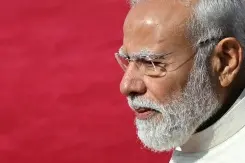
Indian Prime Minister Narendra Modi travels to the United Arab Emirates on Friday before continuing to five European countries, as New Delhi confronts the economic fallout from the ongoing conflict in the Middle East. The six-day diplomatic mission underscores India's urgent need to diversify its energy imports and solidify strategic alliances amid global uncertainty.
The blockade of the Strait of Hormuz has sent global gas and fuel prices soaring, squeezing economies heavily reliant on Gulf energy, including India. Modi last week urged citizens to curb gold purchases and fuel consumption to conserve foreign exchange, as the rupee hit record lows against the dollar. The Indian central bank has intervened to stabilise the currency, but the pressure remains intense.
Energy security at the forefront
India, the world's third-largest oil importer, sources about half of its crude through the Strait of Hormuz, which has been largely blocked since US-Israeli strikes against Iran began on 28 February. The disruption has forced India to tap strategic petroleum reserves and seek alternative suppliers. During the UAE leg, Modi is expected to discuss long-term liquefied natural gas supply contracts and joint investment in India's strategic oil storage facilities.
"The priority for India should be to move from a traditional buyer-seller energy relationship to a broader strategic energy security partnership," said K.C. Singh, a former Indian ambassador to Iran and the UAE. He noted that divisions within the Gulf Cooperation Council and open confrontation between Iran and the Emirates have reshaped regional geopolitics. The UAE has drawn closer to the United States and Israel, while Saudi Arabia has turned toward Pakistan, Egypt, and Turkey.
Diversifying economic and strategic partners
The tour reflects India's ambition to position itself as a major industrial and technological hub while reducing dependence on any single region. Modi will visit the Netherlands, Sweden, Norway, and Italy, building on the landmark India-EU free trade agreement signed in January, which the Indian foreign ministry described as "the mother of all deals."
In the Netherlands, Modi will hold talks on boosting bilateral trade, currently valued at €23.7 billion, and on collaboration in defence, semiconductors, water management, agriculture, and health. This will be his second visit to the country since 2017.
Sweden will host Modi on Sunday, where he will address a forum of European business leaders alongside European Commission President Ursula von der Leyen. The forum will focus on investment opportunities in clean energy, digital infrastructure, and manufacturing. The following day, he travels to Norway for the India-Nordic summit, aiming to deepen ties with Denmark, Finland, Iceland, Norway, and Sweden.
Arctic ambitions and climate considerations
India maintains a research base on the Norwegian island of Svalbard and closely monitors the opening of Arctic sea routes due to climate change. Melting ice affects monsoon patterns and food security in India. "India's interest in the Arctic is not merely academic; the melting ice has direct consequences for the monsoon and our food security," noted Indian MP Shashi Tharoor in the Indian Express.
During the Nordic summit, Modi is expected to propose joint research on polar science, sustainable shipping, and renewable energy. The Nordic countries are leaders in green technology, and India hopes to attract investment in solar, wind, and hydrogen projects.
Strengthening ties with Italy and the Gulf
The final stop on 19 May will be Italy, where Modi will meet Prime Minister Giorgia Meloni. The two leaders have developed a close working relationship, and discussions are likely to cover defence cooperation, trade, and migration. Italy is an important gateway for Indian companies entering European markets.
In the UAE, Modi will address the large Indian diaspora of 4.5 million people and seek to reinforce the strategic partnership. The Gulf region remains India's primary source of oil and natural gas, and the talks will focus on ensuring stable energy supplies despite regional tensions.
The Indian foreign ministry stated that the visit will "deepen India's partnership with Europe, particularly trade and investment links in light of the recent free trade agreement." The deal, signed in January, is expected to eliminate tariffs on 90% of goods and boost bilateral trade by billions of dollars over the next decade.
Analysts say Modi's trip is a calculated move to secure India's energy future and reduce vulnerability to external shocks. The simultaneous engagement with both Gulf monarchies and European democracies reflects a pragmatic foreign policy that prioritises economic resilience and strategic autonomy.
New Delhi has also been strengthening its military and diplomatic ties with countries like France and Australia, but this European tour signals a renewed focus on the continent as a partner in technology, clean energy, and geopolitical stability.
As the world watches the unfolding crisis in the Middle East, India's proactive diplomacy aims to shield its economy from further disruption while carving out a more prominent role on the global stage.
Source: Bourse News