

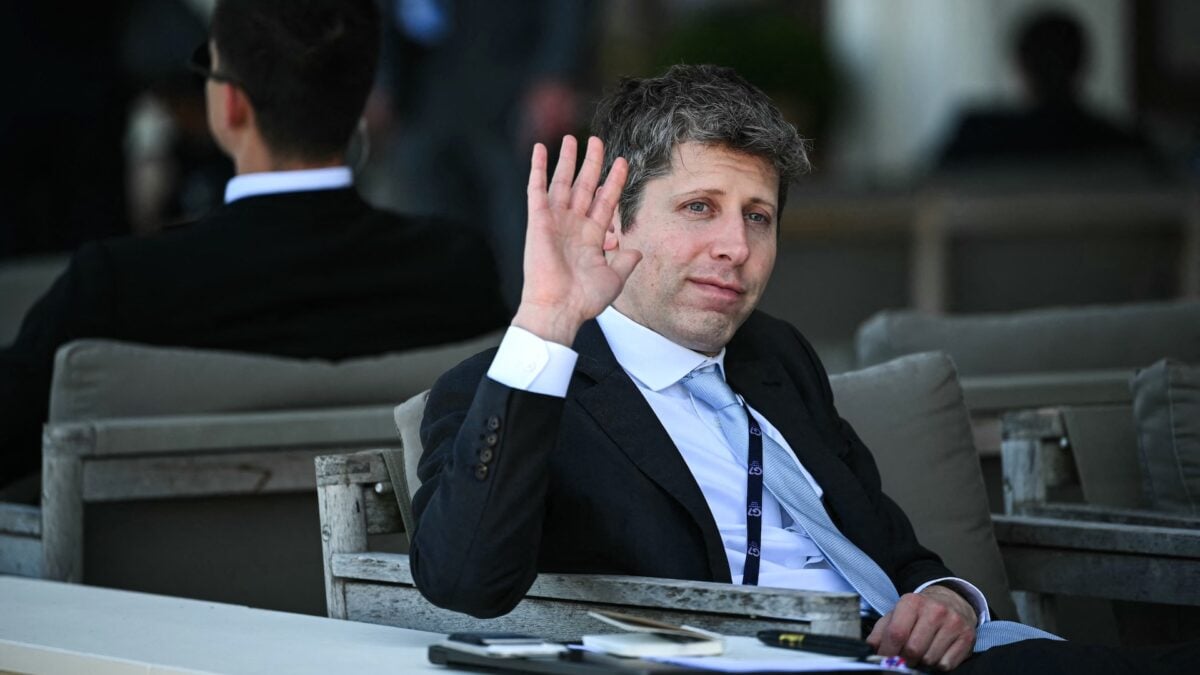
OpenAI CEO Sam Altman tried to speak with California Gov. Gavin Newsom last week in an effort to influence the outcome of legislation that would set new safety standards for how AI chatbots interact with children, according to a new report. The bill passed the California Legislature on Monday, but it is not law yet. Newsom must decide whether to sign or veto it.
SB 1119, introduced by state Sen. Steve Padilla and Assemblymembers Buffy Wicks and Rebecca Bauer-Kahan, is one of the most direct responses to recent concerns about AI’s effect on young people. Its supporters frame it as a children’s safety measure rather than a broad AI regulatory package. The legislation would require companies that offer chatbots to determine a user’s age, provide parents with tools to limit how much time their children spend on AI chat products, and subject those companies to independent audits. It also includes privacy and advertising protections. Companies could not serve children ads that rely on personal information obtained from their chatbot conversations. Companies could not sell data collected from children’s chats. Companies could still serve age-appropriate contextual advertising, but ads would have to be labeled.
A late change to the bill
The bill was amended Friday in ways that narrow the situations in which families can sue AI companies. Lawmakers did not release many details about what led to the amendment, but the change is likely to make the bill more acceptable to the technology industry. It is unclear what role Altman may have played in getting those changes into the final version. The report said it could not determine whether his outreach made a difference.
OpenAI, the developer of ChatGPT, has publicly supported the bill. Asked for comment after the bill passed, an OpenAI spokesperson directed attention to a statement that was published shortly before the vote. In it, the company said SB 1119 builds on youth safety measures it has backed through its products, global policy principles, advocacy in California and its work on a separate national proposal called the Parents & Kids Safe AI Act. The company encouraged Newsom to sign the bill.
The statement did not address Altman’s reported last-week contact with the governor’s office. A person familiar with the matter denied that Altman and Newsom spoke directly. Whether Altman spoke with aides or sent a message is not clear. OpenAI did not comment on the record about the outreach.
California’s shift on AI regulation
The bill adds to a growing list of California efforts to regulate AI. Newsom has historically resisted putting strict limits on emerging technology, vetoing a high-profile 2024 bill that would have required large AI developers to conduct safety tests and add emergency kill switches. He argued at the time that such requirements were too broad and could slow innovation. That veto made California the center of a national debate about whether the state should lead the U.S. in AI regulation.
This new chatbot bill may be harder to veto because of the political climate around kids and AI. Over the past year, advocates have pointed to reports of teenagers harmed by AI companions. In 2026, the bill’s supporters say, there have been cases of children who died by suicide after conversations with chatbots encouraged self-harm. Those stories changed the conversation: lawmakers who generally avoid tech regulation have shown appetite for protecting minors. The issue is no longer about banning AI but about placing guardrails on commercial products aimed at vulnerable users.
Newsom has long had close ties to the technology industry. He has accepted donations from tech executives and often framed California’s future as dependent on keeping startups in the state. But the public mood has shifted. Data center expansion has drawn local protests over electricity and water use, and more voters are telling pollsters they are worried about AI’s harms. That has put pressure on Democrats who once avoided criticizing tech power.
The timing is notable for the governor. Newsom is term-limited and will leave office on Jan. 7, 2027. He is widely expected to run for president in 2028, likely as a Democrat, though he has spent recent years courting figures on the right. He has hosted podcast conversations with right-wing influencers such as Charlie Kirk and Steve Bannon, and critics say he often appeared more eager to find common ground than to challenge false claims. Some Democrats worry that he is positioning himself as a centrist or independent in ways that could hurt him in a primary. Others believe he wants to show that California can govern AI without being anti-innovation.
What happens next
The governor’s decision on SB 1119 will also matter for the state’s next leader. Former U.S. Health and Human Services Secretary Xavier Becerra, the Democratic nominee for governor, and Republican tech entrepreneur Steve Hilton are competing in the November election. Both have generally friendly relationships with Big Tech. Hilton has called for less regulation across the board and is married to Rachel Whetstone, a longtime tech executive who has worked for companies like Uber, Netflix, Facebook and Google. Becerra has proposed modest AI guardrails and has received significant Silicon Valley donations. Neither wants to be seen as hostile to the industry.
Becerra leads Hilton in virtually every public poll. The most recent survey from UC Berkeley’s Institute of Governmental Studies put Becerra at 55 percent and Hilton at 37 percent. If Becerra wins, he will likely be asked soon after the election whether he would have signed SB 1119. Newsom will have several weeks to make his decision, giving him time to hear from lobbyists, child safety groups and AI companies.
Supporters also argue that SB 1119 could become a de facto national standard. Because many AI services operate nationwide and cannot easily comply with differing state laws, a California requirement is likely to shape the product choices made by companies for users everywhere. But all of it depends on Newsom’s signature.
OpenAI, for its part, says it has already moved in the direction the bill requires. The company launched ChatGPT for Teens on Aug. 18. Under that system, people under 18 or users whose stated age is between 13 and 17 are automatically placed into a version of ChatGPT with built-in safeguards and parental controls. The controls are not optional settings, according to the company. OpenAI’s statement portrayed SB 1119 as consistent with its own approach.
Still, the bill’s requirements go beyond what OpenAI has voluntarily introduced. All companies offering chatbots to young users, not just OpenAI, would need to comply. Independent audits would be public or available to policymakers. And the restriction on using chat data for behavioral advertising would apply across the industry. That is why Altman’s reported attempt to soften the bill was seen by some advocates as a sign that even the leading AI company regards the measure as significant.
The politics of children’s online safety are complex. Tech companies, including OpenAI, often say they support child safety in principle but worry that specific mandates will burden small developers or force them to collect too much personal data, including data meant to verify a child’s age. Civil libertarians sometimes caution that age verification can violate privacy or lead to government-backed identification systems. The bill’s writers tried to avoid that problem by requiring companies to determine age rather than requiring a specific identity document. That language gives the tech industry room to use age-estimation techniques instead of collecting IDs.
The coming weeks will reveal whether Newsom agrees with that approach. If he signs, California will become the first state to pass a comprehensive chatbot-specific children’s safety law. If he vetoes, lobbyists from both sides will shift their focus to the next governor and to Washington, where federal children’s online safety legislation has repeatedly stalled.
In the meantime, the state legislature’s action has already changed the national conversation. Parents, school boards and child psychologists have begun asking what AI products should do when a child makes a distressed statement. Many of those questions now have an answer in the text of SB 1119. The only remaining question is whether it will become law. Newsom has not said publicly how he will act, and the people around Altman will not say what they heard from Sacramento. For now, the bill is awaiting the governor’s signature, with a visible web of influence already surrounding it. The latest poll shows who is likely to greet the next stage of this debate after Newsom leaves office: Becerra leads the governor’s race by 18 points, with 55 percent support to Hilton’s 37 percent.
Source: Gizmodo News