

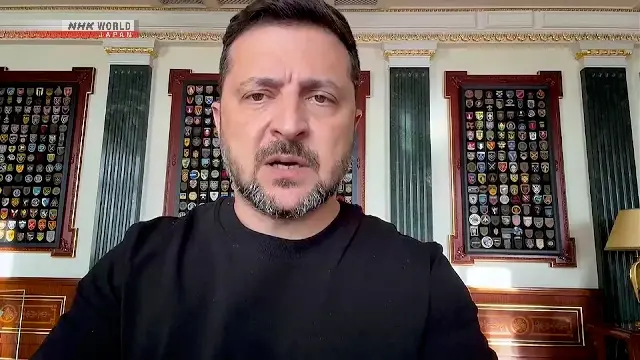
Ukrainian President Volodymyr Zelenskyy has expressed cautious optimism that the United States will soon provide a favorable response to Ukraine's request for a license to produce PAC-3 interceptor missiles domestically. In an exclusive interview with the Financial Times published on Monday, Zelenskyy conceded that Ukraine's air defense capabilities have deteriorated markedly in recent months, leaving the nation increasingly vulnerable to Russian ballistic missile attacks. He underscored that the ability to manufacture advanced interceptors on Ukrainian soil would be a game-changer in the ongoing war, potentially reducing dependence on foreign deliveries and accelerating defensive deployments.
The Air Defense Crisis
Ukraine's air defense network has been under immense strain since Russia escalated its missile campaign in the spring of 2024. The Armed Forces of Ukraine reported that over the past week, Russian forces launched a relentless barrage of ballistic missiles and UAVs, particularly aimed at Kyiv and other key infrastructure hubs. According to the Ukrainian Air Force, not a single one of the 29 ballistic missiles fired by Russian troops on Monday was intercepted—a stark indicator of the gaps in the current shield. Zelenskyy described the anti-ballistic defense sector as "the main weak point" of Ukraine's military posture, noting that while manned aircraft and anti-cruise missile systems remain effective, the country lacks sufficient capability to defeat high-speed ballistic threats.
The Patriot air defense system, supplied by the United States and Germany, has been the backbone of Ukraine's high-end protection. However, the system relies on a steady supply of PAC-3 missiles—the most modern variant of the Patriot family, designed specifically to engage ballistic missiles. Ukraine has received several Patriot batteries, but operational tempo and repeated Russian saturation attacks have consumed a significant portion of the available interceptors. Zelenskyy revealed that deliveries of PAC-3 missiles from existing Western stockpiles are frequently delayed, leaving Ukrainian crews to ration their ammunition. This scarcity has forced commanders to prioritize defense of major cities and critical infrastructure, leaving other regions exposed.
The PAC-3 Production Proposal
To break the cycle of dependency, Kyiv has formally requested a production license from Washington that would allow Ukrainian industry to manufacture PAC-3 interceptors locally. The proposal envisions a phased technology transfer, beginning with assembly of imported components and eventually progressing to full domestic production. Ukraine already possesses a robust defense industrial base, including facilities capable of missile final assembly and testing—a legacy of the Soviet-era missile programs that produced the S-300 and Buk systems. Zelenskyy argued that with American technical assistance and licensing, Ukraine could quickly scale up output to meet both immediate wartime needs and long-term stockpile replenishment.
"We are not asking for a gift; we are asking for the ability to defend ourselves with our own hands," Zelenskyy told the Financial Times. He stressed that the license would not only bolster Ukrainian security but also strengthen NATO's eastern flank by creating a decentralized production hub for advanced interceptors. The president expressed confidence that the Biden administration would send a "positive signal" during the upcoming NATO summit in Turkey, where defense cooperation and regional security are high on the agenda. However, he acknowledged that the decision is complex, involving export control regulations, intellectual property concerns, and broader geopolitical calculations.
Russian Escalation Ahead of the Summit
The timing of Zelenskyy's interview and the renewed Russian offensive are closely linked. Military analysts note that Moscow has historically increased pressure before major international meetings, seeking to demonstrate that Western support cannot shield Ukraine from punishment. The strikes on Kyiv, which killed 19 civilians, represent the deadliest single attack on the capital in weeks. The Ukrainian Air Force confirmed that the barrage included Iskander-M and Kh-47M2 Kinzhal missiles, both of which are extremely difficult to intercept without sufficient PAC-3 coverage. In previous instances, Patriot batteries achieved impressive kill rates against hypersonic Kinzhals, but only when they had enough missiles on hand. The current ammunition shortage has forced commanders to conserve interceptors, leading to the recent failures.
Background of the Patriot System in Ukraine
The first Patriot system arrived in Ukraine in April 2023, following intensive diplomatic efforts. It immediately proved its value by shooting down Russian Kh-47M2 Kinzhal missiles—advertised by Moscow as unstoppable. That success reshaped the air war, forcing Russian pilots to launch from longer ranges and reducing the effectiveness of ballistic strikes. However, the high cost and complexity of the system meant that only a limited number of batteries could be deployed. Each Patriot battery requires around 90 personnel to operate, along with sophisticated radar and support vehicles. The United States and its allies have provided training, but maintaining a constant supply of PAC-3 interceptors remains the primary constraint.
The PAC-3 (MIM-104F) is the most advanced Patriot variant, employing hit-to-kill technology rather than a traditional fragmentation warhead. It destroys incoming missiles by direct collision, making it highly effective against maneuvering ballistic targets. Each PAC-3 missile costs approximately $4 million, and Ukraine has consumed hundreds since the system became operational. Without a reliable pipeline, Ukrainian commanders face the impossible trade-off between protecting cities and preserving missiles for future threats. A domestic production license could circumvent these delays, as Ukrainian factories—like the state-owned Ukroboronprom or private enterprises—could operate at a pace limited only by raw materials and skilled labor.
Geopolitical Implications
The proposed license touches on sensitive issues in US-Ukraine relations. Some American policymakers worry that transferring missile production technology could violate non-proliferation commitments or allow Ukraine to become a future exporter. Others argue that arming Ukraine to defend itself is a sound investment compared to the costs of a prolonged war. A production deal would also send a powerful message to Russia: that the West is willing to treat Ukraine as a long-term partner rather than a temporary proxy. The NATO summit in Turkey, scheduled for early July, provides a platform for such announcements. Turkish President Recep Tayyip Erdogan, who has maintained working relations with both Russia and Ukraine, is expected to encourage practical solutions that strengthen Ukraine's defensive self-sufficiency.
In parallel, Ukraine is also pursuing alternative options. The country has integrated Soviet-era S-300s with modern Western radars and is developing its own interceptor designs through the R-360 Neptune program—the same missile used to sink the Russian cruiser Moskva. However, land-based ballistic missile defense is a far more demanding challenge, and Western interceptors remain essential. Zelenskyy made clear that without a positive US decision, Ukraine will continue to struggle against the kind of mass missile attacks that Russia seems prepared to sustain for months.
Military and Industrial Readiness
Ukraine's defense industry has already demonstrated remarkable adaptability. Domestic factories have produced millions of rounds of ammunition, thousands of drones, and reverse-engineered versions of Russian weapons. The country has also entered joint ventures with Western firms to repair and maintain armored vehicles. Adding production of PAC-3 missiles would represent a significant upgrade, requiring sterile manufacturing facilities, precise electronic assembly, and rigorous quality control. Ukrainian engineers have experience with solid-fuel rocket motors and seeker heads from the Soviet-era V-880 and V-601 air defense missiles, which are conceptually similar to the PAC-3. With American oversight, the transition could be achieved within 12 to 18 months.
Zelenskyy also mentioned that even a license to produce components—like guidance systems or rocket motors—would alleviate pressure on the supply chain. "We don't need everything at once," he said. "Start with the most critical parts, and we will build the rest." This pragmatic approach may appeal to US officials wary of a full technology transfer. The Ukrainian proposal specifically requests a "manufacturing license agreement" similar to those previously granted to allied nations such as Japan, South Korea, and Germany for Patriot-related systems. Those precedents demonstrate that the United States can safeguard its intellectual property while empowering trusted partners.
The Human Cost
The debate over missile production might seem technical, but its implications are brutally direct. Monday's missile strike on Kyiv hit a residential building in the Shevchenkivskyi district, killing entire families and trapping dozens under rubble. Emergency workers pulled survivors from the debris throughout the night. Victims included children, hospital patients, and elderly residents. The Ukrainian Air Force acknowledged that it lacked the interceptors to engage the incoming threats—a failure that intensifies public pressure on the government to secure more effective defenses. In a statement, the General Staff said: "Every patriot missile we cannot fire is a civilian life we cannot save."
Looking Ahead
As the NATO summit approaches, all eyes are on Washington's response. US National Security Adviser Jake Sullivan recently hinted that the administration is "considering options to deepen Ukraine's self-defense capacity," though he provided no specifics. A production license decision would likely require inter-agency coordination with the Departments of State, Defense, and Commerce, as well as consultations with Congress. Ukrainian officials hope for a memorandum of understanding during the summit, followed by detailed negotiations over the summer. In the meantime, the Pentagon is expediting shipments of additional PAC-3 missiles from its own reserves, but those are finite.
Zelenskyy concluded his interview with a note of resolve: "We know we can defend ourselves if have the tools. The world has provided many tools, but the most precious ones remain scarce. Our people are ready to build those tools here, now. We just need the green light." Whether that green light arrives in Turkey or later remains uncertain, but the war's trajectory may hinge on the answer.
Source: NHK WORLD News