

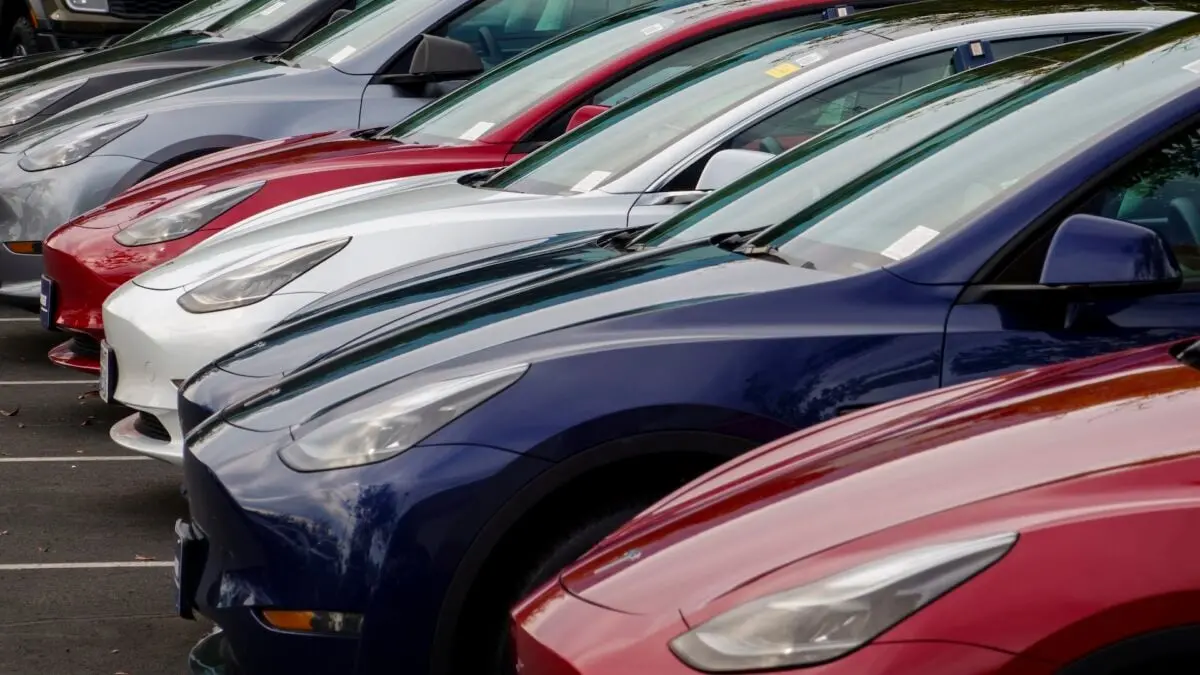
Tesla is staging a remarkable comeback in Europe, with sales rebounding sharply after a turbulent 2025 that saw the electric vehicle maker lose ground amid political backlash against CEO Elon Musk. The company announced plans to hire 1,000 new workers at its Gigafactory near Berlin, aiming to increase production to 7,500 vehicles per week by October, according to a report from Electrek. This follows a previous hiring round of 1,000 jobs earlier this year, when Tesla targeted weekly output of 6,000 vehicles by the end of June.
The production boost would bring the German plant's annual capacity to approximately 390,000 EVs, still below the 500,000 target set when the facility opened in 2022. Tesla did not immediately respond to a request for comment.
The turnaround is striking given that Tesla's European registrations had plummeted last year, largely attributed to Musk's hardcore conservative politics, his direct involvement with DOGE (the Department of Government Efficiency), and his personal ties to President Donald Trump. At the time, Trump threatened to take over Greenland and imposed tariffs on the continent, while Musk promoted far-right and anti-immigrant movements, including Germany's Alternative for Germany (AfD) party. More recently, Musk faced accusations of inciting violence after posts linked to anti-immigrant demonstrations in Belfast.
Yet, according to the European Automobile Manufacturers' Association, Tesla registrations in Europe rose 57 percent to more than 118,000 vehicles from January through May 2026, compared with the same period in 2025. The rebound is driven by rising fuel costs and new government incentives for zero-emission vehicles in Germany.
German Incentives and Fuel Costs Fuel Tesla's Revival
Germany, Europe's largest auto market, introduced revised purchase subsidies for EVs in early 2026, targeting buyers of fully electric vehicles under a certain price threshold. These incentives, combined with persistently high fuel prices—partly due to global oil market volatility and geopolitical tensions—have made Tesla's Model Y and Model 3 more attractive to cost-conscious consumers. The German government's push to meet ambitious climate targets has also accelerated the transition to electric mobility, benefiting established players like Tesla, which has a robust charging network across the continent.
The Berlin Gigafactory, which produces the Model Y, has ramped up efficiency and addressed earlier production bottlenecks. Tesla's ability to produce vehicles locally avoids import tariffs and reduces delivery times, giving it a competitive edge over Chinese rivals like BYD, which face higher entry barriers despite technological advances in driving range and charging speed.
EU's Tech Sovereignty Push Collides with Consumer Reality
The resurgence of Tesla in Europe comes at a time when European leaders have spent much of 2026 talking about reducing dependence on U.S. technology companies. French President Emmanuel Macron, speaking at the Munich Security Conference in February, declared: "In this new geopolitical environment, Europe has to become a geopolitical power. It's ongoing, but we have to accelerate and clearly deliver all the components of a geopolitical power, in defence, in technology, and in the derisking vis-à-vis all the big powers in order to be much more independent."
Earlier this year, the French government announced it would stop using American video conferencing platforms like Microsoft Teams and Zoom, switching to the French platform Visio. France also signed a deal for its armed forces to use Mistral's AI models and software. In June, the European Commission unveiled a "tech sovereignty package" aimed at strengthening the bloc's digital autonomy, focusing on semiconductors, AI, cloud computing, and open-source software. The Commission also reached a preliminary determination that Amazon Web Services and Microsoft Azure should be regulated as "gatekeepers" under the Digital Markets Act, the EU's sweeping antitrust law.
Yet, electric vehicles represent one of the easiest sectors for Europe to assert independence. Unlike cloud computing or social media, Europe boasts several homegrown automakers—Volkswagen, BMW, and Stellantis—that are investing heavily in EV production. European consumers also have increasing access to Chinese options like BYD, whose latest models boast breakthroughs in driving range and charging speed. Despite this, Tesla continues to dominate market share. The question is why.
Why European Consumers Are Choosing Tesla Over Local Brands
Market analysis suggests that Tesla's brand recognition, advanced software integration, and supercharger network remain key differentiators. While Volkswagen's ID series and BMW's i models have improved, they still lag in over-the-air updates and autonomous driving features. Stellantis, which includes Peugeot, Fiat, and Opel, has struggled to scale its EV production profitably. Additionally, Tesla's direct-to-consumer sales model offers a seamless buying experience compared to traditional dealership networks, which can be slow and bureaucratic.
Chinese automakers like BYD have made inroads but face tariff barriers and consumer skepticism about long-term reliability and resale value. The EU's anti-subsidy investigation into Chinese EVs, launched in 2024, has led to provisional tariffs that made some Chinese models less price-competitive. This has inadvertently benefited Tesla, which manufactures within the EU.
However, the broader geopolitical narrative complicates matters. Musk's political alignment with Trump and his provocative social media presence have alienated some European buyers, but the data suggests that economic factors outweigh political sentiment. The 57% sales surge indicates that many Europeans are willing to overlook Musk's politics for a compelling product at the right price. This mirrors a trend seen in the U.S., where Tesla sales fell during Musk's controversial interventions but have since recovered.
The War on American Big Tech: A Battlefield of Contradictions
The irony is not lost on observers. While European leaders talk tough about digital sovereignty, their own citizens are voting with their wallets in favor of American technology. Tesla's resurgence underscores the difficulty of breaking free from U.S. dominance in key industries. In cloud computing, European alternatives like OVHcloud and Ionos remain niche players. In AI, Mistral and DeepL have gained traction but still trail OpenAI and Google. Social media remains dominated by Meta, X (formerly Twitter), and TikTok (owned by China).
The automotive sector should be different, as Europe has deep manufacturing expertise and a strong supply chain. Yet, Tesla's factory in Germany is now a symbol of American industrial encroachment. The company employs thousands of workers, sources parts locally, and pays taxes in Germany—but decisions are made in Texas. The EU has few tools to counter this short of imposing tariffs on Tesla imports from China or the U.S., but that would hurt consumers and disrupt supply chains.
Moreover, the EU's own climate goals require a rapid electrification of transport, and Tesla is helping meet those targets. Banning or discouraging Tesla would be counterproductive. Thus, the war on American Big Tech appears selective: it targets software and services but spares hardware and manufacturing, where Europe competes directly.
Future Prospects and the Road Ahead
Tesla's plans to ramp up production at the Berlin Gigafactory suggest confidence that the rebound is sustainable. The company continues to innovate, with the Cybertruck and Semi Truck gradually entering international markets. However, analysts caution that the European EV market remains highly competitive, with legacy automakers accelerating their electric lineups. Volkswagen plans to launch a sub-$25,000 electric model by 2027, and BMW is expanding its i-series with solid-state battery technology expected by 2028.
Meanwhile, the geopolitical landscape remains volatile. Musk's involvement in DOGE and his ties to Trump could still trigger further backlash if new controversies emerge. European regulators are also scrutinizing Tesla's Autopilot and Full Self-Driving features for safety compliance. Any major recalls or bans could damage the brand's reputation.
For now, Tesla seems confident that European customers will keep making their way back to its showrooms. The company's ability to adapt to local incentives, optimize production, and leverage its brand power has proven resilient. Whether this signals a permanent shift or a temporary truce in the tech war remains to be seen. What is clear is that the easiest front in the war on American Big Tech—electric vehicles—has fallen, at least for now.
Source: Gizmodo News