

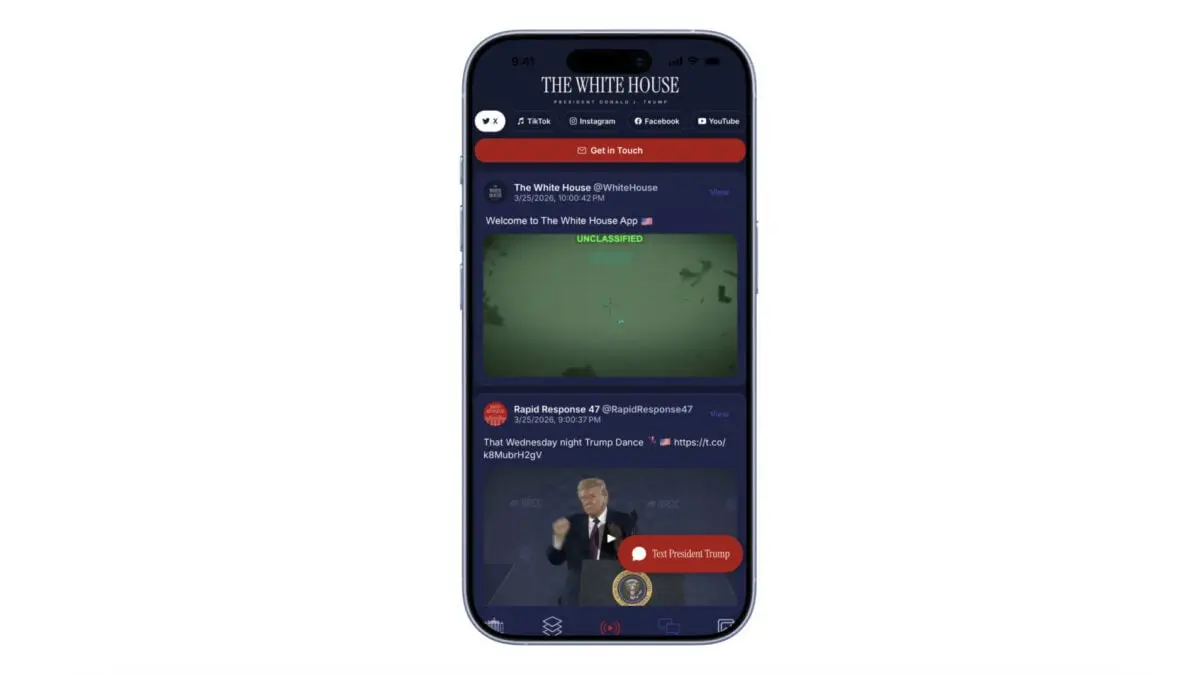
If you work for the Department of Homeland Security (DHS), your work phone may soon have a new addition — and you didn't ask for it. The White House app, originally launched in March 2026 on both the App Store and Google Play, is now slated to be automatically loaded onto all DHS mobile devices. An internal email seen by Politico and reported on Tuesday told DHS employees that the app provides 'a convenient way to access official White House communications, including announcements, executive actions, speeches, livestreams, videos and other updates.' The email did not mention the option to opt out, leading to concerns among government IT experts and privacy advocates.
The app, branded as a source of 'unfiltered, real-time updates straight from the source' — the source being President Donald Trump — aims to keep federal employees instantly informed. Its features include breaking news alerts on major announcements and executive actions, video streaming capabilities, a library of archived Trump sound bites, and an option to send feedback, including by voice. But these seemingly benign functions come with a darker underbelly. According to Notus.org, the app shares user data — such as time zone, IP address, and more — with third parties. What's worse, the app does not disclose its data-sharing practices the way most other applications do, raising red flags under federal privacy guidelines.
Security Implications and Expert Warnings
Auto-installing any application on government-issued devices is a sensitive matter. Sonny Hashmi, a former IT executive at the General Services Administration (GSA), told Government Executive that such an auto-install is 'cause for alarm.' He warned, 'Any app that is installed on government issued devices can potentially create backdoor access to government networks behind the firewall.' This sentiment is echoed by cybersecurity researchers who point out that even well-intentioned apps can introduce vulnerabilities if not thoroughly vetted. The Trump administration's decision to mandate the app on DHS devices follows an earlier directive last month that told federal agencies to begin installing it. The Federal Aviation Administration (FAA) was named as an agency already slated to receive the app as an auto-download, a move that some experts call rushed and insufficiently transparent.
The potential for a backdoor is not merely theoretical. In 2014, when Apple automatically downloaded a U2 album onto hundreds of millions of iPhones, it was a marketing gimmick that annoyed users but posed no security threat. Here, however, the stakes are far higher. Government networks house sensitive data, and any unauthorized access could lead to espionage or data breaches. The White House has not publicly commented on the security measures embedded in the app, but its privacy policy — or lack thereof — has already drawn scrutiny. Notus.org noted that the app's data sharing is not clearly disclosed, meaning users may not realize that their location and usage patterns are being harvested.
Historical Precedent and Broader Implications
This is not the first time the White House has released a mobile app. In 2010, during the Obama administration, an earlier version was launched. That app was also met with mixed reviews, but it was not force-installed on government devices. The Obama-era app provided similar features — news updates, videos, and event information — but without the controversy surrounding third-party data sharing or mandatory deployment. The current mandate reflects a more aggressive approach to controlling the message inside the federal workforce, one that some critics argue blurs the line between official communication and political propaganda.
Beyond DHS, the ripple effects of this policy could be far-reaching. Other agencies may soon face similar requirements, setting a precedent that could be exploited by future administrations of either party. The concept of 'government-sponsored app stores' or mandatory software on official devices has been debated for years. In 2023, a Government Accountability Office report recommended stricter guidelines for app preloading on federal devices, but those guidelines are not legally binding. The Trump administration's move appears to circumvent the spirit of those recommendations by presenting the app as a routine update tool rather than a potentially risky code injection.
Data Privacy in the Spotlight
The data-sharing practices of the White House app are particularly troubling. The app requests permissions typical for many news apps — access to device location, IP address, and time zone — but the extent to which it shares that information with third parties is unclear. Under the Privacy Act of 1974, federal agencies must limit collection of personally identifiable information to what is necessary for official functions. Yet the app's feedback feature, which allows voice submissions, could capture far more than intended. Privacy advocates argue that voice recordings alone could reveal sensitive information about a user's environment, conversations, and even emotional state. Without a clear data retention policy, the potential for misuse increases exponentially.
Moreover, the app's vague privacy disclosures have prompted comparisons to commercial apps that have faced fines for deceptive practices. The Federal Trade Commission has taken action against companies that fail to adequately disclose data sharing, but government-developed apps are not always subject to the same enforcement. This regulatory gap may leave DHS employees — who are already subject to rigorous background checks and security protocols — exposed to risks that their private-sector counterparts would not tolerate.
The Road Ahead: Compliance and Resistance
It remains unclear whether DHS employees can refuse to use the app or uninstall it from their devices. The email seen by Politico did not mention enforcement mechanisms, but given the nature of government IT management, supervisors could mandate its use. Some employees may turn to workarounds, such as using personal devices for work communications, but that comes with its own set of security and policy violations. The American Federation of Government Employees, which represents many DHS workers, has not yet issued a statement, but union leaders are likely to raise concerns over privacy and due process.
Meanwhile, the White House continues to promote the app as a tool for transparency. A press release on the White House website touts the app's ability to keep Americans informed, but it does not address the auto-installation program for federal employees. The photo included in the press release — showing a phone with a post reading 'That Wednesday night Trump dance 🕺🇺🇸' — has been criticized as frivolous and out of touch with the seriousness of the issue. Yet the app's underlying purpose is clear: to ensure that every DHS employee receives real-time, unmediated messages from the president, whether they want them or not.
As the debate continues, one thing is certain: the line between official government communications and the personal agenda of the administration in power is becoming increasingly blurred. For DHS employees, their next workday might begin with a notification from the White House app — and that notification may well be the least of their concerns.
Source: Gizmodo News