

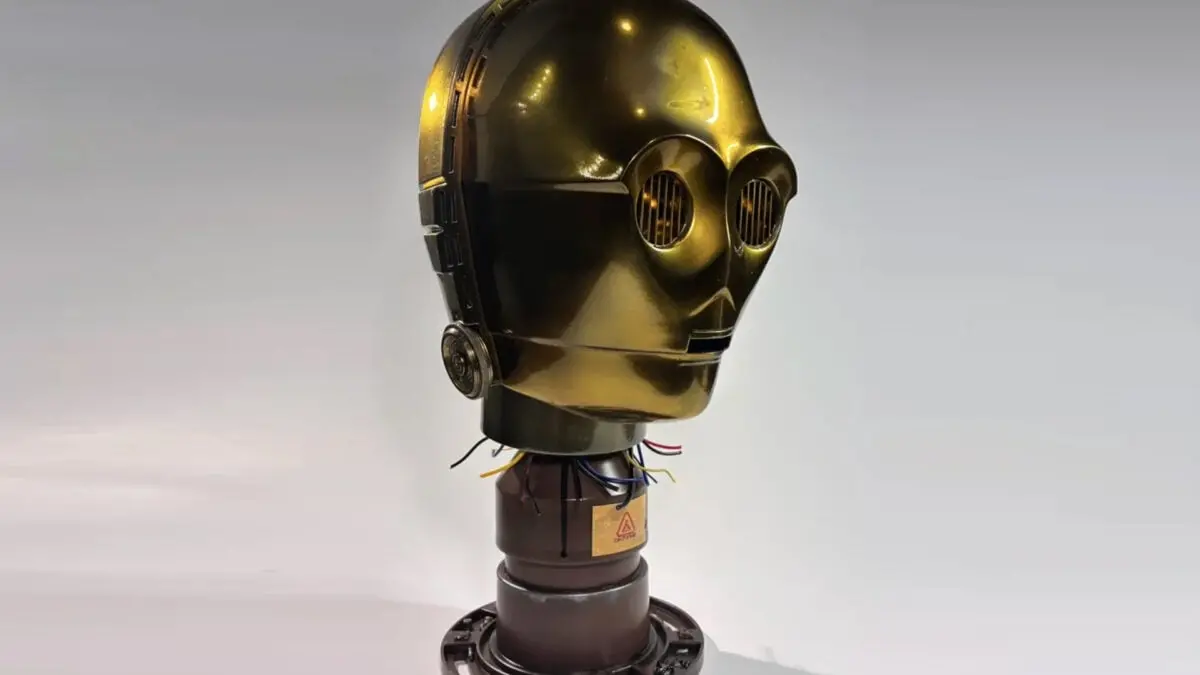
May the fourth be with you, and all that. For Star Wars Day, we're turning our attention to one of the saga's most memorable droids: C-3PO, the shiny golden protocol droid whose personality is equal parts fussy and endearing. Threepio is often overshadowed by his more famous counterpart R2-D2, but a new DIY project is giving him his moment in the sun — or rather, in the glow of a workbench lamp.
Samuel Potozkin, a student at Chapman University in Orange County, California, recently shared a video documenting how he built a fully functional C-3PO head that can hold a real conversation. The head is powered by artificial intelligence and runs on a Raspberry Pi 5. When you speak into a microphone, the system converts your speech to text, sends it to a custom language model trained to emulate C-3PO's famously prissy and proper demeanor, and then generates a spoken response in a voice that could fool even the most devoted Star Wars fan.
The project comes at a time when Star Wars memorabilia is hotter than ever. Just last month, the original C-3PO head prop from The Empire Strikes Back sold at auction for over $1 million — one of the highest prices ever paid for a piece of Star Wars history. In that film, Threepio's head is separated from his body after he wanders through the wrong door in Cloud City, leading to one of the franchise's most iconic scenes. While most fans can't afford a million-dollar prop, Potozkin's project proves that with some technical know-how and a little creativity, you can build your own version right at home.
The technical pipeline is elegant in its simplicity. A microphone picks up the user's speech and sends it to the Raspberry Pi 5, which runs a real-time speech-to-text converter. Once the text is generated, it's fed as a prompt to a large language model (LLM) that has been fine-tuned to mimic C-3PO's distinctive manner of speaking. The LLM's response is then processed through a text-to-speech engine that adds the metallic, slightly reedy quality that defines Threepio's vocal delivery. Potozkin notes in his detailed paper on GitHub that achieving the right sound required some audio post-processing tricks. Initial tests produced a voice that was too natural and lacked the metallic resonance of the droid. To fix this, he applied a short delay line to create tightly spaced temporal reflections, then added a chorus effect by slightly modulating the time and pitch of duplicated signal paths. The result is a voice that sounds uncannily like the real C-3PO — recognizable even without the visual cue of the golden head.
Potozkin's work is part of a broader trend of DIY robotics and AI projects that blend pop culture with hands-on engineering. In recent years, hobbyists have built everything from voice-activated BB-8 replicas to R2-D2 units that can navigate rooms. What sets this project apart is the integration of conversational AI. Unlike simple voice response systems, the custom LLM allows Threepio to engage in actual dialogue, answering questions, making comments, and even expressing his characteristic exasperation. The GitHub repository includes the full code, wiring diagrams, and a bill of materials, making it accessible to anyone with basic electronics skills and an interest in AI.
For Star Wars fans, the appeal is obvious. Owning a C-3PO head that can talk is like having a piece of the galaxy far, far away in your living room. It's also a fantastic conversation starter — imagine hosting a viewing party where your very own Threepio can chime in with commentary during the films. The head's design is based on the classic Empire Strikes Back appearance, with the characteristic gold plating and glowing eyes. Potozkin 3D-printed the shell and finished it with metallic paint to achieve a look that's both accurate and affordable.
The project also raises interesting questions about the future of AI-powered companions. As language models become more sophisticated, we may see a new generation of interactive collectibles that blur the line between toy and personal assistant. Companies like Disney have already experimented with animatronic characters that use AI to respond to visitors, but Potozkin's open-source approach democratizes the technology. Anyone with a Raspberry Pi and a 3D printer can now build their own talking droid head.
There are practical considerations, of course. The system requires a stable internet connection to access the cloud-based LLM, and the audio processing adds a slight delay to responses. But for a project of this nature, the trade-off is acceptable. Potozkin's video shows the head in action, responding to questions about Star Wars trivia and offering dry observations about the user's life. It's both charming and slightly eerie — exactly what you'd expect from a disembodied droid head.
For those who want to take the project further, Potozkin has left plenty of room for customization. The LLM can be retrained with different personalities, allowing builders to create their own unique droid characters. The same pipeline could be adapted for other Star Wars droids, or even for characters from other franchises. The only limit is your imagination — and your willingness to spend a weekend with a soldering iron.
As Star Wars Day rolls around, Potozkin's creation serves as a reminder that the Force isn't just for Jedi. It's also for makers, tinkerers, and anyone who ever wanted to have a conversation with a golden droid. Next May the 4th, you could make your own talking C-3PO head the centerpiece of your viewing party. Just don't ask him to take a seat at the fancy restaurant — he's absolutely not admitting you under any circumstances.
Source: Gizmodo News