

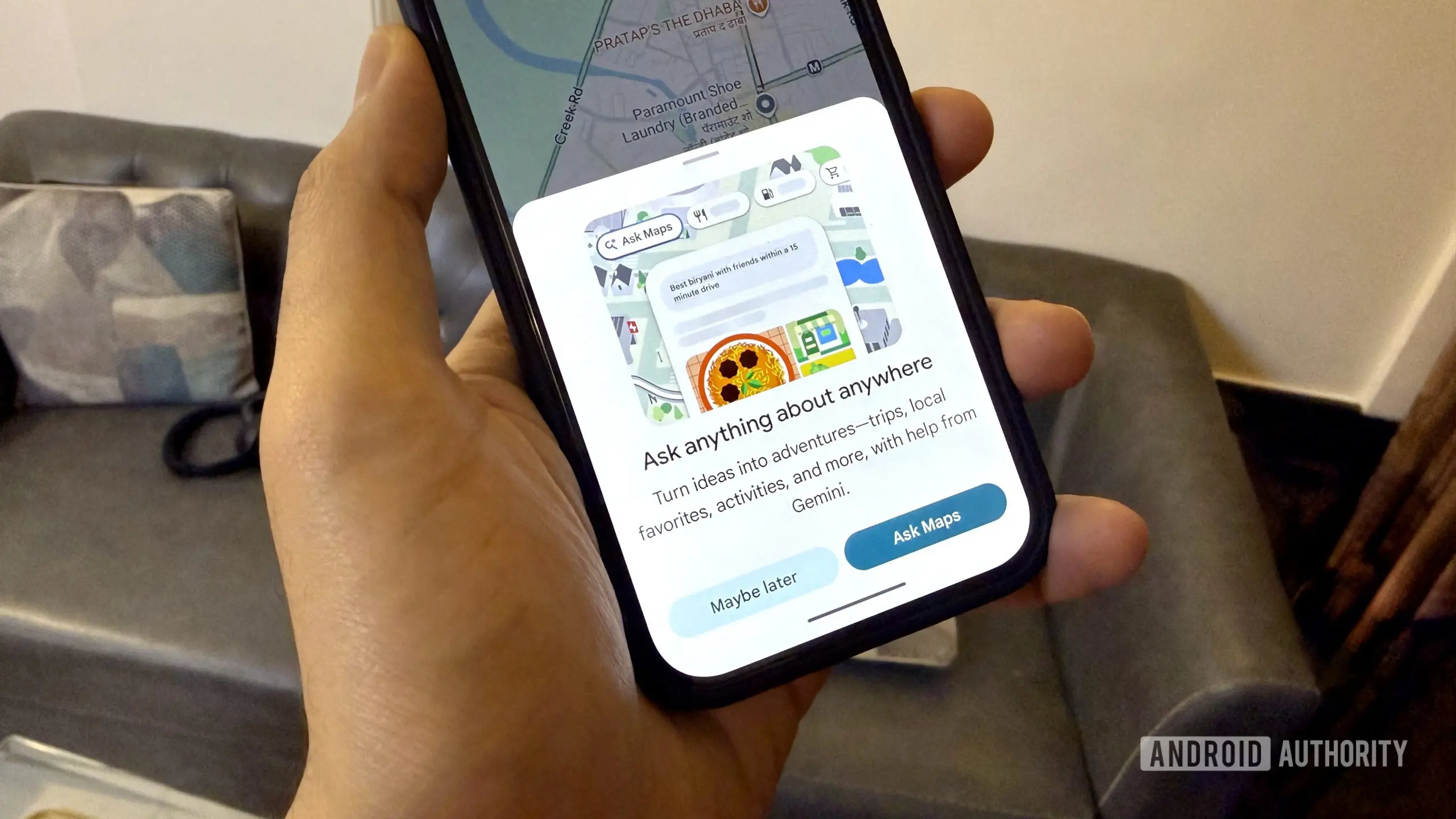
Google Maps, the ubiquitous navigation and discovery app, appears to be taking a significant step toward becoming a direct ordering platform. Evidence from the latest Android version suggests that the Ask Maps feature, which already leverages Gemini AI for restaurant recommendations, will soon be able to place food orders on your behalf—even while you are driving to pick them up.
In version 26.27.00.941319029 of Google Maps for Android, code analysts discovered a series of new text strings that explicitly outline a promotional flow for food ordering. The strings include phrases like “Ask Maps to order food,” “Say what you're craving, discover local favorites, and Maps will order for you—even while you're on the go,” and “Order food.” These indicate that Google is preparing to announce and enable the feature, likely through a prompt that users can accept or dismiss.
Background: Ask Maps and Gemini Integration
Introduced earlier this year, Ask Maps marks Google’s attempt to bring conversational AI to its mapping service. By tapping into the Gemini large language model, users can ask natural-language questions such as “Find a cozy Italian restaurant near me” or “What are the best brunch spots in this area?” The system then returns personalized recommendations based on reviews, ratings, and user history. The proposed ordering feature extends this capability from passive suggestion to active transaction.
Google has been steadily integrating Gemini across its ecosystem, from the Pixel smartphone lineup to Google Workspace. Maps, however, represents one of its most practical applications due to the high frequency of location-based queries. If food ordering is successfully implemented, it could bridge the gap between discovering a place and actually using its services without leaving the app.
APK Teardown: What the Strings Reveal
The uncovered strings are part of an internal promotional campaign that would appear when the feature becomes available. They read:
- “Ask Maps to order food” (promo title)
- “Say what you're craving, discover local favorites, and Maps will order for you—even while you're on the go.” (body text)
- “Order food” (query suggestion)
- “Try it out” (call-to-action button)
- “Maybe later” (dismiss option)
The phrase “on the go” is particularly telling. It implies that the ordering process can be initiated and completed without the user manually typing in or tapping through menus. Instead, Gemini would handle the entire workflow: receiving the voice or text request, identifying a suitable restaurant, navigating the menu, placing the order, and confirming payment—all while the user is driving or multitasking.
This aligns with the broader trend of agentic AI, where models are given limited autonomy to perform tasks on behalf of the user. However, the strings do not specify how the actual payment will be processed. It is possible that Google Pay credentials already stored on the device will be used, or that the user will be prompted to authorize a transaction before it is finalized.
Technical Questions and Potential Restrictions
One key uncertainty is whether this ordering capability will rely on cloud-based Gemini processing or require on-device agentic features similar to those anticipated for the Pixel 10 series. Recent reports have indicated that Pixel 10 might introduce a specialized “Agent” mode that allows Gemini to execute tasks such as booking reservations or ordering food by interacting with third-party apps and websites. If Maps orders are processed entirely in the cloud, they would work across a wide range of Android devices. If they depend on Pixel-specific hardware, the rollout would be more limited.
Historically, Google has avoided locking Maps features to its Pixel line. Maps is a core service intended for all Android users, and placing restrictions on fundamental functions like ordering would alienate a large user base. However, Google has occasionally experimented with exclusive features for its own devices, such as certain Gemini shortcuts on the Pixel 8 and 9 series.
Another technical aspect concerns the integration with third-party restaurant ordering systems. Currently, Maps already provides links to partners like Uber Eats, DoorDash, and restaurant websites for takeout or delivery. The new feature would likely go a step further by allowing Gemini to interact directly with those services’ APIs or through a unified ordering interface. Code strings do not reveal which partners are involved, but Google has been deepening its ties with food delivery platforms in recent years.
Industry Context: The Rise of AI-Powered Ordering
The move toward automated food ordering fits a broader industry trend. Voice assistants like Amazon Alexa and Apple Siri have offered basic ordering capabilities for years, but they have struggled with complex commands or inconsistent integration across providers. Gemini’s advanced natural language understanding could overcome these hurdles by interpreting nuanced requests such as “Order a large pepperoni pizza from the place I liked last week, and have it ready for pickup in 20 minutes.”
Restaurants themselves are increasingly investing in their own digital ordering channels. A 2024 study by the National Restaurant Association found that 68% of quick-service restaurants now accept orders via voice or text. By embedding ordering directly into Maps, Google is positioning itself as a central hub for local commerce, potentially diverting traffic from dedicated food delivery apps.
Privacy and Security Considerations
Allowing a virtual assistant to place orders introduces new privacy and security implications. Users will need to trust that Gemini will not accidentally order expensive items or share payment details with unintended services. Google’s existing privacy policies for Gemini state that conversations are logged and may be reviewed for training purposes, but specific transactional data may be handled separately. The strings do not mention any opt-in for financial permissions, so it’s likely that the user will be asked to authorize the first order and possibly set a spending limit.
Additionally, the feature will probably require location sharing to determine the user’s current restaurant or pickup point. Given that Maps already has access to real-time location, this is less of a new concern. However, the combination of location and transaction data could be seen as more intrusive by privacy-conscious users.
Timeline and Availability
Since the promotional strings are present in the current build but not yet active, the feature may be in late-stage testing. Google often rolls out such capabilities first to a small percentage of users via server-side flags, then expands based on feedback. A public launch could occur within the next few months, possibly alongside a larger Google Maps update or a Pixel event.
It remains to be seen whether the feature will debut globally or be limited to English-speaking markets initially. Given that Ask Maps itself is only available in select regions, food ordering will likely follow a similar geographical rollout.
The addition of food ordering is a natural evolution for Google Maps, which has gradually transformed from a simple navigation tool into a comprehensive local discovery and commerce platform. By enabling Gemini to act as an agent that not only recommends but also executes transactions, Google is blurring the line between search and action. For users, this means one less step between craving and consummation—potentially a very convenient one, as long as the technology performs reliably.
Source: Android Authority News